Crude oil prices declined last week due to oversupply fears, as Libya negotiated gradually normalizing its disrupted output and Saudi Arabia threatened to restore production lost due to unfavourable market conditions. As members of the Organization of the Petroleum Exporting Countries (OPEC) and its allies (OPEC+), both countries play pivotal roles in balancing the global crude oil markets based on the supply and demand of energy products. Slowing economic growth in China has lowered crude oil demand forecasts in the world’s second-biggest economy.
Data compiled by Polymerupdate Research showed that the benchmark Brent crude futures for near-month delivery on the InterContinental Exchange (ICE) declined by 3.25 percent, or US$ 2.51 a barrel, last week, reflecting weak global demand sentiment, led by China. Brent futures started the week at US$ 74.49 a barrel at the close of previous Friday and declined to US$ 73.90 a barrel on Monday.
Apart from Tuesday, when the contract price increased slightly to close at US$ 75.17, the energy contract remained sluggish, with profit-taking from day traders. Notably, Brent crude futures have declined by 21 percent over the past one year, closing at US$ 71.98 a barrel on Friday, down from US$ 90.71 a barrel registered on October 2, 2023.
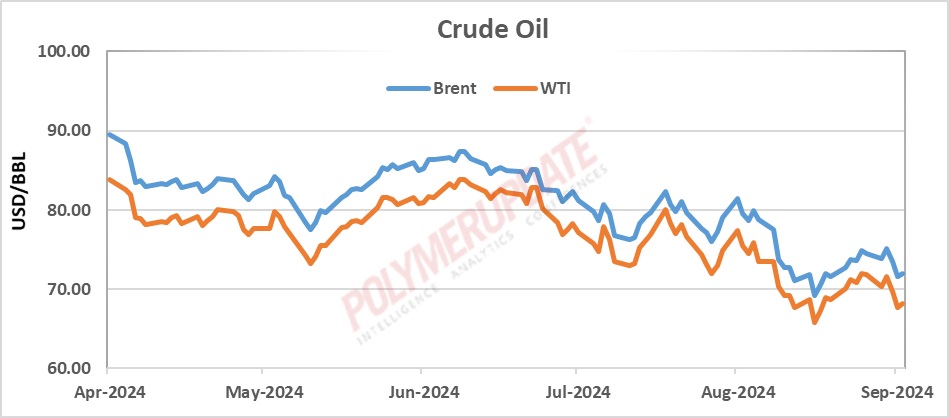
The fall in the Western Texas Intermediate (WTI) futures was more pronounced as economists urged the United States Federal Reserves (US Fed) to focus on economic growth, given that the country’s retail inflation is under control. The US-centric WTI futures for near-month delivery slumped by 5.20 percent, or US$ 3.74 a barrel, last week.
The energy contract started last week at US$ 71.92 a barrel and closed at US$ 68.18 a barrel on Friday. However, extreme volatility was observed throughout the week due to reports of Russia’s intensified offensive on Ukrainian energy facilities and Kyiv’s counterattacks on Moscow. Overall, the WTI futures for near-month delivery have posted a 23 percent decline over the past year, closing at US$ 68.18 a barrel, down from US$ 88.82 a barrel on October 2, 2023.
Restoring supply from LibyaAnalysts forecast that the United Nations-brokered negotiations between Libya’s rival governments made a substantial headway last week, reportedly agreeing on the procedures of Central Bank staffing and decision-making, seeking to defuse the ongoing oil blockade. Before the 14-month rift between the existing government and rival group started, Libya’s crude oil output was estimated at 1.5 million barrels per day (bpd). However, the energy production in the country was disrupted due to rival group’s continuous attacks on energy production facilities.
Now, both groups have signalled to bridge the differences and come to the negotiation table for the betterment of the country’s economy, which eventually is expected to normalise crude oil production. Reports said that Libya factions have signalled an agreement on the process of appointing central bank governor, an initial step to resolve the dispute over control of the central bank and oil revenue that has slashed Libya’s oil output and exports. The pending resolution to Libya’s central bank crisis would restore significant oil supply.
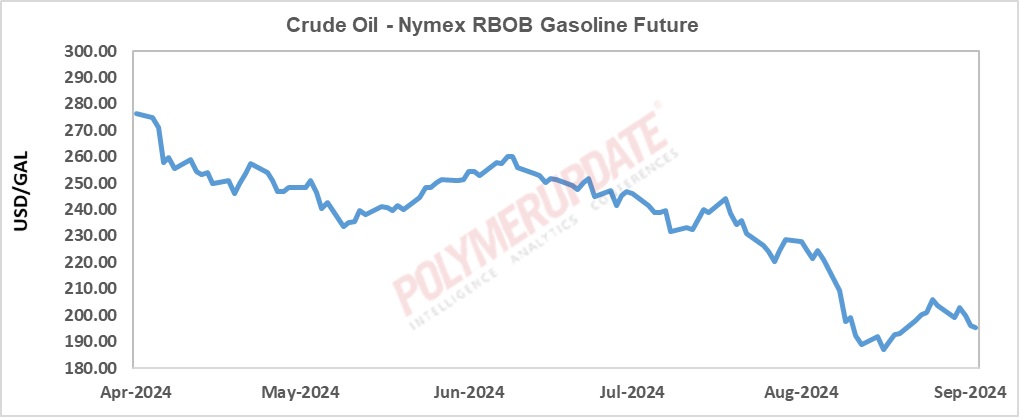 Hurricane threatens US supply
At least half a dozen cities in the United States are suffering because of the occurrence of the devastating hurricane Helene with approximately 2 million citizens rendered homeless and suffered with power supply disruptions. Deaths have been reported in Florida, Georgia, North Carolina, South Carolina, Tennessee, and Virginia. Hundreds of people have been reported missing in these cities due to the hurricane.
Hurricane Helene roared ashore in Florida’s Big Bend region late Thursday and was termed as a Category 4 hurricane with 140 mph (225 kph) winds. Later, Helene quickly moved through Georgia, then soaked the Carolinas and Tennessee with torrential rains that flooded creeks and rivers and strained dams. Hundreds of water rescues were put into service, including in rural Unicoi County in East Tennessee, where dozens of patients and staff were plucked by helicopter from a hospital rooftop Friday. The storm unleashed the worst flooding in a century in North Carolina.
Services around these cities were severely disrupted with officials warning that rebuilding from the widespread loss of homes and property would be lengthy and difficult. The storm upended life throughout the Southeast. The storm caused energy supply and production coming to a grinding halt. Simultaneously, crude oil demand in these cities also affected badly. Gradually, the hurricane threatened the US Gulf Coast and has changed course towards Florida and away from oil and gas-producing areas near Texas, Louisiana, and Mississippi.
Demand worries continue in ChinaBoth Brent crude and WTI Cushing posted losses for three consecutive months as the U.S. and Chinese demand concerns outweigh recent disruptions in Libyan oil supply amid a dispute between government factions there and the tensions in the key Middle East producing region related to the Israel-Gaza conflict. Oil exports from Libya were temporarily suspended. By contrast, the Arabian Gulf Oil Company has resumed output at up to 120,000 bpd to meet domestic needs, after the standoff between the factions shut most of the country’s oilfields.
Meanwhile, pessimism about Chinese demand growth re-surfaced after an official survey showed manufacturing activity in the world’s second biggest economy sinking to a six-month low in August, and this trend is expected to continue in September. Factory gate prices tumbled in China and owners struggled for orders, although another survey tracking export-oriented companies showed signs of a tentative recovery in August. China’s central bank recently cut its key interest rate by 50 basis points (bps) and announced a large stimulus package to boost the economy.
Deceleration in world demandInternational Energy Agency in its July 2024 Oil Market Report forecasts world oil demand continues to decelerate, with 2Q24 growth easing to 710,000 bpd year-on-year – the slowest quarterly increase since the October-December 2022 quarter. Chinese consumption contracted, as the country's post-pandemic rebound has run its course. Global gains are forecast to average just below 1 million bpd in 2024 and 2025, as subpar economic growth, greater efficiencies and vehicle electrification act as headwinds.
Also, global crude oil supply rose by 150,000 bpd to 102.9 million bpd in June as field maintenance eased and biofuels rose, offsetting a significant drop in Saudi flows. Solid monthly gains pushed April-June 2024 quarter output 910,000 bpd higher q-o-q. Growth of 770,000 bpd is seen for July-September 2024 with non-OPEC+ providing 600,000 bpd of the gains. Annual increases of 770,000 bpd are forecast in 2024 with gains of 1.8 million bpd next year.
OutlookSaudi Arabia, a large producer accounting for around 10 percent in global supply, has indicated to restore its market share by increasing output. The country lost its substantial market share due to its participation in the OPEC+ over 5 million barrels output cut. Also, China's ongoing economic challenges continue to weigh on crude demand, though temporary price spikes may occur this week as geopolitical tensions re-escalated while a low-pressure system is once again forming in the Western Caribbean with a 30 percent chance of development in the near future. OPEC's ministerial meeting will provide market direction, but rising non-OPEC supplies and Chinese demand concerns may cap upside.
DILIP KUMAR JHA
Editor
dilip.jha@polymerupdate.com