Click the icon to add a specified price to your Dashboard list. This makes it easy to keep track on the prices that matter most to you.

Indian polyvinyl chloride (PVC) manufacturers have challenged the Gujarat High Court (HC) order allowing the segregation of special-grade plastic raw material from anti-dumping duty (ADD) levies, sources close to the development said. The segregation is expected to benefit Epigral Ltd (formerly Meghmani Finechem Ltd), the sole producer of special-grade PVC in India.
Confirming the development, sources said, “We have learned that Indian primary producers of PVC have challenged the Gujarat HC order permitting the separation of special-grade plastic raw material, which is exclusively produced by Epigral Ltd in India. The case is scheduled for a hearing on May 9, just four days ahead of the internal deadline for Final Findings set by the Directorate General of Foreign Trade (DGTR), i.e., May 13, irrespective of the Supreme Court’s decision.”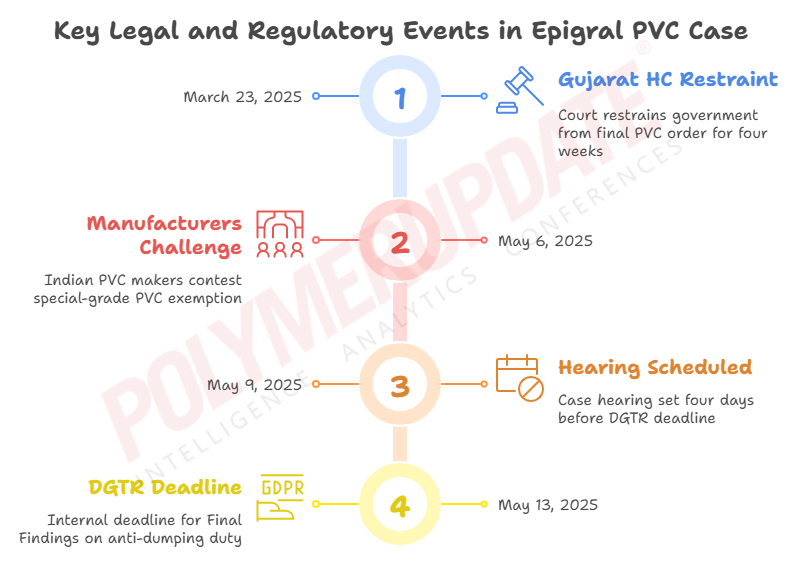 Gujarat HC order
The two-judge bench, headed by Hon. Justice Bhargav D. Daria and Hon. Justice D. N. Ray, ordered on May 25, “The Specialty Grade Special PVC (SPVC) resins imported by the petitioners for the manufacture of Chlorinated PVC (CPVC), to be used for the production of safe and non-hazardous CPVC pipes and fittings for potable water supply, are to be excluded from the ‘product under consideration’ (PUC). This exclusion is for the purpose of the investigation initiated by the Designated Authority, in the absence of any classificatory investigation carried out while determining the PUC. This is due to a clear procedural lapse on the part of the Designated Authority, as per the Manual of Operating Practices for Trade Remedy Investigations, in arriving at such preliminary findings.”
The order further stated, “The respondent Designated Authority is therefore directed to exclude specialty grade SPVC resins imported by the petitioners for the manufacturing of CPVC from the scope of the PUC investigation, as such specialty grade SPVC resins are neither produced by the domestic industry nor are they technically or commercially substitutable and interchangeable with the grades commercially produced by the domestic industry. In view of this, the disposal of this petition would not survive and shall accordingly be disposed of by a separate order.”
Representations
Learned advocate Ankit Shah, appearing for the respondents, i.e., the government, prayed for a stay on the operation and implementation of the order pronounced today. However, considering that the respondent Designated Authority is to pronounce the final assessment order and has not extended the timeline, as recorded by the court in its order dated March 25, 2025, the request for a stay on the operation and implementation of this judgment was refused.
The petitioner, i.e., Epigral Ltd, was represented by learned advocates Mihir Joshi and Dhaval Shah. Additional Solicitor General N. Venkatraman, along with advocate Ankit Shah, appeared for the government and the designated authorities. Learned senior advocate Kamal Trivedi, accompanied by advocate Rajesh Sharma, Ms. Gargi Vyas, Vinay Bairagra, and Utshav Shukla, represented other respondents. Another set of respondents was represented by advocate Balbir Singh, alongside advocates Gargi Vyas, Pragyan Pradip Sharma, and Rajesh Sharma.
The company
Epigral Ltd is engaged in the manufacture of CPVC, which, according to the petitioners, is a critical material used in producing pipes and fittings, particularly for the safe and non-hazardous conduction of potable water. The petitioners argued that CPVC production requires specialized grades of PVC Suspension Resins, which are imported from countries such as China PR, Indonesia, Japan, Korea PR, Taiwan, Thailand, and the USA. The grade of PVC is determined by its polymerization ability, measured by its 'K' value. Petitioner No. 1 specifically imports PVC Suspension Resins with 'K' values of 57 and 65, which are specialized grades essential for manufacturing CPVC pipes and fittings for potable water supply.
Epigral Ltd commissioned its CPVC resin plant in Dahej, Gujarat, in June 2022, with a production capacity of 30,000 tonnes per annum (TPA), which was subsequently increased by an additional 45,000 TPA in April 2024. This expansion has made the company the largest producer of CPVC at a single location globally. According to the petitioners, the CPVC market in India reached over 225,000 TPA in FY 2023-2024 and is expected to grow at a compound annual growth rate (CAGR) of more than 10 percent over the next decade, while the current CPVC resin capacity stands at 97,000 TPA.
The petitioners further stated that Indian manufacturers were initially heavily reliant on CPVC resin imports. However, with the commencement of domestic production by Petitioner No. 1, India’s dependence on CPVC resin imports has decreased by 40 percent. The company is also planning to double its manufacturing capacity from 75,000 TPA to 150,000 TPA.
The Designated Authority initiated an investigation under the Anti-Dumping Rules to determine the existence, degree, and effect of the alleged dumping of the product under consideration originating from or exported by the subject countries. The investigation aims to recommend the appropriate anti-dumping duty necessary to address the alleged injury caused to the domestic industry.
The previous order
On March 23, the Gujarat High Court restrained the Indian government from passing any final order (i.e., levying any anti-dumping duty or ADD) on Polyvinyl Chloride (PVC) Resin used for Chlorinated PVC (CPVC) manufacturing for four weeks, due to the pendency of the case. The next hearing is scheduled for April 30, 2025.
The same bench observed, “It appears from the record that the respondent, i.e., the Central Government, has not implemented the provisional order passed by the Adjudicating Authority in view of the pendency of this petition. Additionally, the Central Government has not exercised its discretion in extending the period. We are, therefore, left with no option but to restrain the respondents from passing the final order on the subject matter for four weeks from today.”
The court noted that the concerned party is facing prejudice, while the respondent authority has failed to exercise its discretion to extend the period of one year by six months, despite having the power to do so. Furthermore, the court opined that if the respondent authorities were to issue a final order, the entire petition would become infructuous, as the hearing of the petition was already concluded on March 13, 2025.
DILIP KUMAR JHA
Editor
dilip.jha@polymerupdate.com