Click the icon to add a specified price to your Dashboard list. This makes it easy to keep track on the prices that matter most to you.

Indian manufacturers of polyethylene terephthalate (PET) resin have approached the Directorate General of Trade Remedies (DGTR), urging swift action against Chinese exporters accused of dumping this plastic raw material at low prices to Indian downstream users. Specifically targeting Wankai New Materials Co. Ltd., these domestic producers have requested the trade regulator to impose higher anti-dumping duties (ADD) or restrict imports, either from this single Chinese manufacturer or any other source of Wankai PET resin.
In a formal submission to the DGTR, under the Union Ministry of Commerce and Industry, a delegation of primary Indian PET manufacturers alleged that Wankai New Materials Co. Ltd. has been engaging in unfair trade practices for an extended period. “The Chinese company supplies PET resin at prices nearly equivalent to the cost of raw materials, creating immense pressure on Indian producers. Many domestic manufacturers have been forced to reduce their production capacity to minimal levels, operating merely for survival. We have urged the regulator to take stringent action against Wankai New Materials Co. Ltd. to safeguard the interests of domestic producers,” stated a delegation member who requested anonymity.
An industry executive highlighted that increasing imports from Wankai New Materials Co. Ltd. have been causing significant harm to domestic PET resin manufacturers. “The landed cost of Wankai’s PET resin is almost identical to the cost of its raw materials, making it impossible for local producers to compete. Immediate action is necessary to curb the influx of Wankai materials into India; otherwise, several domestic producers may be forced to shut down their operations,” the delegation member added.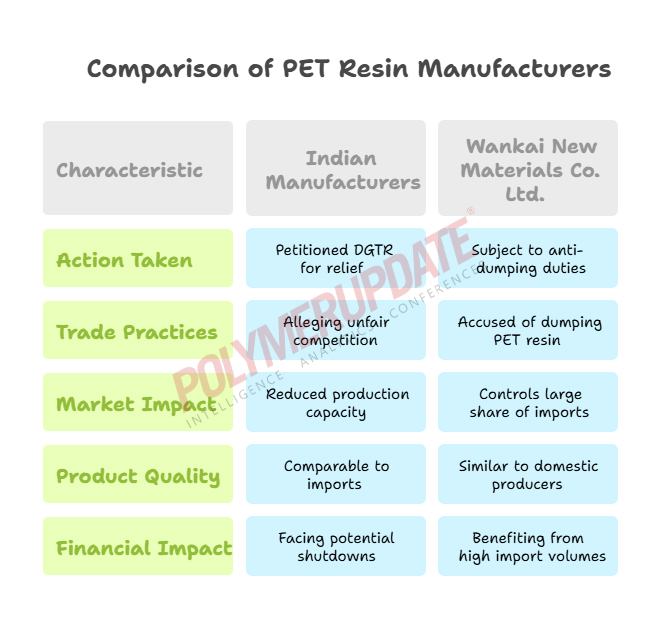 Wankai under surveillance
Notably, Wankai New Materials Co. Ltd. has been under surveillance for several years. The company reportedly controls approximately 90 percent of India's total PET resin imports. The quality of Wankai’s material is nearly identical to that of domestic producers, making it easy for downstream users to replace domestic material with imports. Attempts to contact Wankai for comments were unsuccessful. PET resin, a widely used thermoplastic polymer, is primarily utilized in the textile industry.
Wankai New Materials Co. Ltd. was previously found in violation of dumping guidelines during an investigation in 2021. Following the inquiry, the DGTR imposed an anti-dumping duty (ADD) of US$ 15.54 a tonne on imports of PET resin from Wankai for five years. This was subsequently increased to US$ 40.41 a tonne in 2024. In addition to Wankai, ADD was imposed on Jiangsu Xingye Plastic Co. Ltd., Jiangyin Chengold Packaging Materials Co. Ltd./China Prosperity (Jiangyin) Petrochemical Co. Ltd., Jiangyin Xingyu New Material Co. Ltd./Jiangsu Sanfame, and other Chinese companies, with duties reaching up to US$ 200.66 a tonne. These ADD measures, effective from March 27, 2021, are set to expire on March 27, 2026, unless extended or renewed.
An earlier investigation by the Indian government revealed that several Chinese companies, including Wankai, were dumping PET resin into the Indian market at prices below prevailing domestic rates. These imports were found to have caused severe injury to Indian producers and were therefore subject to regulatory action. The matter pertains to PET resin with an intrinsic viscosity of 0.72 decilitres per gram or higher (bottle-grade PET resin, excluding recycled PET resin), originating in or exported from China to India.
Revised notification
“The designated Indian authority, in its final findings, has concluded that the imposition of an anti-dumping duty is necessary to offset the injury caused to the domestic industry by the dumped imports of the subject goods from the subject country. Accordingly, it has recommended the imposition of a definitive anti-dumping duty on imports of the subject goods originating in or exported from the subject country and imported into India,” the earlier notification stated.
Therefore, the Central Government, after considering the aforesaid final findings of the designated authority, hereby imposes an anti-dumping duty on PET resins at a rate equivalent to the injury margin. The anti-dumping duty imposed under this notification shall be effective for a period of five years (unless revoked, superseded, or amended earlier) from the date of publication of this notification in the Official Gazette, i.e., March 2021, and shall be payable in Indian currency.
Case history
The case dates back to March 2021, when the DGTR imposed anti-dumping duties (ADD) on Chinese producers and suppliers of PET resin with an intrinsic viscosity of 0.72 decilitres per gram or higher, originating in or exported directly from China. IVL Dhunseri Petrochem Industries Pvt. Ltd. and Reliance Industries Ltd. (RIL) subsequently filed an application with the Designated Authority, alleging non-absorption of the ADD imposed on imports of PET resin originating in or exported from China and produced by Wankai New Materials Co., Ltd. or Zhejiang Wankai New Materials Co., Ltd.
Indian companies alleged that PET resin with an intrinsic viscosity of 0.72 decilitres per gram or higher is subject to anti-dumping duties, as it is being imported into India at prices or under conditions that constitute an absorption of the existing ADD. These companies urged the Designated Authority to recommend modifications to the applicable ADD to ensure a level playing field for domestic producers. Indian players provided sufficient evidence to satisfy the Designated Authority in support of their claims.
Market fundamentals
India's PET resin market was valued at 1.23 million tonnes in 2024 and is projected to reach 1.74 million tonnes by 2030, growing at a compounded annual growth rate (CAGR) of 6.2 percent. PET, a thermoplastic polymer resin belonging to the polyester family, has become the preferred choice in the packaging sector due to its exceptional rigidity, eco-friendly attributes, and recyclability. India imports a substantial volume of PET resin from various countries of which China contributes the highest.
The demand for PET in food and beverage packaging has risen significantly, particularly after the Covid-19 pandemic, which originated in Wuhan, China, and gradually spread worldwide in 2020. This surge in demand can be attributed to increased awareness of hygiene, leading to higher consumption of disposable and packaged items to minimize infection risks.
Additionally, in India’s rapidly expanding pharmaceutical sector, PET bottles have gained preference over aluminium and glass packaging due to their superior quality standards and enhanced safety features. This trend is expected to further drive the demand for PET in the foreseeable future.
DILIP KUMAR JHA
Editor
dilip.jha@polymerupdate.com