Click the icon to add a specified price to your Dashboard list. This makes it easy to keep track on the prices that matter most to you.

Manufacturers of polyvinyl chloride (PVC) pipes and fittings in the organised sector are expected to generate 10–11 percent revenue growth in the financial year 2025–26, driven by robust demand from end-user segments and a more stable price environment, according to a study released by leading rating agency Crisil. This growth marks a recovery from the flattish revenue performance recorded in the previous year.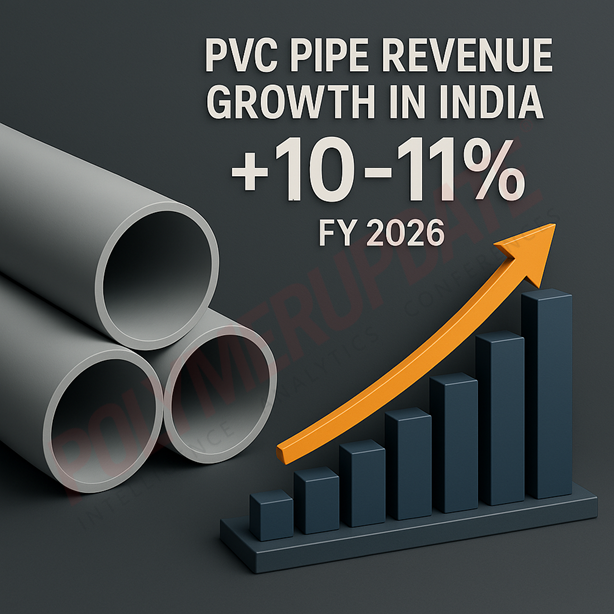 The improvement is expected to reduce high-cost inventory levels as dealers begin restocking, and partly offset the 130 basis points (1.3 percent) decline in operating margins seen last fiscal. Improved profitability and easing inventory pressures will also reduce working capital requirements and provide room for capacity expansion without straining balance sheets.
“Our analysis of 16 PVC pipe manufacturers, with cumulative revenues of around Rs 30,000 crore — accounting for about two-thirds of the organised segment’s revenues last fiscal — supports this outlook. Typically, manufacturers sell to dealers, who in turn supply end-user industries such as irrigation, water supply, sanitation and plumbing, urban infrastructure, and real estate, catering to both greenfield and replacement demand,” the study noted.
Robust demand
Demand for PVC resin has grown at a healthy compound annual growth rate (CAGR) of 6.2 percent during FY 2020–2025, reaching 4.7 million metric tonnes (MMT) in FY 2024–25, reflecting approximately 11 percent year-on-year (YoY) growth. This surge was driven by strong demand from end-user sectors, supported by favourable government initiatives and the steady development of infrastructure projects. Looking ahead, this growth momentum is expected to continue, with PVC demand projected to rise at around 8 percent annually, reaching 5.5 MMT by FY 2026–27.
Demand from irrigation and water supply projects — which contribute nearly three-fourths of the sector’s revenue — is expected to remain strong, given the government’s sustained push in these areas. Replacement and new demand from the real estate sector will also contribute, although at a more moderate pace compared to the past few fiscals, as the number of new project launches is likely to decline.
Himank Sharma, Director at Crisil Ratings, stated: “Demand for PVC pipes and fittings has remained robust in recent times, driven by government schemes such as the Jal Jeevan Mission and the Pradhan Mantri Awas Yojana, which focus on water supply, sanitation, and housing. What has changed is that the government has more than doubled the budgetary allocation for these schemes this fiscal, year-on-year, which could significantly boost the requirement for PVC pipes and fittings.”
Falling import dependence
While demand is expected to remain favourable, prices have been volatile, influenced by global trends in PVC resin — a key raw material. India currently imports nearly 55–60 percent of its PVC resin requirements due to strong demand and limited domestic capacity. However, the country’s reliance on imported PVC resin is projected to decline to less than 30 percent of total demand by the financial year 2026–27.
India’s PVC import dependence is estimated at 1.41 million tonnes, or approximately 26 percent of the anticipated total demand of 5.496 million metric tonnes (MMT) in FY 2026–27. Domestic production is expected to meet the remaining 74 percent, reaching a record 4.086 million tonnes. In light of robust and sustained demand over recent years, the top five industry players are setting up large-scale manufacturing facilities.
This decline in import dependency is primarily driven by a significant increase in domestic production, supported by substantial investments in both greenfield and brownfield projects. An additional PVC resin production capacity of around 2.5 MMT is expected to come onstream by FY27. As a result, India’s import dependency is projected to fall from around 3 MMT in FY 2024–25 to approximately 1.4 MMT by FY 2026–27.
Lower import prices
The landed cost of PVC resin imports has consistently been 20–25 percent lower than the domestic cost of production, making the market vulnerable to dumping from countries such as China, Taiwan, South Korea, Japan, Indonesia, the US, and Thailand. When global PVC resin prices fell by 10 percent last fiscal due to lower crude oil prices, the government imposed a provisional anti-dumping duty (ADD) to protect small domestic resin manufacturers.
The initial price decline followed by the imposition of ADD led to volatility in price realisations, prompting PVC pipe dealers to prioritise destocking to avoid inventory-related losses. As a result, volume growth plateaued for manufacturers, and their operating margins were impacted due to high-cost inventories remaining on their books amid reduced dealer offtake.
Sales volume to increase
This fiscal, however, volume growth is expected to accelerate, driven by strong demand and stable prices, with the provisional anti-dumping duty (ADD) keeping resin prices rangebound. Higher volumes are likely to support a 10–11 percent revenue growth for manufacturers and improve operating rates, resulting in a rebound in operating margins to around 13.5–14 percent this fiscal.
“Additionally, stronger demand will lead to restocking by dealers and reduce manufacturers’ inventory levels by 8–10 days, thereby limiting additional debt,” said Rushabh Borkar, Associate Director, Crisil Ratings. “Despite a planned capital expenditure of approximately Rs 2,100 crore, manufacturers — supported by strong cash accruals and healthy liquidity — are expected to maintain a comfortable debt-to-EBITDA ratio below 0.35 times and interest coverage above 22 times this fiscal.”
DILIP KUMAR JHA
Editor
dilip.jha@polymerupdate.com