Click the icon to add a specified price to your Dashboard list. This makes it easy to keep track on the prices that matter most to you.

Russian oil major Rosneft has backed Nayara Energy Ltd, India’s largest single-location crude oil refiner based in Vadinar (Gujarat), as it reaffirmed its commitment to invest Rs 70,000 crore (US$8 billion) in downstream projects linked to its refinery — despite being named in the latest list of sanctioned entities by the European Union. The company’s reaffirmation denounces the EU’s sanctions as unjust and detrimental to India’s interests.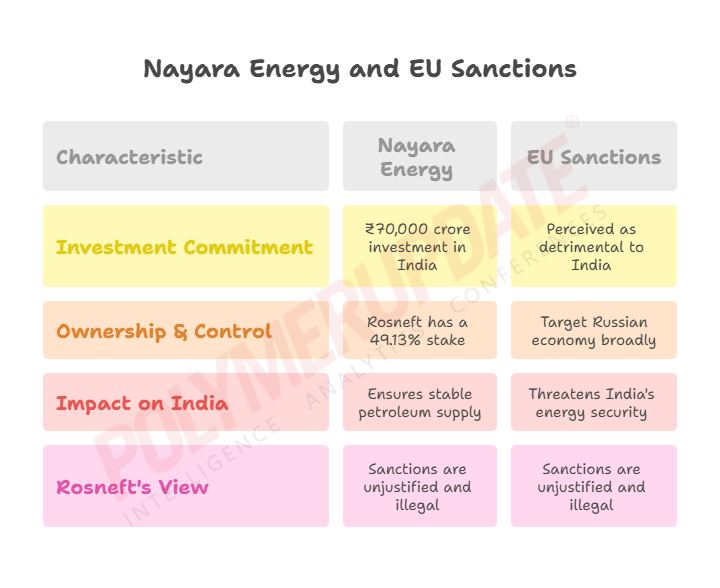 Earlier this year, Nayara Energy — India’s second-largest crude oil refiner — announced a massive investment to set up a 1.5 million tonnes per annum (MMTPA) ethane cracker at its existing site. Nayara, an oil refining and marketing company, owns and operates the Vadinar refinery in Gujarat, which has a capacity of 20 MMTPA, making it the second-largest refinery in the country. This proposed investment marks the first significant capital expenditure (capex) by an overseas company in India’s petrochemical sector.
The company has already commenced front-end engineering work for the petrochemical project. Nayara Energy Ltd is a joint venture between Russian energy major Rosneft, which holds a 49.13 percent stake, and an investment consortium through a Special Purpose Vehicle (SPV), Kesani Enterprises Company, which also holds a 49.13 percent stake. Kesani is owned by Russia's United Capital Partners (UCP) and Hara Capital Sarl, a wholly-owned subsidiary of Mareterra Group Holding (formerly Genera Group Holding S.p.A.).
Nayara owns and operates a 20 million tonne-per-year oil refinery at Vadinar in Gujarat, along with a retail network of over 6,750 petrol pumps — the largest network for any private oil company in India.
History of Nayara Energy
The Vadinar refinery of Nayara Energy is supported by extensive infrastructure, including a crude oil tanker facility, water intake systems, a multi-fuel power plant, a product jetty, and dispatch facilities via rail, road, and sea. Formerly known as Essar Oil Ltd, Nayara Energy was privatized through a leveraged buyout completed on December 30, 2015. Essar Oil was delisted at a valuation of US$ 5.3 billion (Rs 380 billion). In 2017, a Rosneft-led consortium acquired Essar Oil for US$ 12.9 billion and rebranded it as Nayara Energy. The company is now expanding its capacity to strengthen its presence in the petrochemical and alternative energy sectors and has already established a polypropylene unit at Vadinar.
In 2018, the company adopted a phased asset development strategy to enter the petrochemical sector and is now well-positioned to become a major player, leveraging its unique integration opportunities with the refinery. Key advantages include its proximity to a port and the strategic location of its refinery in western India. Vadinar, near Dwarka, is located in the largest petrochemical consumption region of the country.
According to the company’s website, “Nayara Energy has adopted a phased asset development strategy to enter the petrochemicals sector. Under Phase 1 of its petrochemical expansion project, the company is setting up a 450,000 tonnes per annum (TPA) polypropylene plant within its Vadinar Refinery in Gujarat. This includes a Propylene Recovery Unit (PRU), upgrades to the existing FCC (Fluidized Catalytic Cracking) Unit, and a Polypropylene Unit (PPU).”
Nayara Energy aims to build one of the largest integrated petrochemical complexes in the country. With its strategically integrated refinery complex in western India — including captive port and power assets — the company is well-positioned to make a strong entry into this high-growth segment, it stated on its website.
EU sanctions
The European Union’s (EU’s) 18th package of sanctions against Russia is being regarded as the harshest yet, targeting a broad swath of the Russian economy — with potential cascading effects on India as well. Since Russia’s invasion of Ukraine on February 26, 2022, the newly imposed sanctions announced on Friday cover a wide range of areas, including energy supplies, shipping, and revenue streams that had previously remained unaffected. These unilateral sanctions are a significant concern for India, a major buyer of Russian crude oil.
The EU’s latest sanctions follow a 50-day deadline set by U.S. President Donald Trump (ending in August) for Russia to sign a peace agreement. He also urged Russia’s key trade partners — including India, China, and Brazil — to engage with President Vladimir Putin and encourage him to pursue a peace process. In response, President Putin has outlined stringent conditions for entering peace talks.
The 18th round of sanctions introduces a new crude oil price cap proposed by the EU within the Group of Seven (G7) framework. Led by the United States, the G7 coalition has enforced a price cap of US$60 per barrel on Russian oil since December 2022. The EU now plans to impose a floating price ceiling, set at 15 percent below the average market price of Russian crude — translating to a revised cap of US$47.60 per barrel. This lower cap is intended to reduce Russia’s energy revenues without disrupting the global oil supply.
EU sanctions illegal: Rosneft
Rosneft Oil Company said in a statement, “We consider the European Union's decision to impose restrictive measures on the Indian refinery of Nayara Energy as unjustified and illegal. These sanctions are yet another example of the extraterritorial application of politically motivated restrictions that blatantly violate international law and infringe on the economic interests of a sovereign state.”
Rosneft clarified that it is not the controlling shareholder of Nayara Energy — its share in the company’s authorised capital is less than 50 percent. The enterprise is managed by an independent Board of Directors.
“The European Union's grounds for imposing sanctions are entirely baseless and factually incorrect. Nayara Energy is an Indian legal entity whose economic activity is focused on the development of its assets. The company is fully taxed in India. Nayara Energy’s shareholders have never received dividend payments, and the accumulated profits have been used exclusively for the development of its refinery, petrochemical operations, and retail network in India,” Rosneft’s statement further added.
The Nayara Energy refinery is a strategically important asset for India’s energy sector, ensuring a stable supply of petroleum products to the domestic market. The imposition of sanctions on the refinery directly threatens India’s energy security and could have a negative impact on its economy.
DILIP KUMAR JHA
Editor
dilip.jha@polymerupdate.com