Click the icon to add a specified price to your Dashboard list. This makes it easy to keep track on the prices that matter most to you.

A day after announcing on his social media platform Truth Social plans to impose a 25 percent tariff on India, U.S. President Donald Trump issued an Executive Order on July 31, granting negotiators seven days to expedite the India–United States Bilateral Trade Agreement (BTA). The extension comes amid growing transcontinental uncertainty, following multiple prior comments and social media posts by Trump highlighting his friendship with India.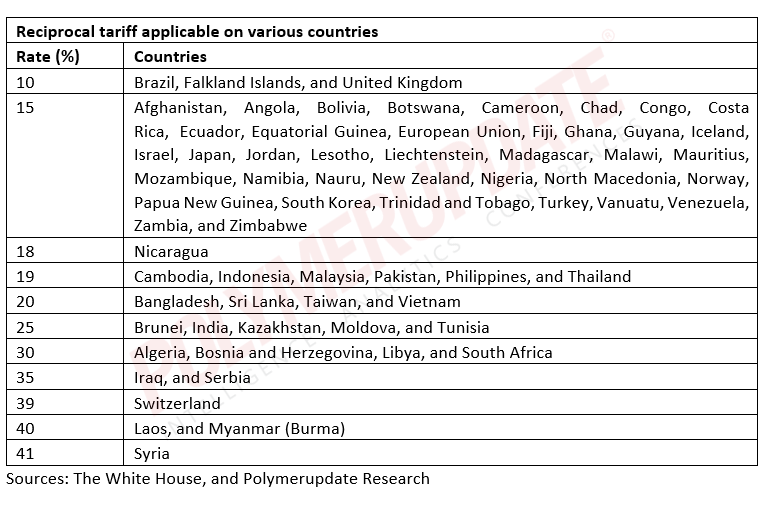 Trump’s July 31 Executive Order marks a modified version of an earlier order issued in April, which imposed higher tariffs on several countries, including India. In April, President Trump had imposed a 26 percent tariff on Indian goods. However, he later announced a 90-day ceasefire, allowing countries time to negotiate tariff and trade deals with the United States. While several countries and regions—including the United Kingdom and the European Union—have concluded agreements with the U.S., larger economies such as China, India, and Brazil are still in negotiations.
After the ceasefire period ended on July 9, President Trump extended the tariff applicability deadline to July 31, and now to August 7. Along with this extension, he also revised the tariff rates for several countries. The tariff on India has been adjusted to 25 percent, down from the earlier 26 percent.
Trump’s executive order reads, “These modifications shall be effective with respect to goods entered for consumption, or withdrawn from warehouse for consumption seven days after the date of this order (July 31), except that goods loaded onto a vessel at the port of loading and in transit on the final mode of transit before seven days after the date of this order. Such goods should have entered for consumption, or withdrawn from warehouse for consumption, before October 5, 2025, shall not be subject to such additional duty and shall instead remain subject to the additional ad valorem duties previously imposed earlier.”.png) Caveat
Caveat
However, this Executive Order also carries a caveat. “Certain foreign trading partners have agreed to, or are on the verge of concluding, meaningful trade and security agreements with the United States. Goods of those trading partners will remain subject to the additional ad valorem duties as modified on July 31 until such time as those agreements are concluded, and I issue subsequent orders memorializing the terms of those agreements,” Trump clarified.
The additional ad valorem rate of duty applicable to any good from the European Union is determined by the good’s current ad valorem (or ad valorem equivalent) rate of duty. For goods from the European Union with a duty rate of less than 15 percent, the additional ad valorem duty under this order shall be 15 percent. For goods with a duty rate of at least 15 percent, the additional ad valorem duty shall be zero. Goods from any foreign trading partner not specifically mentioned so far will be subject to an additional ad valorem duty of 10 percent, unless otherwise expressly stated.
The beginning of India-US trade negotiations
India’s Bilateral Trade Agreement (BTA) with the United States is yet to see the light of day, despite being one of the first countries to initiate dialogue aimed at peacefully resolving differences and facilitating smooth business deals. Now, a U.S. delegation is set to visit India on August 25 for the sixth round of talks in New Delhi, with the previous five rounds having remained inconclusive. India began trade talks with the United States in Washington in March 2025, after U.S. President Donald Trump raised concerns over the widening trade deficit, which stood at US$ 45.7 billion in 2024.
Immediately after taking office, President Trump reiterated his pre-election campaign slogan, “Make America Great Again (MAGA),” by encouraging businesses to establish operations and create jobs in the United States. To attract global investment, Trump has been employing a variety of measures, including sanctions and tariffs.
The India–U.S. trade deliberations aim to iron out key differences and give fresh momentum to the negotiations. The U.S. has stated that the pace of talks would help open new markets for American goods and create opportunities for workers, farmers, and entrepreneurs in both countries. Washington is seeking increased market access, reduced tariffs and non-tariff barriers, and a robust set of additional commitments to ensure long-term benefits. Ahead of the BTA negotiations, India’s Commerce Secretary, Sunil Barthwal, had stated that India would strive to conclude the agreement with the U.S. as quickly as possible.
Bilateral trade
U.S. total goods trade with India was estimated at US$ 129.2 billion in 2024. U.S. goods exports to India stood at US$ 41.8 billion, up 3.4 percent (US$ 1.4 billion) from 2023. U.S. goods imports from India totaled US$ 87.4 billion in 2024, reflecting a 4.5 percent increase (US$ 3.7 billion) over the previous year. Consequently, the U.S. goods trade deficit with India widened to US$ 45.7 billion in 2024, a 5.4 percent rise (US$ 2.4 billion) from 2023.
Both sides have targeted to conclude the first phase of the pact by the fall (September-October) of 2025, with an aim to more than double the bilateral trade to US$ 500 billion by 2030, from about US$ 191 billion (both merchandise and services) currently. In a trade pact, two countries either significantly reduce or eliminate customs duties on the maximum number of goods traded between them. They also ease norms to promote trade in services and boost investments.
Contentious issues
The most contentious issues between the two countries remain tariffs on agriculture, dairy products, automobiles and auto components, and steel. Beyond tariffs, the United States is also pushing for large-scale commercial deals involving oil and liquefied natural gas (LNG), civilian and military aircraft from Boeing, helicopters, and nuclear reactors. Industry sources said negotiators from Washington are also urging New Delhi to ease foreign direct investment (FDI) restrictions in multi-brand retail, which would benefit companies like Amazon and Walmart.
However, India is determined to safeguard the livelihoods of its farmers and over 8 million dairy cooperative members, as well as protect micro, small, and medium enterprises (MSMEs) and labour-intensive sectors from potential adverse impacts of the deal. Although agricultural goods make up less than 5 percent of U.S. exports to India, Washington is aggressively pressing for greater market access in this area.
Currently, Indian farm exports to the U.S. face a modest 5.3 percent tariff, while U.S. farm exports to India are subject to a much steeper 37.7 percent tariff — a 32.4 percent duty differential. Under a proposed 25 percent reciprocal tariff regime, Indian agricultural exports could face higher duties in the U.S., while reduced tariffs on U.S. farm imports could flood Indian markets with cheaper goods.
The U.S. argues that India’s GM-free feed certification and facility registration requirements for dairy products effectively amount to a ban on American dairy imports. India currently prohibits the import of animal products derived from livestock fed with animal-derived feed — for example, butter from cows fed meat — due to deep religious sensitivities. India considers this policy non-negotiable.
Outlook
Both India and the United States are emphasizing the need to boost local manufacturing and generate domestic employment. While India is focused on its ‘Make in India’ initiative, the United States is advancing its “Make America Great Again (MAGA)” agenda. A peaceful resolution of the differences, without escalating into a trade war, would be a significant and welcome development.
DILIP KUMAR JHA
Editor
dilip.jha@polymerupdate.com