Click the icon to add a specified price to your Dashboard list. This makes it easy to keep track on the prices that matter most to you.

India is poised to emerge as a global petrochemical manufacturer with a planned capital expenditure (capex) of US$ 37 billion in the medium term to reduce import dependence and achieve self-sufficiency, according to a study by global rating agency S&P. The report, titled “First China, Now India: Self-Sufficiency Goals Will Add to Petrochemicals Supply”, however, warns that India’s aggressive capacity expansion could accelerate the oversupply situation in the Asian petrochemical market—a trend similar to what China experienced in recent years.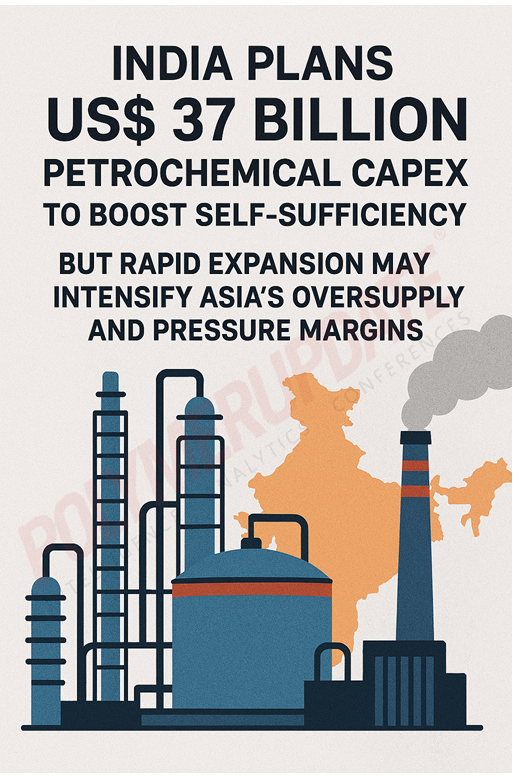 As the world’s third-largest petrochemical consumer after China and the United States, India has historically relied heavily on imports to meet its growing domestic demand. However, a shift toward increased domestic production under Prime Minister Narendra Modi’s “Make in India” vision is underway, aiming to transform the country into a self-reliant petrochemical producer. Under this mission, India is targeting one-third of the global capacity expansion by 2030, backed by large-scale investments to reduce dependence on imported petrochemicals used in daily essentials ranging from toothbrushes to auto parts.
A driving force amid oversupply
A country paper on India’s petrochemical industry, presented by the apex industry body Chemicals and Petrochemicals Manufacturers Association (CPMA), estimates that India will remain a key driver of petrochemical demand in Asia, supported by strong economic growth and resilient industrial production. However, rising demand is unlikely to bring much relief to domestic producers facing margin pressures, as prices of key bulk chemicals are expected to remain subdued due to ample supplies and new capacities coming onstream.
The prevailing oversupply in the Asian petrochemicals market is unlikely to deter India from pursuing capacity expansion, aided by the government fast-track approvals for both brownfield and greenfield projects. Of the proposed US$ 37 billion investment, government-owned enterprises are expected to account for US$25 billion, while the private sector will contribute US$ 12 billion with greater flexibility. India’s capacity expansion is expected to intensify competition in the Asian petrochemical market in the coming years.
Current scenario
India’s current petrochemical manufacturing capacity is estimated at 29.62 million tonnes per annum. With ongoing expansions, overall capacity is projected to reach 46 million tonnes by 2030. The country offers vast potential across the petrochemical value chain. With annual consumption ranging between 25 and 30 million tonnes, India—Asia’s third-largest economy—has per capita consumption levels significantly lower than those of developed nations. This gap presents ample opportunities for demand growth and investment.
The Indian petrochemical industry is planning substantial capacity additions in both polyethylene (PE) and polypropylene (PP), anticipating a rebound in long-term demand from domestic and international markets. If implemented on schedule, these expansions will not only reduce India’s reliance on imported petrochemicals but could also create a temporary oversupply, exerting downward pressure on prices in the near term. In recent years, US tariffs and trade disruptions under former President Donald Trump limited export opportunities to the American market for Asian petrochemical producers.
The government, along with Public Sector Undertakings such as Oil and Natural Gas Corporation (ONGC) and Bharat Petroleum Corporation Ltd. (BPCL), as well as private players like Haldia Petrochemicals, is committed to large-scale investments. Currently, petrochemical projects worth nearly US$ 45 billion are underway, with an additional US$ 100 billion planned to meet rising demand, in line with India’s transition toward a lower-carbon future.
A KPMG report published in January 2025 estimates that India’s US$ 220 billion chemicals and petrochemicals sector contributes about 6 percent to the country’s gross domestic product (GDP) and employs over 5 million people. “India is a net importer of chemicals and petrochemicals, relying on imports for around 45 percent of petrochemical intermediates. With annual imports valued at approximately US$ 88.6 billion, chemicals and petrochemicals represent India’s second-largest import category. With over US$ 124 billion in planned investments, this dependency is expected to reduce significantly, playing a vital role in achieving the Viksit Bharat goal,” the report notes.
Growing demand
India’s per capita petrochemical consumption stands at approximately 12 kg—just one-third of the global average—highlighting substantial room for growth and investment. More importantly, the sector is evolving rapidly, becoming increasingly sophisticated in terms of products and processes, thereby necessitating further investment and targeted policy support to fully capitalize on value-addition opportunities.
According to CPMA, India’s aggregate demand for petrochemicals declined by 4 percent in 2020-21 due to the pandemic, which disrupted demand and supply chains. Demand then rebounded strongly, growing 13 percent in 2021-22. However, growth moderated to 8 percent in 2022-23, with the aggregate demand reaching 58 MMT in 2023-24—an 8 percent increase.
The outlook for the next two years suggests demand growth of about 7 percent and 5 percent, respectively. By 2025-26, India’s petrochemical demand is projected to reach 62 million tonnes and rise further to 65 million tonnes by 2026. This trajectory underscores the rising consumption of petrochemicals across value chains and signals healthy long-term growth for the industry.
China as the leader
According to GlobalData, a London-based data analytics firm, China is set to dominate the global petrochemical market in the mid-term, driven by robust economic growth, with both the highest number of new projects and the largest absolute capacity expansion. The country is forecast to account for 51 percent of Asia’s total capacity additions by 2030. The study also highlights that China will lead global capacity growth, with additions totalling 245.5 million tonnes per annum (MTPA) by 2030. A key contributor to this expansion will be the Shandong Yulong Petrochemical Longkou Ethylene Plant 2, expected to add 5.2 MTPA by 2030.
Global petrochemical capacity is projected to grow substantially by the end of the decade. GlobalData estimates an increase from 2,214.9 MTPA in 2020 to 3,103.6 MTPA by 2030, reflecting cumulative growth of 40 percent. Reliance Industries Ltd. and Haldia Petrochemicals Ltd. from India, along with China Petrochemical Corporation, are expected to be the top three companies worldwide in terms of planned and announced capacity additions by 2030.
China is already the world’s largest exporter of key petrochemical products, including polyethylene terephthalate (PET) resins, purified terephthalic acid (PTA), polyvinyl chloride (PVC), and polyester fiber. At the same time, Beijing has mandated that the country’s total refining capacity remain capped at below one billion tonnes annually by this year, compared with the current level of about 960 million tonnes.
DILIP KUMAR JHA
Editor
dilip.jha@polymerupdate.com