Click the icon to add a specified price to your Dashboard list. This makes it easy to keep track on the prices that matter most to you.

Achieving net zero by 2050 would require investments of US$ 450 billion in mining energy transition minerals by 2030 and US$ 800 billion by 2040, the International Energy Agency (IEA) said in its latest report. The finance sector can play a critical role in promoting responsible mining, particularly in light of the rising demand for energy transition minerals such as lithium, cobalt, and rare earth elements, which are essential for the global shift to sustainable energy systems. Massive investments are required across the value chain — from exploration and extraction to processing and refining — presenting a unique opportunity to drive transformative change.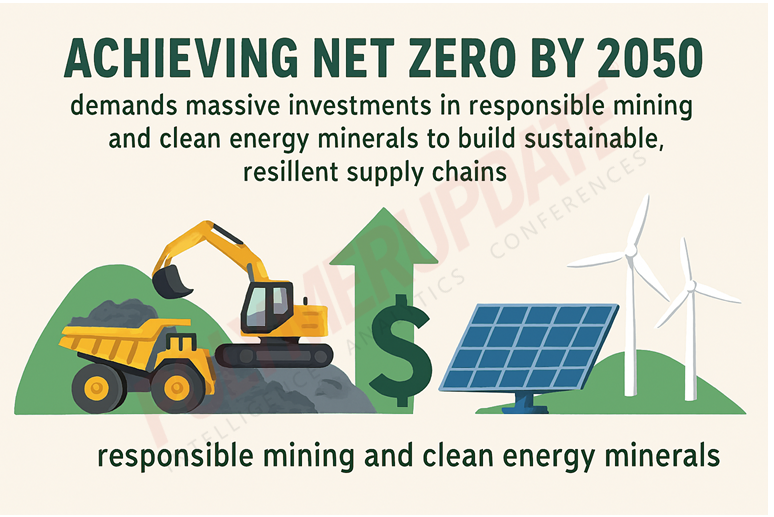 The ongoing global energy crisis represents a pivotal moment for clean energy transitions worldwide, spurring a wave of investment throughout the value chain, including in critical minerals. These investments are set to flow into a range of industries over the coming years. In this context, developing secure, resilient, and sustainable supply chains for the mineral ingredients essential to clean energy is vital. Notably, the United Nations has reaffirmed its commitment to achieving a net-zero transition by 2050.
Since 1970, global mineral extraction has increased five-fold, and the market for critical energy transition minerals — the building blocks of clean energy technologies such as solar panels, wind turbines, and batteries — is expected to expand rapidly. In 2023 alone, demand for materials such as nickel, cobalt, graphite, and rare earth elements rose between 8 percent and 15 percent. In the case of lithium, demand by 2050 is projected to reach nine times the 2022 world production level.
Clean energy technology
There is a global market opportunity for key mass-manufactured clean energy technologies worth around US$ 650 billion annually by 2030 — more than three times today’s level — if countries worldwide fully implement their announced energy and climate pledges. Related clean energy manufacturing jobs are expected to more than double from 6 million today to nearly 14 million by 2030, with over half of these jobs tied to electric vehicles, solar photovoltaics (PV), wind, and heat pumps. As clean energy transitions advance beyond 2030, this growth is expected to spur further rapid industrial and employment expansion.
Major economies across Asia, Europe, and North America are intensifying efforts to expand their clean energy technology manufacturing sectors, with overlapping goals of advancing net-zero transitions, strengthening energy security, and enhancing competitiveness in the new energy economy. The ongoing global energy crisis has further accelerated these initiatives, carrying significant implications for governments, businesses, investors, and citizens worldwide.
“Every country needs to identify how it can benefit from the opportunities and navigate the challenges of this new energy economy. The rapid growth of clean technology manufacturing is set to create new markets worth hundreds of billions of dollars, as well as millions of new jobs in the coming years — provided countries follow through on their energy and climate pledges. This transition is, in turn, transforming the industries that supply the materials and products underpinning the energy system, heralding the dawn of a new industrial age — the age of clean energy technology manufacturing,” UNEP said in its latest report.
Finance- a critical need
The global energy sector is undergoing profound changes that are set to transform it over the coming decades — from one overwhelmingly dependent on fossil fuels to one increasingly dominated by renewables and other clean energy technologies. A new global energy economy is emerging, driven by the rapid growth of solar, wind, electric vehicles, and a range of other technologies such as electrolysers for hydrogen production.
Supplying the required energy transition minerals at the scale envisioned will demand a substantial increase in investment across the mining and processing industries. However, if this expansion follows current mainstream practices, it could lead to significant social and environmental harm, adversely impacting local communities and ecosystems near mining sites. This assessment report highlights the major challenges that must be addressed to ensure that the low-carbon energy transition is supplied with the necessary minerals in a timely and responsible manner.
The financial system, along with the governance and regulation of mineral exploration and mining, must be reformed to enable greater capital flows and support a clean energy transition, according to a new report by the UN Environment Programme (UNEP)-hosted International Resource Panel. With mineral extraction now accounting for 50 percent of total annual global raw material extraction, up from 31 percent in 1970, financing responsible mining will be critical to achieving a successful and equitable energy transition.
“The demand for minerals and metals needed for the energy transition requires a mining industry that contributes to sustainable development while respecting human rights and the environment. Through sustainable finance, responsible mining can become the default, not the exception. A capital-intensive and high-risk industry, mining relies on diverse sources of finance — public, private, or blended — for every stage of a project, including mine closure, as well as upstream activities in the minerals and metals value chain, such as mineral processing, metallurgical plants, and metal refineries,” said Janez Potocnik, Co-Chair of the International Resource Panel.
An expensive option
A survey conducted for this report among large-scale mining-related companies confirms that while maintaining environmental standards is perceived as expensive, most companies estimate that it would add less than 25 percent to their operational costs. However, the majority of respondents believe that Environmental, Social, and Governance (ESG) reporting can help attract new investors. In this context, the substantial investments required by mining companies place the financial sector in a strong position to exert pressure on firms to improve their ESG performance.
Enhancing circularity within the sector could help reduce demand for additional energy transition minerals. Measures such as recycling targets, government-backed financing, extended tax provisions for recycling infrastructure, incentives for eco-design, and green bonds to fund recycling facilities can lessen reliance on virgin materials. Public-private partnerships, public awareness campaigns, and the creation of a global database for both former and operating mining tailings facilities are also among the recommended strategies. Still, even with ambitious circularity measures in place, the scale of investment required remains significant.
Recommendations
UNEP recommends enhancing ESG outcomes in artisanal and small-scale mining (ASM). It calls for greater transparency; formalization of labour through locally tailored licensing procedures; capacity building; tax incentives; funding and technical support; increased local participation; and improved access to geological and geospatial data. Establishing an international sustainability framework for this industry could help manage environmental and social risks while improving access to formal sources of finance within the artisanal and small-scale mining sector.
DILIP KUMAR JHA
Editor
dilip.jha@polymerupdate.com