Click the icon to add a specified price to your Dashboard list. This makes it easy to keep track on the prices that matter most to you.

Hyderabad-headquartered Recykal, a digital technology company, specializes in waste management and recycling. Founded in 2016 by a group of professionals from diverse fields, including Abhay Deshpande, Abhishek Deshpande, Ekta Narain, Vikram Prabhakar, and Anirudha Jalan, the company began its journey in 2017 by connecting waste collection centres with recyclers through the launch of a specialized marketplace platform. Currently operating across 25 states, Recykal has successfully channelized over 1.2 million tonnes of waste through its digitally connected ecosystem, enabling circularity for more than 620 brands, over 675 recyclers, and more than 5,000 aggregators, in collaboration with various national and international government bodies, says Sujan Parthasaradhi, Chief Innovation Officer of Recykal, in an interview with Dilip Kumar Jha, Editor at Polymerupdate. Edited excerpts: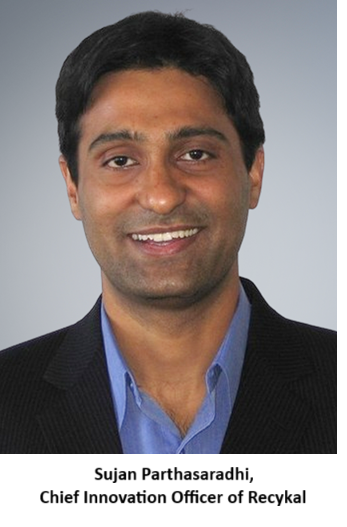 How does Recykal leverage AI / IoT for sorting, identifying, and grading different types of plastics (PET, HDPE, PP etc.) and how do these innovations help improve the quality of recycled polymers in India?
Recykal leverages advanced AI and IoT tools to build a clean, traceable stream of post-consumer recyclables. Our AI models can detect five layers of metadata on every item- colour, category (PET, aluminium, glass), contamination levels, SKU/size, and even brand identity. This enables precise sorting through our automated “Reklaim Line,” capable of handling up to 200 items per minute. By delivering cleaner, pre-segregated recyclables to processors, yields improve by 20–30 percent, ensuring consistent quality and better recovery compared to traditional mixed streams, ultimately boosting the availability of food-grade PCR.
Our machines integrate computer vision and AI to deliver affordable, customizable, scalable, and secure sorting solutions that empower the waste management workforce for reliable and efficient collection and segregation. The devices are designed to be low-priced, simple, and intuitively easy to operate even by rag pickers, waste aggregators, and material recovery facility (MRF) workers, where literacy levels may be low. We have built devices with the latest technology that can be used by common man.
What are the tools or platforms Recykal has introduced to monitor price volatility in plastic raw materials and recycled plastics, and how does this data help recyclers, brands, and aggregators make better decisions?
Recykal has introduced a digital marketplace that consolidates pricing information from over 100 organized recyclers, giving visibility into the average selling price (ASP) of various grades of PET, HDPE, LDPE, and other plastics. By integrating monthly association-declared pricing and making it digitally accessible, the platform brings transparency to what was traditionally a recycler-driven, opaque system. This visibility allows brands, recyclers, and aggregators to negotiate fairly, plan procurement better, and minimize volatility. Beyond price tracking, Recykal also provides value-added services such as quality audits, assured offtake, and faster payment cycles, ensuring recyclers get stability while brands and aggregators benefit from reliable, predictable pricing. Also, the Recykal’s deposit return system (DRS) collection device ecosystem publishes the daily collection and trends, ensuring a visibility on the total supply of the material in the DRS scheme, which absorbs the shocks of price fluctuations.
Can you share how Recykal’s marketplace and traceability tools are influencing the demand for post-consumer recycled (PCR) resins among brands? What innovations are helping ensure consistency of supply and quality?
Recykal’s marketplace and traceability tools have become critical in driving demand for post-consumer recycled (PCR) resins among leading fast moving consumer goods (FMCG) and manufacturing companies. Every transaction is digitally documented through GST filings, EPR credits, and compliance paperwork, giving brands complete confidence in the origin and quality of recycled material. By tracking the entire journey from informal waste collectors to recyclers to brand procurement Recykal ensures end-to-end traceability and compliance. The marketplace effectively addresses the key challenges in the industry logistics, compliance, pricing, and the consistent supply of high-quality recycled material. It enables transparent transactions and predictable supply chains, ensuring compliance and strengthening the reliability of India’s recycling ecosystem.
To further improve supply consistency, the company has piloted AI-powered sorting systems that segregate plastics by type, colour, and contamination, raising quality standards for PCR resins. With government mandates pushing companies to adopt at least 30 percent PCR content in packaging, Recykal’s transparent, technology-driven system assures quality and compliance, making PCR resins more attractive and strengthening trust across the value chain.
What roles do reverse vending machines (RVMs) or digital deposit refund systems (dDRS) play in Recykal’s strategy for recovering more plastic packaging waste and what are some of the challenges and innovations in deploying them in India?
RVMs and dDRS form the backbone of Recykal’s digital-first waste recovery model. Traditionally, bottles and containers take 2–3 months to reach recyclers, by that time, quality is lost due to contamination. Our AI-enabled RVMs built to withstand India’s hot, humid, and dusty conditions enable consumers and waste pickers to deposit PET bottles, Tetra Paks, aluminium cans, and glass bottles, receiving instant refunds via UPI. This shortens the collection cycle dramatically, ensures higher-quality material, and provides recyclers with real-time visibility of upcoming supply. Proven pilots in Bhutan and Char Dham have shown success, through awareness-building.
The Reklaim Devices are made in India with local contents above 50 percent ensuring a vision of made in India for the Globe, and also the devices are Cybersecure to protect any sort of man in middle attacks and building up consumer trust in the scheme and the devices which they are interacting with, also all the devices are battery operated and work on solar as well with 50 percent of the product portfolio as portable ensuring the last mile inclusion in the change.
How is Recykal using technology to support informal sector waste collectors and aggregators — for example, in ensuring proper material segregation, digital payments, or linking them with markets via your platform?
Recykal’s platforms are designed to digitally include and empower informal collectors, the backbone of India’s recycling ecosystem. We are developing portable, easy-to-use digital devices that enable waste pickers to participate directly in dDRS flows, receive instant digital payments, and track contributions transparently. By connecting them to recyclers and brands, we ensure consistent demand and material traceability, resulting in income improvements of upwards of 100% in many cases. Beyond collections, Recykal also creates new livelihood opportunities, such as managing RVMs or operating collection centres ensuring informal workers are not displaced but elevated into the formal, tech-driven circular economy.
DILIP KUMAR JHA
Editor
dilip.jha@polymerupdate.com