
Click the icon to add a specified price to your Dashboard list. This makes it easy to keep track on the prices that matter most to you.

India signed 17 Memoranda of Understanding (MoUs) with Germany to strengthen bilateral ties across the defence, technology and clean energy sectors, and to enhance the strategic partnership, even as a free trade agreement with the European Union is expected to be signed by January-end. The development underscored India’s growing focus on non-US trade ties, as negotiations with the United States have taken a back seat. Additionally, eight key announcements were made between the two trade partners during the Silver Jubilee celebrations of India–Germany bilateral ties, which coincided with German Chancellor Friedrich Merz’s first visit to India and his maiden Asia tour. Germany also committed to supporting the India–European Union Free Trade Agreement (FTA).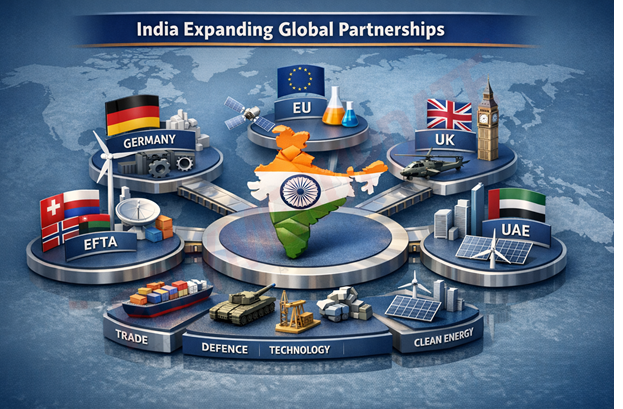 Merz’s visit witnessed the signing of several joint declarations of intent across sectors such as semiconductors, critical minerals, telecommunications, and the defence industrial cooperation roadmap, with a focus on the co-development and co-production of military hardware. Both countries placed special emphasis on talent mobility and skills cooperation. A major highlight of the visit was the announcement of a visa-free transit facility for Indian passport holders transiting through Germany.
Prime Minister Narendra Modi said, “The meeting with German Chancellor Friedrich Merz is taking place at a very important time, when we are celebrating the Platinum Jubilee of India–Germany relations and the Silver Jubilee of the India–Germany Strategic Partnership. This means our relationship carries the permanence of platinum and the shine of silver. The ongoing manufacturing cooperation between our MSMEs and Germany’s Mittelstand, the rapidly growing collaboration in IT and services, and joint ventures and research collaborations in the automotive, energy, machinery and chemical sectors are giving rise to new technologies. These strong linkages have directly benefited our trade, which has now crossed nearly US$ 50 billion.”
Merz commented, “India is a ‘Desired Partner’ and a ‘Partner of Choice’ for Germany,” while expressing strong commitment to elevating India–Germany relations to a higher and more strategic level. He added that there is a need to conclude negotiations on the India–European Union Free Trade Agreement to unlock the full potential of economic ties between the two countries. “We want to elevate the relationship to a new and higher level amid major geopolitical changes,” he said.
Strengthening non-US ties
In a significant push to expand its global economic and strategic footprint, India has recently concluded a series of important bilateral agreements with Oman, the United Arab Emirates (UAE), the Netherlands and Germany. These developments reflect a concerted effort by New Delhi to deepen trade, investment, technology cooperation and geopolitical collaboration across regions. Collectively, these trade agreements have helped India achieve record-high exports and narrow its trade deficit, largely insulating it from the impact of US tariffs.
With Oman, India signed a landmark Comprehensive Economic Partnership Agreement (CEPA) in December 2025, granting Indian exporters duty-free access to over 98 percent of Omani tariff lines, covering the vast majority of Indian exports, while India will liberalise tariffs on key imports from Oman. The pact, seen as a major boost for labour-intensive sectors such as gems and jewellery, textiles, leather, pharmaceuticals and engineering goods, is expected to push bilateral trade beyond the current level of around US$ 10 billion annually and strengthen economic integration with the Gulf region.
India’s partnership with the UAE is anchored in a CEPA that came into force in May 2022, leading to a sharp rise in two-way trade. Bilateral trade has crossed US$ 100 billion, with both sides exploring initiatives such as local-currency trade mechanisms to reduce dependence on third-party currencies, improve transaction efficiency and broaden cooperation in services and investment.
With the Netherlands, India recently signed a Memorandum of Understanding (MoU) to establish the India–Netherlands Joint Trade and Investment Committee (JTIC), creating a formal institutional platform to regularly review and expand bilateral trade and investment ties. The agreement signals a shared intent to address trade barriers, promote two-way investments and deepen cooperation in areas such as technology, sustainable growth and supply-chain diversification.
India and the United Kingdom have also signed a landmark Free Trade Agreement (FTA)—officially concluded in May 2025 and subsequently ratified—marking the most ambitious post-Brexit trade deal for both countries. Under the Comprehensive Trade and Economic Agreement (CETA), India will receive zero-duty access for about 99 percent of its exports to the UK, while the UK will benefit from reduced tariffs on roughly 90 percent of its exports to India. The pact includes provisions on services, regulatory cooperation and professional mobility, with the aim of doubling bilateral trade to around US$ 120 billion by 2030.
India has also signed a landmark Trade and Economic Partnership Agreement (TEPA) with the European Free Trade Association (EFTA)—comprising Iceland, Norway, Switzerland and Liechtenstein—which came into force on October 1, 2025, after being signed in March 2024. This is India’s first comprehensive trade agreement with a group of developed European nations and is designed to enhance market access, reduce or eliminate tariffs across a wide range of goods and services, and strengthen investment and economic ties. Under the agreement, EFTA states have committed to invest up to US$100 billion in India over the next 15 years.
US-India trade talks
The newly appointed US Ambassador to India, Sergio Gor, said during his arrival visit to India on Monday, “It is great to be here as the United States Ambassador. I come to this remarkable nation with profound respect and with a clear mission to take the partnership between our two great nations to the next level. This is the intersection of the world’s oldest democracy and the world’s largest democracy.”
Gor announced that trade talks between India and the United States would commence on Tuesday. However, an Indian Commerce Ministry official refuted the claim, clarifying that no official trade dialogue was scheduled for the week. “The Commerce Ministry has not received any official communication from Washington regarding further discussions. The referenced ‘next call’ may relate to Washington’s internal review of India’s recent trade proposals rather than a formal bilateral exchange. Nothing can be said at this juncture about bilateral trade talks this month, but at least for this week, nothing is scheduled,” the official said.
Both India and the US committed to negotiating a Bilateral Trade Agreement (BTA) in February last year, shortly after US President Donald Trump assumed office for a second term in January 2025. However, talks stalled after President Trump imposed a 25 percent reciprocal tariff, along with an additional penal tariff of 25 percent on India for purchasing crude oil from Russia, taking the total tariff burden to 50 percent. As a result, India’s exports to the United States nearly came to a standstill.
What particularly irked India was the selective imposition of penal tariffs. The US singled out India for heavy tariffs while sparing China, the world’s largest buyer of Russian crude. Notably, the United States itself continues to purchase significant volumes of various products from Russia. India–US bilateral trade prior to Trump’s second term stood at US$ 131.84 billion in 2024, with India’s exports valued at US$ 86.51 billion and imports at US$ 45.33 billion, resulting in a trade surplus of US$ 41.18 billion for New Delhi. The US was India’s top trading partner for the fourth consecutive year in 2024.
In a fresh escalation, the United States has threatened to impose a 500 percent tariff if India continues to purchase Russian oil, along with an additional 25 percent tariff for dealings with Iran.
Conclusion
Collectively, these agreements reflect India’s strategic diplomacy and economic engagement across continents—from the Middle East and Europe to the broader global market—aimed at boosting trade, strengthening supply chains, attracting investment, and enhancing technology and defence cooperation. Each partnership not only expands market access but also supports India’s ‘Make in India’ initiative, economic growth, and global connectivity goals in an increasingly interconnected world.
DILIP KUMAR JHA
Editor
dilip.jha@polymerupdate.com


