
Click the icon to add a specified price to your Dashboard list. This makes it easy to keep track on the prices that matter most to you.

China’s exports ended last year with a growth spurt, pushing its trade surplus to a record US$1.19 trillion in 2025. This extended a boom that has seen Chinese factories bypass Donald Trump’s tariffs by making deeper inroads into markets beyond the United States. According to China’s National Bureau of Statistics (NBS), the trade surplus was driven by resilient exports to diverse markets—including the European Union and the Global South—as shipments to the United States declined, alongside slower import growth reflecting softer domestic demand.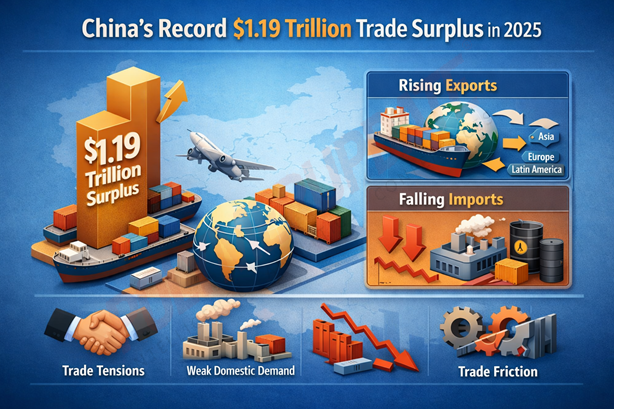 This trend highlights a structural shift in global trade, strengthening China’s external position while intensifying trade frictions, even as Beijing seeks to promote domestic consumption. Trade performance also defied expectations of a front-loading-related slowdown, with both exports and imports exceeding forecasts for the year. The trade surplus surged to a new record high, reaching a level roughly equivalent to the GDP of a top-20 global economy in 2025.
Export performance
China’s exports grew by 6.6 percent year on year in December, up from 5.9 percent in November, beating market expectations of a moderation. For the full year, exports rose 5.5 percent year on year, slightly lower than the 5.9 percent growth recorded in 2024. This strong export performance came despite a clear drop-off in shipments to the United States, which fell 20.0 percent year on year for the full year. Exports to South Korea (-1.1 percent) and Japan (3.5 percent) were also relatively subdued over the year.
Exports to other regions more than offset this drag in 2025, with key destinations such as ASEAN (13.4 percent) and the European Union (8.4 percent) posting growth well above the overall export average. Strong export growth was also recorded to India (12.8 percent), Africa (25.8 percent), and Latin America (7.4 percent).
By product, semiconductors (26.8 percent), ships (26.7 percent), and automobiles (21.4 percent) were the top performers for the year. In contrast, exports with high exposure to the U.S., such as toys (-12.7 percent), furniture (-6.1 percent), and footwear (-11.3 percent), were among the major underperformers. Overall, the export mix suggests that China continues to move up the value-added ladder.
Lagging imports
Arguably, the bigger surprise in the December trade report was that China’s imports grew by 5.7 percent year on year in December, up from 1.9 percent in November—much stronger than expected. Overall, imports lagged in 2025, ending the year flat at 0.0 percent year on year. A sustained acceleration in imports could go a long way toward easing pressure on, and from, China’s key trading partners.
By source, China’s imports rose the most from Indonesia (15.6 percent), Singapore (14.7 percent), India (9.7 percent), and the Netherlands (8.8 percent) in 2025. In contrast, the trade war with the United States resulted in a 14.6 percent year-on-year decline in imports from the U.S. Imports from Malaysia (-20.4 percent), Canada (-10.4 percent), and Australia (-7.5 percent) also contracted amid various tariff developments.
By product, China’s imports remained heavily concentrated on its technology-driven priorities. High-tech imports rose 9.3 percent year on year, led by strong inflows of automatic data processing equipment (18.2 percent) and semiconductors (10.1 percent). In contrast, auto imports plunged 39.7 percent, while crude oil imports fell 8.8 percent. Imports of construction-related products such as steel (-10.7 percent) and lumber (-13.9 percent) also performed poorly over the year, reflecting subdued demand.
Equivalent to 20 global economies
China’s 2025 trade surplus would have been equivalent to the GDP of a top-20 global economy in 2024. In sum, China ended 2025 with a record trade surplus of US$1.19 trillion, roughly equivalent to the economic output of a top-20 global economy in its own right. The trade surplus rose 19.9 percent year on year in 2025. As analysts have frequently noted in their reports over the past year, external demand has been a major driver of China’s economic growth in 2025 and is set to help the country achieve its growth target of around 5 percent when GDP data is published next week.
For China, the key question is how long this engine of growth can remain the primary driver. On one side of the debate are Chinese companies that are increasingly competitive on a global scale, across all rungs of the value-added ladder. China’s economies of scale, decades of manufacturing infrastructure and expertise, and the recent national strategy to promote a modern industrial system are likely to keep Chinese companies highly competitive.
Protectionism
On the other side of the debate, global trade protectionism is increasing. U.S. tariffs on China have led to a sharp drop in exports, but the slack has so far been taken up by the rest of the world. Should more economies begin ramping up tariffs on China—as Mexico has done and the European Union has threatened—China could eventually face a much tighter squeeze.
Cognisant of these risks and continuing to seek win-win cooperation, China has turned its focus toward promoting domestic demand as a future engine of growth. With a growing middle class, the consumer potential for both local and global products and services should not be underestimated. This transition will take time—perhaps more time than some of China’s trade partners would prefer—but it is likely to be a defining theme of the coming decade and beyond.
DILIP KUMAR JHA
Editor
dilip.jha@polymerupdate.com


