
Click the icon to add a specified price to your Dashboard list. This makes it easy to keep track on the prices that matter most to you.

Angst in the US job market continued despite President Donald Trump taking numerous measures under the “Make America Great Again” (MAGA) policy, including imposing sanctions and tariffs on trade partners and ordering companies to prioritise the employment of Americans over other nationals. Concerns deepened as US employers added just 50,000 jobs in December, sharply lower than forecasts of 70,000 additions. The manufacturing sector shed 8,000 jobs in the final month of 2025 due to unfavourable tariff policies, which made imports—from raw materials to finished products—more expensive.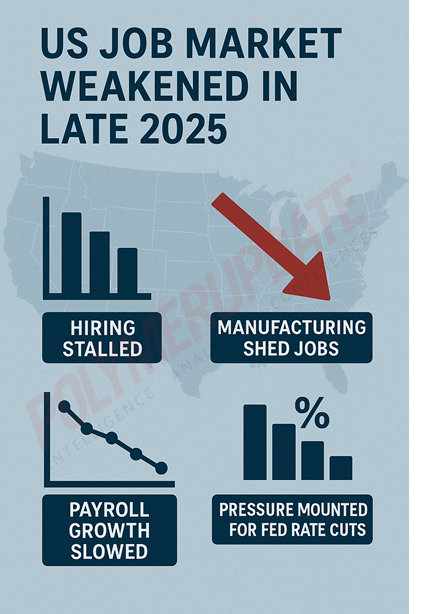 Data from the U.S. Bureau of Labor Statistics (BLS) showed that the US labour market closed out 2025 on a subdued note, with employers adding 50,000 jobs in December, below economists’ expectations and marking another month of tepid hiring that highlighted ongoing weakness in the broader economy. While total nonfarm payrolls rose slightly in the final month of the year, job gains were concentrated in just a few sectors, and key segments of the economy—particularly manufacturing—continued to struggle, the BLS added.
Commenting on the data, James Knightley, Chief International Economist for the US at ING Economics, said, “Job growth has effectively ground to a halt, and the jobs that are being added are concentrated in just three sectors. The bulk of the US economy is trimming employment, which points to further work for the Federal Reserve. Nonetheless, the dip in unemployment and a likely ‘hot’ inflation print next week suggest no action before March.”
Non-farm payrolls
US non-farm payrolls for December came in at 50,000, well below expectations of 70,000, while there were net downward revisions of 76,000 to the previous two months’ data. Federal Reserve Chair Jerome Powell has suggested that officials believe the Bureau of Labor Statistics is overestimating payroll growth by around 60,000 jobs per month, indicating that the US jobs market is effectively stagnant.
Looking at the past six months, non-farm payroll growth has averaged just 14,500 jobs per month. Adjusting for Chair Powell’s assessment of the measurement error, this implies that the US economy is losing more than 45,000 jobs per month. After a year of weak monthly job gains, December’s 50,000 increase capped a sluggish year in which total employment growth amounted to roughly 584,000 jobs—the weakest annual tally since the early 2000s outside recessionary periods.
There was relatively better news from the household survey, which is used to calculate the unemployment rate. The rate dipped to 4.4 percent from a downwardly revised 4.5 percent (originally reported as 4.6 percent last month). Wage growth rose 0.3 percent month-on-month, in line with expectations.
Despite the marginally lower unemployment rate, analysts cautioned that the decline was not necessarily a sign of underlying strength. Part of the drop reflected people exiting the labour force rather than new hiring, a dynamic that can mask latent slack in the US labour market.
Job composition
Once again, the composition of job creation was heavily concentrated in private education and healthcare services, which accounted for 41,000 of the 50,000 jobs added in December. Over the three-year period since January 2023, this sector has generated 55 percent of the 5.2 million jobs added to the US economy. Government employment (+13,000 in December) has contributed 20 percent, while leisure and hospitality (+47,000 in December) has accounted for 18 percent of total net job creation over the same period.
All other sectors—technology, construction, manufacturing, business services, financial services, retail, transport and logistics—have collectively contributed just 7 percent of job creation during this period. In December, this group actually lost 51,000 jobs and has recorded only one month of gains over the past eight months. This trend is deeply concerning and reinforces the case for the Federal Reserve (Fed) to provide additional support to the economy.
While the dip in the unemployment rate and resilient wage growth offer some mitigation, the US jobs market has clearly cooled through 2025. With monetary policy still described as modestly restrictive, the data support the case for further gradual interest rate cuts.
Manufacturing sector under stress
One of the starkest weaknesses in the December jobs report was in the manufacturing sector. According to BLS data, manufacturing employment fell by 8,000 jobs in December, extending a months-long downward trend that has seen factory headcounts steadily shrink. This decline came even as some broader measures of manufacturing activity—such as certain Purchasing Managers’ Index (PMI) readings—pointed to modest expansions in output or employment expectations.
Still, the real-world impact on workers has been clear: factory jobs have been cut for the eighth consecutive month, and overall manufacturing employment is now lower than a year ago. Manufacturing losses were broad-based, with both durable and nondurable goods categories recording declines. Some subsectors, such as plastics and rubber products manufacturing, experienced sharper contractions, while isolated gains in niche areas, including miscellaneous manufacturing, were insufficient to offset the broader downturn.
Economists attribute the sector’s relative weakness to a combination of import tariffs, softening global demand, supply-chain frictions, and structural shifts in manufacturing that increasingly favour automation and technology over traditional labour-intensive production.
Winners and losers
Outside of manufacturing, job gains were most notable in leisure and hospitality and healthcare, which together accounted for a large share of the modest overall payroll increase. These sectors have continued to absorb a significant portion of the US labour force in recent years, buoyed by steady consumer demand for services. By contrast, other goods-producing industries, including construction and retail trade, also recorded employment declines in December, underscoring that the hiring slowdown is not confined to manufacturing alone.
The latest employment figures present a nuanced picture for policymakers. On the one hand, steady—but slow—job growth alongside a stable unemployment rate reduces near-term pressure on the Federal Reserve to cut interest rates following a year of monetary easing. On the other hand, the persistence of sectoral weaknesses, particularly in manufacturing, raises concerns about broader economic momentum and wage growth in middle-income industries.
Outlook
As 2026 unfolds, economists will be watching closely whether hiring picks up and whether sectors that have lagged can rebound — especially as global macroeconomic conditions and domestic policy choices continue to shape labour market dynamics.
DILIP KUMAR JHA
Editor
dilip.jha@polymerupdate.com


