
Click the icon to add a specified price to your Dashboard list. This makes it easy to keep track on the prices that matter most to you.

India’s merchandise trade deficit widened in December 2025 due to a sudden spurt in imports driven by robust domestic demand, even as exports remained steady amid ongoing geopolitical turbulence involving the United States and the Middle East. Shipments to the United States stayed resilient despite a cumulative 50 percent tariff (25 percent reciprocal and an additional 25 percent penal levy for purchasing crude oil from Russia), although exporters continued to face pricing and margin pressures.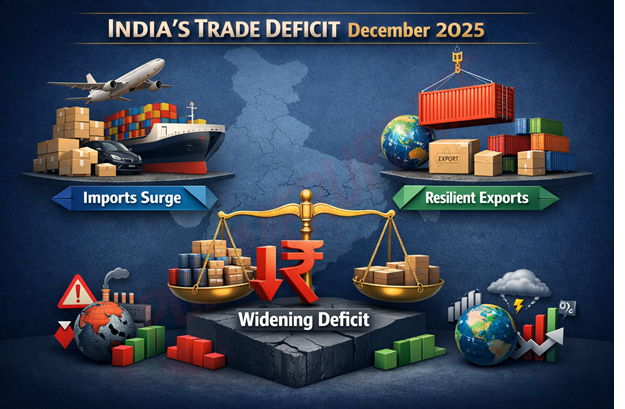 According to provisional data released by the Ministry of Commerce and Industry, India’s merchandise exports rose to US$ 38.51 billion in December 2025 from US$ 37.80 billion a year earlier, while imports surged to US$ 63.55 billion from US$ 58.43 billion. This resulted in a trade deficit of US$ 25.04 billion. The trade gap had stood at US$ 24.53 billion in November and US$ 20.63 billion in December 2024. The performance assumes greater significance against the backdrop of ongoing geopolitical tensions, supply-chain realignments, inflationary pressures, and rising protectionism across major economies.
Expressing strong optimism about sustained and broad-based growth in India’s foreign trade, S C Ralhan, President of the Federation of Indian Export Organisations (FIEO), said that the continued expansion of India’s exports during April–December 2025 is a clear testament to the resilience, agility, and growing global competitiveness of Indian exporters. He emphasized that exporters have not only weathered global uncertainties but have also capitalized on emerging opportunities through market diversification, value addition, and improved product competitiveness, aided by a supportive policy ecosystem.
Cumulative exports up
India’s overall exports during April–December 2025 rose by 4.33 percent to US$ 634.26 billion, compared with US$ 607.93 billion in the corresponding period of the previous fiscal. Merchandise exports during the period stood at US$ 330.29 billion, registering growth of 2.44 percent over US$ 322.41 billion in April–December 2024–25. Exports in December 2025 alone grew by 1.87 percent to US$ 38.51 billion, reflecting sustained demand across key product segments.
This performance is particularly encouraging given the volatility in global trade flows and reflects the effectiveness of government initiatives aimed at boosting exports, including policy continuity, export facilitation measures, improved logistics, digitisation of trade processes, and focused support for MSME exporters. Rajesh Agrawal, Commerce Secretary, Government of India, said, “We have been holding well and remain in positive territory. Going forward, we hope to stay in positive territory. India could end the financial year 2025–26 (March 2026) with exports exceeding US$ 850 billion, including services, with services exports likely to cross the US$ 400 billion mark for the first time.”
Imports gain momentum
On the import side, India’s overall imports during April–December 2025 increased by 4.95 percent to US$ 730.84 billion, compared with US$ 696.37 billion in the same period last year. Merchandise imports rose by 5.90 percent to US$ 578.61 billion from US$ 546.36 billion in April–December 2024–25. Imports in December 2025 stood at US$ 63.55 billion, compared with US$ 58.43 billion a year earlier, resulting in a trade deficit of about US$ 25 billion for the month.
During April–December 2025, engineering goods, petroleum products, electronic goods, drugs and pharmaceuticals, gems and jewellery, chemicals, readymade garments, cotton textiles, handloom products, rice, and marine products emerged as the top export items. On the import side, key commodities included petroleum products, electronic goods, gold, machinery, transport equipment, non-ferrous metals, chemicals, coal, plastics, and iron and steel.
Higher inflows of energy products, electronics, machinery, and industrial inputs indicate robust domestic manufacturing activity, infrastructure expansion, and investment demand, which augur well for medium-term economic growth. Engineering Export Promotion Council (EEPC) India Chairman Pankaj Chadha said, “Market diversification was among the key factors driving growth. In the face of persistent challenges, primarily stemming from Trump-era tariffs and ongoing geopolitical tensions, there is a greater need for government support.”
Leading trade partners
India’s top export destinations—the United States, the United Arab Emirates (UAE), China, the Netherlands, the United Kingdom (UK), Germany, Bangladesh, Singapore, Saudi Arabia, and Hong Kong—demonstrate a well-diversified and resilient export footprint. This diversification is particularly critical at a time when global trade routes are being reshaped by geopolitical conflicts, sanctions, shipping disruptions, and strategic realignments.
Shipments to the United States, India’s largest overseas market, rose month on month in December, indicating that demand held up despite higher tariffs, even as exporters faced pricing and margin pressures. Bilateral trade between India and China also increased, with imports rising sharply alongside an improvement in exports, reflecting continued dependence on Chinese intermediate and electronic goods.
Exports to the United States, subject to cumulative tariffs of 50 percent, faced headwinds, with shipments estimated at US$ 6.9 billion in December 2025, compared with US$ 7 billion a year earlier, according to data compiled by the Ministry of Commerce and Industry. Imports from the US rose by 7.6 percent to US$ 4 billion, driven by a 40–50 percent jump in crude oil shipments.
Strong engagements
India’s continued strong engagement with advanced economies such as the United States and Europe, alongside deepening trade ties with emerging markets and regional partners, reinforces its standing as a reliable, trusted, and competitive global trading partner. Growing exports to Bangladesh, Singapore, and Saudi Arabia also underscore the importance of regional integration, South–South cooperation, and strategic partnerships across the Indo-Pacific and the Middle East.
Ralhan reiterated that the commendable export performance is the outcome of the collective efforts of India’s exporters and the government’s proactive and facilitative trade policies. Going forward, he emphasized that continued policy support, faster logistics, stable trade agreements, and a sustained focus on market diversification will be critical to further accelerating India’s export growth trajectory.
DILIP KUMAR JHA
Editor
dilip.jha@polymerupdate.com


