
Click the icon to add a specified price to your Dashboard list. This makes it easy to keep track on the prices that matter most to you.

Reliance Industries Ltd (RIL), India’s largest private-sector conglomerate, reported an 8.4 percent increase in revenue from its oil-to-chemicals (O2C) segment in the October–December 2025 quarter, driven by a spurt in income from fuel retailing operations and growth in polymer demand. The company optimised freight costs through cargo aggregation, backhaul, and service-mix flexibility. The partial resumption of the Red Sea route also benefited operations during the third quarter of the current financial year (October–December 2025).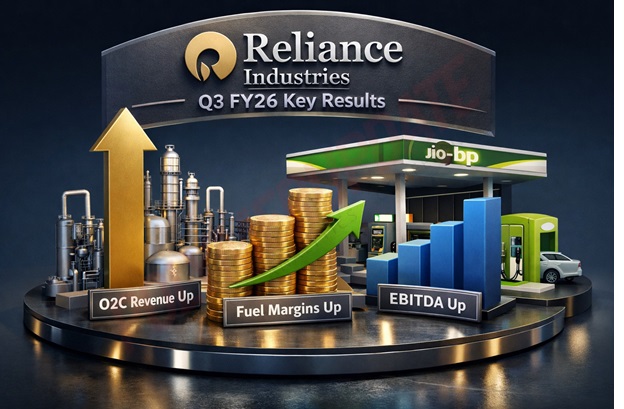 According to a company statement, RIL’s O2C segment revenue rose year-on-year (yoy) to Rs 162,095 crore (US$ 18 billion) in the October–December 2025 quarter, from Rs 149,595 crore in the comparable quarter of the previous year and Rs 160,558 crore in the preceding quarter. RIL reported a 1.2 percent contraction in exports to Rs 66,830 crore during the October–December 2025 quarter, compared with Rs 67,672 crore in the corresponding quarter last year and Rs 70,955 crore in the preceding quarter.
The company’s O2C earnings before interest, tax, depreciation, and amortisation (EBITDA) margin improved to 10.2 percent in the third quarter of FY 2025–26, from 9.6 percent in the comparable period last year and 9.3 percent in the July–September 2025 quarter. EBITDA for the period rose 14.6 percent yoy to Rs 16,507 crore (US$ 1.8 billion), up from Rs 14,402 crore in the October–December 2024 quarter and Rs 15,008 crore in the July–September 2025 quarter.
Higher EBITDA was attributed to a sharp increase in transportation fuel cracks and higher sulphur realisations, partially offset by weakness in downstream chemical margins and higher feedstock freight rates. Favourable ethane cracking economics and strong domestic market placements continued to support profitability.
Mukesh Ambani, Chairman and Managing Director of RIL, said, “Robust growth in the O2C business was led by significantly higher fuel margins, supported by favourable demand–supply dynamics and operational flexibility. I am happy to highlight the strong growth in our fuel retailing business, with the continued expansion of the Jio-bp network. Upstream segment EBITDA was impacted by lower volumes and prices.”
Operational efficiency
Mukesh Ambani-led Reliance Industries Ltd (RIL) reported total throughput of 20.6 million metric tonnes (MMT) in the third quarter of the current financial year, marking a 2 percent increase from 20.2 MMT in the corresponding period last year, but a marginal decline from 20.8 MMT recorded in the July–September 2025 quarter. Production meant for sale rose 1.7 percent year-on-year (yoy) to 18.2 MMT during the October–December 2025 period, compared with 17.9 MMT in the same period of the previous year and 18.1 MMT in the preceding quarter.
RIL reported cumulative throughput of 80.5 MMT and production meant for sale of 71.2 MMT for the April–December 2025 period, the company statement added. Fuel retailing operations under Jio-bp expanded the network by 14 percent yoy to 2,125 outlets, driving volume growth of 24.7 percent for high-speed diesel (HSD) and 20.8 percent for motor spirit (MS).
During the period, the company maximised refinery utilisation to capture higher margins. Agile crude sourcing helped RIL sustain throughput despite procurement challenges. It reported record gasifier output, while a calibrated liquid fuel mix and optimised grid power sourcing led to lower fuel costs. In addition, aromatics production was optimised due to low margins, with priority given to higher-value transportation fuel output. Freight costs were optimised through cargo aggregation, backhaul, and service-mix flexibility. The partial resumption of the Red Sea route also benefited operations.
Business environment
In the October–December 2025 quarter, global oil demand rose by 0.6 million barrels per day (bpd) year-on-year (yoy) to 104.7 million bpd. Jet/kerosene demand increased by 0.4 million bpd yoy, gasoline demand grew by 0.3 million bpd yoy, and diesel demand rose by 0.2 million bpd yoy. Dated Brent crude averaged US$ 63.7 a barrel during the October–December 2025 period, down US$ 11.1 a barrel, or 14.7 percent, yoy. Crude oil benchmarks declined on expectations of a potential oil supply surplus in 2026, driven by higher output from the Organisation of the Petroleum Exporting Countries and allies (OPEC+) and moderate demand growth.
China’s Strategic Petroleum Reserve (SPR) stock builds lent support to prices. Global refinery crude throughput increased by 0.84 million bpd yoy to 82.9 million bpd in the October–December 2025 quarter. Domestic oil demand grew by 2.2 percent yoy to 62.9 million metric tonnes (MMT), led by gasoline (+5.7 percent), gasoil (+3.2 percent), and jet/kerosene (+2.6 percent).
During the October–December 2025 quarter, domestic polymer demand rose by 2 percent yoy. Polypropylene (PP) demand increased by 8.4 percent, supported by the raffia, furniture, household goods, appliances, paints, automotive, hygiene, and medical sectors. Polyethylene (PE) demand grew by 3.8 percent yoy, driven primarily by the fast-moving consumer goods (FMCG), pharmaceutical, agrochemical, and multilayer films segments. Polyvinyl chloride (PVC) demand declined by 11.8 percent due to prolonged monsoon conditions, which impacted pipe demand in the agriculture and construction sectors.
On a yoy basis, domestic polyester demand declined by 3.8 percent. Polyester staple fibre (PSF) demand rose by 4.9 percent, supported by higher cotton prices that drove substitution towards man-made fibres and relatively lower imports from China. Meanwhile, polyester filament yarn (PFY) demand declined marginally by 0.8 percent due to weak downstream demand and higher PFY imports. Polyethylene terephthalate (PET) demand fell sharply by 15.3 percent, as prolonged heavy monsoons reduced operating rates in the beverage sector.
Consolidated revenue
RIL reported a 10 percent increase in consolidated gross revenue to Rs 293,829 crore in the October–December 2025 quarter, compared with Rs 267,186 crore in the corresponding period of the previous year and Rs 283,548 crore in the preceding quarter. Consolidated EBITDA rose by 6.1 percent to Rs 50,932 crore in the third quarter of FY 2025–26, up from Rs 48,003 crore in the same quarter last year and Rs 50,367 crore in the July–September 2025 quarter.
While profit before tax increased by 3.7 percent, profit after tax rose by a modest 1.7 percent to Rs 22,167 crore in the October–December 2025 quarter, compared with Rs 21,804 crore in the corresponding quarter of the previous year. Consolidated net profit stood at Rs 22,146 crore in the July–September 2025 quarter.
Mukesh Ambani said, “Reliance’s consolidated performance in the October–December 2025 quarter reflects consistent financial delivery and operational resilience across businesses. Jio’s digital ecosystem is deepening its roots in Indian households. Through our mobility and broadband products, we are connecting mobile phones, homes, appliances, and enterprises. The synergistic value delivered by our connectivity and media platforms has meaningfully increased customer engagement. During the quarter, Jio further expanded its subscriber base through attractive propositions enabled by its comprehensive, indigenous technology stack tailored for Indian markets. The business delivered a robust financial performance, with EBITDA growing by 16.4 percent.”
He added, “Our Retail business also had an eventful quarter, strengthening its portfolio with the onboarding of new brands and product ranges. The demerger of the consumer products business came into effect during the quarter. With a broad and diverse product basket ranging from classic Indian brands to new-age labels, the consumer products vertical is progressing on an accelerated growth trajectory under a focused organisational structure. Our deep omni-channel presence across the country and strong traction in hyperlocal quick deliveries supported a resilient performance by the Retail business.”
DILIP KUMAR JHA
Editor
dilip.jha@polymerupdate.com


