
Click the icon to add a specified price to your Dashboard list. This makes it easy to keep track on the prices that matter most to you.

Even as India’s concessional duty trade agreement with the United States faces inordinate delays, New Delhi’s advanced-stage trade deal under negotiation with the European Union (EU) is likely to be the “mother of all deals signed so far,” said Piyush Goyal, India’s Union Minister of Commerce and Industry. India’s proposed Free Trade Agreement (FTA) talks with the EU are at an advanced stage, with both sides expecting the final deal to be signed soon.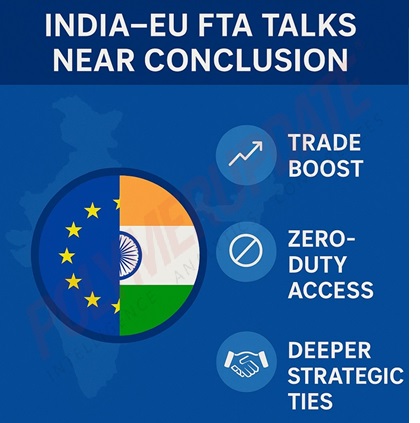 “I have done seven deals so far, all with developed economies. This one will be the mother of all. Even in areas of India’s interest, we are giving them a super deal. It has to be a win-win. The good part is that we do not compete with each other; we have different interests,” Goyal said.
Under the guidance of Prime Minister Narendra Modi, India has successfully negotiated FTAs with the United Arab Emirates (UAE), Australia, the four-nation European Free Trade Association, the United Kingdom, Oman, New Zealand, and Mauritius. Several others, including a Bilateral Trade Agreement (BTA) with the United States, are in the pipeline. Final-stage negotiations are underway, with European negotiators agreeing to exclude agriculture from the trade deal.
Goyal in Brussels
Goyal concluded a significant two-day visit to Brussels from January 8–9, 2026, marking a decisive step forward in the India–EU Free Trade Agreement (FTA) negotiations. In a series of high-level dialogues with the European Commissioner for Trade and Economic Security, Maroš Šefčovič, both leaders provided guidance to their negotiating teams to resolve pending issues and expedite the agreement.
The visit capped a week of intensive diplomatic and technical engagements in Brussels, underscoring the political resolve on both sides to deliver a comprehensive deal. The ministerial engagement was preceded by high-level discussions between Commerce Secretary Rajesh Agrawal and the Director-General for Trade at the European Commission, Ms Sabine Weyand, on January 6–7, 2026. These meetings focused on taking stock of progress achieved across various negotiating tracks. Officials worked to “narrow divergences” and ensure clarity on outstanding issues, thereby clearing the path for the ministerial dialogue.
During their engagement, Goyal and Commissioner Šefčovič held detailed deliberations across key areas of the proposed agreement. Both sides took note of steady progress across several negotiating tracks, including market access for goods, rules of origin, and services. The ministerial-level discussions reaffirmed the strong political resolve on both sides to address pending issues through constructive engagement. The visit concluded with both parties expressing confidence and renewed determination towards the early conclusion of a modern, comprehensive, and mutually beneficial agreement.
A decisive push
Goyal’s visit underscores the intensifying diplomatic and technical engagements between New Delhi and Brussels, signalling a decisive push towards concluding the India–EU Free Trade Agreement (FTA). The talks come at a historic juncture for India–EU economic relations. The negotiations were ambitiously relaunched in June 2022 after a hiatus of over nine years, reflecting a renewed mutual commitment to deepen economic integration. Since the resumption, the two sides have held 14 rounds of intensive negotiations and several high-level ministerial dialogues, with the latest interaction taking place in December 2025.
The European Union is currently India’s largest trading partner and a key investor, with bilateral trade in goods receiving a significant boost in the 2024–25 fiscal year. The agreement is envisioned not merely as a trade deal, but as a comprehensive partnership that addresses modern economic realities. The primary objective of these interactions is to provide strategic guidance to negotiating teams, resolve pending issues, and expedite the conclusion of a balanced and ambitious agreement.
Tangible benefits
A central pillar of India’s negotiation strategy, guided by the vision of Prime Minister Narendra Modi, is to secure an agreement that delivers tangible benefits for the common man. India is pushing for zero-duty access for its labour-intensive sectors, such as textiles, leather, apparel, gems and jewellery, and handicrafts.
Both India and the EU have expressed strong political resolve to deliver a comprehensive deal. The upcoming talks are expected to reaffirm the commitment of both sides to a rules-based trading framework and a modern economic partnership that safeguards the interests of farmers and MSMEs, while integrating Indian industries into global supply chains.
Significance of India-EU FTA
The India–EU Free Trade Agreement (FTA) is expected to boost bilateral trade, investment, and economic cooperation between the two economic blocs. The agreement aims to lower tariffs, streamline regulations, and provide greater market access, resulting in benefits such as increased exports for India and a more balanced supply chain for the European Union. The deal also holds significance for job creation, technology transfer, and serves as a strategic initiative enabling both partners to compete more effectively on the global stage.
Lower tariffs and reduced trade barriers are likely to make Indian goods more competitive in the EU market, thereby increasing exports and improving market access for Indian products. The agreement is projected to unlock billions of dollars in mutual income, stimulate gross domestic product (GDP) growth, and create employment opportunities in India, strengthening economic prospects for both sides. The FTA is also expected to encourage greater investment from European companies, thereby boosting foreign direct investment (FDI) inflows into India.
EU’s withdrawal of preferences
Furthermore, the FTA would help India regain a competitive edge following the withdrawal of its Generalized System of Preferences (GSP) benefits with the EU. For the European Union, India offers an attractive alternative for diversifying supply chains—a key strategic priority—while providing European producers access to India’s large and expanding consumer market. The agreement would also enable European companies to compete more effectively with rivals from the United States and China, reinforcing the EU’s strategic partnership with India, a like-minded democracy that supports rules-based trade and innovation.
The FTA is set to open new avenues for trade, investment, and deeper economic cooperation between India and the EU. It is also expected to foster joint ventures, technology partnerships, and collaborative innovation, while balancing the interests of producers, exporters, and consumers on both sides.
Bilateral trade
India has been the fastest-growing major economy in the world and remains an important trade partner for the European Union. The Indian government’s strong focus on sustained infrastructure expansion has made its secondary and tertiary industries more dynamic and growth-oriented. Consequently, infrastructure and allied sectors present immense opportunities for investment and participation in India’s economic growth. Global investors increasingly view India as a major market for both production and consumption, driven by its expanding population.
India’s bilateral trade with the EU has been progressing well, though significant potential remains for further acceleration. Bilateral merchandise trade has grown substantially, reaching US$ 136.53 billion, making the EU India’s largest trading partner in goods. Of this, India exported US$ 75.85 billion worth of goods and imported US$ 60.68 billion. Trade in services was also robust, reaching a record US$ 53 billion in 2023, with India exporting US$ 30 billion and importing US$ 23 billion.
DILIP KUMAR JHA
Editor
dilip.jha@polymerupdate.com


