
Click the icon to add a specified price to your Dashboard list. This makes it easy to keep track on the prices that matter most to you.

PolyCycl Pvt Ltd, an India-based deep-tech company that has developed technology for the chemical recycling of waste plastics, has received a Series A investment from Rainmatter, the climate- and sustainability-focused investment initiative of Zerodha. The investment will support the next phase of deployment of PolyCycl’s technology platform, which is focused on enabling plastic-to-plastic circularity for hard-to-recycle plastics.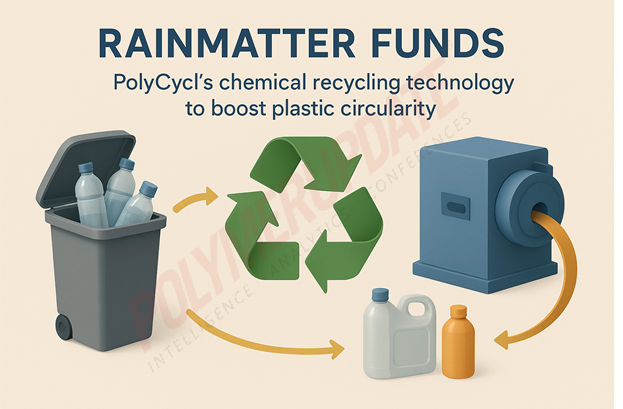 Developed over more than a decade of sustained research and development (R&D), PolyCycl’s fully continuous chemical recycling technology platform converts low-grade waste plastics, such as single-use polythene bags, into liquid hydrocarbon oils using a cost-effective, patented conversion process. These outputs are further refined through the company’s proprietary purification system and supplied to petrochemical and oil & gas companies, where they are used as feedstock for manufacturing a range of low-carbon materials, including new, food-grade virgin plastics.
Amit Tandon, Founder and Chief Executive Officer (CEO) of PolyCycl, said, “Chemical recycling is deep-tech by nature. Our focus has been on building technology that can operate reliably at industrial scale and integrate into circular petrochemical chains. Rainmatter’s investment strengthens our ability to move from technical maturity to wider deployment.” However, Tandon did not disclose funding details, including Rainmatter’s capital investment, stake acquisition, or PolyCycl’s future plans.
A strategic investment
Rainmatter’s financing forms part of PolyCycl’s ongoing capitalisation journey, which has followed a fiscally disciplined approach to deep-tech development, led by founder capital and selective strategic investments. The investment follows the launch of the company’s Generation VI technology platform in 2025. The platform has been validated through extended continuous operations and product pre-qualification by petrochemical majors, demonstrating technical maturity at Technology Readiness Level (TRL) 7 and readiness for scalable deployment.
Nithin Kamath, Founder of Zerodha and Rainmatter, said, “One of the things we have consistently pursued through Rainmatter is long-term solutions to problems we see around us. Plastics and the end-of-life processes associated with plastics need more teams working on them. PolyCycl is attempting to address this plastics problem, and we are excited to back the company.”
Abhinav Singh Negi, Business and Investments at Rainmatter by Zerodha, said, “We aim to back complex technologies that take time to build but have the potential to reshape entire sectors. PolyCycl fits this philosophy through its deep engineering focus and long-term intent. Platforms like this are essential to building credible circularity at scale. This collaboration brings together PolyCycl’s engineering-first approach with Rainmatter’s focus on intentional capital. What stood out for us was the depth of engineering maturity and the potential of the technology for both domestic and international licensing to meaningfully expand the recycling of hard-to-recycle plastics.”
Deployment of chemical technology
PolyCycl will use the investment to fast-track commercial deployments of its chemical recycling technology with industrial partners, strengthen its engineering and operational capabilities, and build execution teams to support scale-up and long-term licensing across domestic and global markets. The funding will also support efforts to deepen engagement with petrochemical and downstream manufacturing partners.
PolyCycl is an India-based, for-purpose company that has developed chemical recycling technology to convert contaminated and hard-to-recycle waste plastics into hydrocarbon oils. These oils are used as circular feedstocks by petrochemical and oil & gas companies to manufacture new virgin plastics, sustainable fuels, and renewable chemicals.
The company’s patented, fully continuous conversion architecture enables scalable deployment and capital-efficient projects, while supporting low operating costs and strong project economics. Engineered to work with real-world post-consumer waste streams, the technology is designed for both domestic and international licensing and to complement existing mechanical recycling and manufacturing infrastructure.
Plastic waste generation
In 2025, India faces a worsening plastic waste crisis, generating around 9.3 million tonnes annually. Projections show per capita plastic waste rising to 0.7 kg per day, yet significant mismanagement persists. However, new 2025 amendments to the Plastic Waste Management Rules aim to strengthen producer responsibility and promote a circular economy through enhanced Extended Producer Responsibility (EPR), digitalisation, and recycling mandates. Key challenges include overwhelmed landfills, low recycling rates, and severe environmental contamination from single-use plastics.
Only about 81 percent of plastic waste is collected, leaving nearly 19 percent unmanaged. Recycling rates vary but remain generally low, at around 30 percent in some estimates. To address these gaps, the revised rules introduce stronger EPR obligations, digital tracking mechanisms such as barcoding, and recycled-content mandates to improve accountability. A national push is also under way to promote mindful consumption, reduce single-use plastics, and encourage greater public participation in waste management.
Plastic waste clogs drains, chokes rivers, and pollutes oceans, leading to widespread microplastic contamination in food and water. Accumulated waste also contributes to respiratory and other health problems. India’s 2025 policy measures aim to shift towards a circular economy by treating plastic as a resource. However, achieving this transition will require scaling up effective waste management systems, accelerating adoption of advanced recycling technologies, and driving behavioural change alongside stricter regulatory enforcement.
DILIP KUMAR JHA
Editor
dilip.jha@polymerupdate.com


