
Click the icon to add a specified price to your Dashboard list. This makes it easy to keep track on the prices that matter most to you.

India’s chlorinated polyvinyl chloride (CPVC) industry plays a foundational role in enabling safe infrastructure, advanced safety systems, and emerging technologies. From fire suppression networks and hot-water plumbing to lithium-ion battery components and data centres, CPVC has become a critical material for sectors central to India’s industrial and technological ambitions, said Binay Agarwal, Business Head, TempRite IMEA, The Lubrizol Corporation.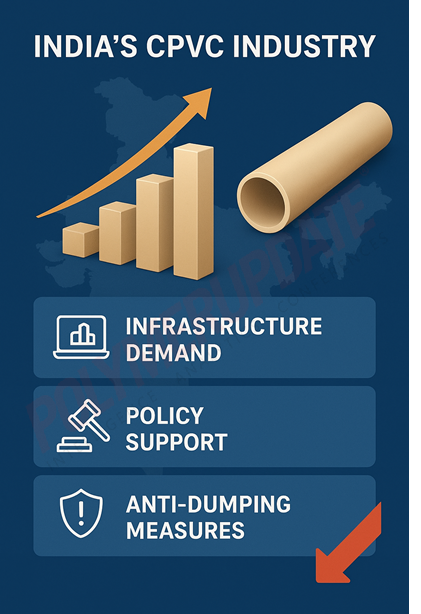 With CPVC demand increasing across construction, digital infrastructure, and electric mobility sectors, the industry has evolved from being a niche polymer market into a strategically important one. This expansion has, at the same time, highlighted a structural discrepancy: while consumption has grown rapidly, local manufacturing capacity has come under pressure from cheap imports in a technically advanced segment that requires long-term investment, stringent quality control, and deep process know-how.
Agarwal further added that government policy in recent years has increasingly emphasised self-reliance in chemicals and materials, particularly in areas where supply security and safety standards are critical. Within the broader Make in India and Atmanirbhar Bharat framework, CPVC has emerged as a material where building domestic capabilities carries both economic and strategic significance.
Progress of the industry
India has witnessed steady and sustained growth in CPVC manufacturing over the past few years, driven by rising demand from the housing, infrastructure, and sanitation sectors. Increased urbanisation, government-led initiatives such as housing and water supply projects, and a shift toward durable, corrosion-resistant piping systems have supported the expansion of domestic CPVC capacity.
Indian manufacturers have steadily enhanced their technological capabilities, improved quality standards, and increased backward integration, thereby reducing reliance on imports. As a result, the CPVC segment has emerged as a key contributor to the country’s plastic processing industry, strengthening India’s position as a competitive manufacturing hub while supporting long-term infrastructure development.
India’s CPVC production is rapidly moving away from import dependency, with significant capacity additions by companies such as Epigral, which now has around 75,000 tonnes per annum of resin capacity, and Meghmani Finechem. However, the industry still relies heavily on imported raw resin. Strong demand from the construction and infrastructure sectors has transformed India into the world’s largest CPVC market, with major domestic players entering production to curb imports and boost self-reliance.
The CPVC market is booming, driven by urbanisation, government infrastructure initiatives such as the Jal Jeevan Mission and AMRUT, and growing demand from plumbing applications across residential and commercial segments, as well as agriculture. The market is forecast to grow at a compounded annual growth rate (CAGR) of 10–12 percent. Companies such as Lubrizol, a pioneer in the segment, along with Astral, Supreme, Finolex, and Prince Pipes, dominate the market, with major players continuing to invest in local capacity. The imposition of anti-dumping duties by the Directorate General of Trade Remedies on CPVC imports from China and South Korea has further encouraged domestic production.
Anti-dumping measures and their impact
Concerns over injurious pricing of CPVC imports led to an anti-dumping investigation in 2019, followed by final findings and the imposition of anti-dumping duties (ADD) on imports from China and South Korea in 2020. In August 2024, following a sunset review, authorities extended these duties for a further five-year period. The extension covers both compounded CPVC and unprocessed CPVC resin.
The continuation of ADDs recognised that imports from these countries were being priced below domestic levels, causing material injury to Indian producers. For domestic manufacturers, these measures provided greater visibility and stability in a sector characterised by high capital intensity and long investment cycles. Following the imposition of duties, the industry witnessed increased confidence to expand capacity, localise compounding operations, and strengthen engagement with downstream users. At the same time, the effectiveness of these measures has been shaped by enforcement realities, which continue to influence market outcomes.
Circumvention risks and enforcement challenges
Despite the presence of ADDs, industry participants point to persistent challenges related to circumvention. One key concern is the rerouting of CPVC material through third countries and the misdeclaration of the country of origin to bypass applicable duties.
Multiple duty-free shipments have reportedly entered India from countries such as Japan and Malaysia, which industry participants contend are, in practice, of Chinese origin. Such practices dilute the intended impact of trade remedial measures, distort competitive dynamics, and weaken incentives for long-term domestic investment. These challenges are not unique to CPVC but reflect broader enforcement gaps across global chemical supply chains.
Inverted duty structures and value addition economics
Beyond anti-dumping measures, structural features of India’s tariff regime continue to affect the economics of domestic CPVC manufacturing. Raw material PVC attracts import duties ranging from 4 percent to 8 percent, while CPVC imports from Association of Southeast Asian Nations (ASEAN) countries can enter India at zero basic customs duty under existing trade agreements.
Under the ASEAN–India Free Trade Agreement (AIFTA), CPVC classified under HS 39049010 that meets rules of origin requirements benefits from zero basic customs duty and does not attract ADD. In contrast, Indian manufacturers importing suspension-grade PVC (HS 39041020) from non-ASEAN countries pay 7.5 percent basic customs duty (BCD), or 5 percent BCD when sourcing from ASEAN countries, before undertaking chlorination domestically.
This inversion results in a higher effective duty burden on raw materials than on finished CPVC imports. The structure weakens the economics of domestic value addition, compresses margins, and discourages incremental investment in CPVC capacity. Over time, it also risks incentivising the relocation of value-added processes to ASEAN markets and encourages the routing of non-ASEAN PVC or CPVC through ASEAN countries, unless origin enforcement is strengthened.
Investment, Technology, and Industry Response
India has already attracted meaningful commitments from global CPVC technology leaders that view the country as a long-term manufacturing and innovation base. Investments running into millions have been made to establish CPVC resin and compound manufacturing facilities in India, reflecting confidence in domestic demand and in the role of CPVC in critical infrastructure and advanced applications.
Lubrizol, a global specialty chemicals company with a long-standing presence in India, is among the participants that have invested in local CPVC manufacturing. Its facilities focus on producing CPVC resins and compounds for domestic consumption while maintaining global performance and safety benchmarks. Alongside manufacturing, companies such as Lubrizol have also invested in application engineering, system design support, and installer training, particularly in fire safety and building services, where performance depends on both material quality and correct installation.
These efforts illustrate how companies operating in the CPVC sector are responding to market and policy conditions by deepening localisation, improving operational efficiency, and strengthening downstream ecosystems, rather than relying solely on trade protection.
Towards a resilient domestic CPVC ecosystem
As CPVC demand continues to grow across fire safety, data centres, and the electric vehicle (EV) value chain, the importance of a resilient domestic supply base is becoming increasingly evident. Effective enforcement of existing anti-dumping measures, vigilance against circumvention, and alignment of tariff structures with the objective of promoting domestic value addition remain central to the sector’s development.
For companies such as Lubrizol and other participants in India’s CPVC industry, long-term engagement is shaped by the ability to operate within a fair and predictable trade environment while continuing to invest in technology, quality, and skills. Strengthening the CPVC ecosystem will not only support sustainable growth in specialty chemicals but also reinforce India’s broader ambition of building globally competitive, technology-driven manufacturing capabilities.
DILIP KUMAR JHA
Editor
dilip.jha@polymerupdate.com


