Click the icon to add a specified price to your Dashboard list. This makes it easy to keep track on the prices that matter most to you.

India has launched seven additional export interventions on Friday for micro, small and medium enterprises (MSMEs) to boost merchandise shipments amid an uncertain global demand environment and geopolitical turbulence. The interventions were triggered by the need to stabilise exports in recent months, as India’s shipments were affected by a hefty 50 percent tariff (25 percent reciprocal and 25 percent penal for purchasing crude oil from Russia) imposed by US President Donald Trump, in addition to multiple Western restrictions on New Delhi for purchasing Russian crude oil.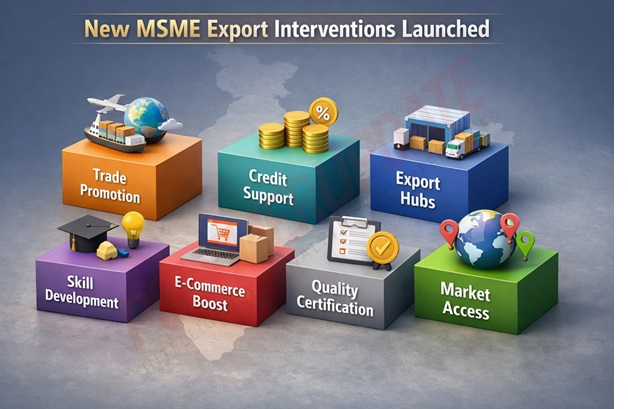 Of the seven measures, three interventions — Support for Alternative Trade Instruments (Export Factoring), Credit Assistance for E-Commerce Exporters, and Support for Emerging Export Opportunities — were launched under the ‘Niryat Protsahan’ (export promotion) initiative. Four others — Trade Regulations, Accreditation & Compliance Enablement (TRACE); Facilitating Logistics, Overseas Warehousing & Fulfilment (FLOW); Logistics Interventions for Freight & Transport (LIFT); and Integrated Support for Trade Intelligence & Facilitation (INSIGHT) — were introduced under the ‘Niryat Disha’ (export direction) scheme.
Welcoming the interventions, S. C. Ralhan, President of the Federation of Indian Export Organisations (FIEO), said, “The mission addresses the fundamental constraints that limit MSME export growth — high cost of credit, limited access to diversified trade finance, compliance burdens, logistics inefficiencies, and information gaps. The newly launched interventions under ‘Niryat Protsahan’ and ‘Niryat Disha’ aim to move beyond traditional incentives and focus on systemic competitiveness enhancement.”
Niryat Protsahan interventions
Support for Alternative Trade Instruments (Export Factoring) — This intervention promotes export factoring as an affordable working capital solution for MSMEs. An interest subvention of 2.75 percent will be provided on the factoring cost for eligible transactions undertaken through RBI/IFSCA-recognised entities. Assistance is capped at Rs 50 lakh per MSME annually and will be processed through a digital claims mechanism to ensure transparency and timely disbursal.
Credit Assistance for E-Commerce Exporters — To support exporters using digital channels, structured credit facilities are being introduced, with interest subvention and partial credit guarantees. The Direct E-Commerce Credit Facility will provide support of up to Rs 50 lakh with 90 percent guarantee coverage. The Overseas Inventory Credit Facility will extend support of up to Rs 5 crore with 75 percent guarantee coverage. An interest subvention of 2.75 percent will be available, subject to an annual ceiling of Rs 15 lakh per applicant.
Support for Emerging Export Opportunities — This intervention enables exporters to access new or high-risk markets through various shared-risk and credit instruments. These structured mechanisms aim to strengthen exporter confidence and liquidity flows.
Niryat Disha interventions
Trade Regulations, Accreditation & Compliance Enablement (TRACE) — TRACE supports exporters in meeting international testing, inspection, certification, and other conformity requirements. Partial reimbursement of 60 percent under the Positive List and 75 percent under the Priority Positive List will be provided for eligible testing, inspection, and certification expenses, subject to an annual ceiling of Rs 25 lakh per IEC.
Facilitating Logistics, Overseas Warehousing & Fulfilment (FLOW) — FLOW supports exporters in accessing overseas warehousing and fulfilment infrastructure, including e-commerce export hubs integrated with global distribution networks. Assistance of up to 30 percent of the approved project cost will be provided for a maximum of three years, subject to prescribed ceilings and MSME participation norms.
Logistics Interventions for Freight & Transport (LIFT) — LIFT mitigates geographical disadvantages faced by exporters in low export-intensity districts. Partial reimbursement of up to 30 percent of eligible freight expenditure will be provided, subject to a ceiling of Rs 20 lakh per IEC per financial year.
Integrated Support for Trade Intelligence & Facilitation (INSIGHT) — INSIGHT strengthens exporter capacity building, district- and cluster-level facilitation under the Districts as Export Hubs initiative, and the development of trade intelligence systems. Financial assistance is up to 50 percent of the project cost, with up to 100 percent support for proposals from Central and State government institutions and Indian missions abroad, subject to notified ceilings.
Addressing structural constraints
The newly launched interventions aim to address structural constraints faced by MSMEs, including the high cost of capital, limited access to diversified trade finance instruments, compliance burdens in international markets, logistics disadvantages, and barriers to market entry.
These additional interventions were launched under the Export Promotion Mission (EPM), a flagship initiative of the Department of Commerce, aimed at empowering MSMEs for global markets. The interventions are designed to address key challenges faced by Indian exporters, promote broad-based and inclusive export growth, and strengthen India’s position as a globally competitive export powerhouse, said Union Minister of Commerce and Industry Piyush Goyal. Union Commerce Secretary Rajesh Agarwal also graced the occasion.
Through these coordinated financial and ecosystem interventions, the government aims to reduce the cost of capital, diversify trade finance instruments, enhance compliance readiness, address logistics constraints, and strengthen overseas market integration for MSMEs. Three interventions — Market Access Support, Interest Subvention for Pre- and Post-Shipment Export Credit, and Collateral Support for Export Credit — are already under implementation. With this launch, 10 out of the 11 proposed interventions under the EPM are now operational.
Growth leadership
The minister highlighted India’s growing leadership in emerging technologies and global partnerships. Referring to the recently concluded AI Summit, he commended Prime Minister Narendra Modi and the concerned ministers for positioning India at the centre of global conversations on artificial intelligence and future technologies. Goyal stated that advancements in artificial intelligence, machine learning, quantum computing, data centres, and indigenous large language models would open significant opportunities for India’s youth and catalyse investments across sectors.
India’s expanding network of Free Trade Agreements (FTAs) has significantly enhanced market access for Indian exporters. Nearly 70 percent of global gross domestic product (GDP) and two-thirds of global trade are now accessible to India through nine concluded FTAs, including the first tranche of the Bilateral Trade Agreement (BTA) with the United States. These agreements provide preferential access across sectors in 38 developed and emerging economies.
Stabilising exports
Data compiled by the Union Ministry of Commerce and Industry showed that India’s merchandise exports stood at US$ 36.56 billion in January 2026, almost similar to US$ 36.34 billion recorded in the corresponding month of the previous year. Meanwhile, the country’s services exports jumped to US$ 43.90 billion in January 2026, an increase of over 26 percent from US$ 34.75 billion registered in January 2025. India’s overall exports during the period rose by 6.15 percent to US$ 720.76 billion, compared with US$ 679.02 billion in the corresponding period of the previous fiscal. Merchandise exports reached US$ 366.63 billion, registering growth of 2.2 percent over US$ 358.75 billion recorded in April–January 2024–25.
The interventions launched today are aimed at extending the benefits of global trade to every MSME, startup, and entrepreneur. The Export Promotion Mission is intended to promote new products, services, and exporters, while enabling Indian businesses to access new markets. The EPM seeks to simplify processes for MSMEs, strengthen access to credit, enhance quality standards, support compliance with international regulations, and expand global logistics and warehousing infrastructure. Initiatives such as overseas warehousing, including Bharat Mart in Dubai, are intended to provide Indian exporters with strategic access to markets across the GCC, Africa, Central Asia, and Europe.
DILIP KUMAR JHA
Editor
dilip.jha@polymerupdate.com