Click the icon to add a specified price to your Dashboard list. This makes it easy to keep track on the prices that matter most to you.

The wide-scale adoption of AI (Artificial Intelligence) and AI-based applications holds unprecedented potential to drive economic and social development. Open-source AI applications and other accessible AI approaches, where appropriate, along with the broad diffusion of AI use cases, can enhance the scalability, replicability, and adaptability of AI systems across sectors, according to the New Delhi Declaration adopted at the AI Impact Summit 2026, held at the historic Bharat Mandapam in New Delhi on February 18–19, 2026.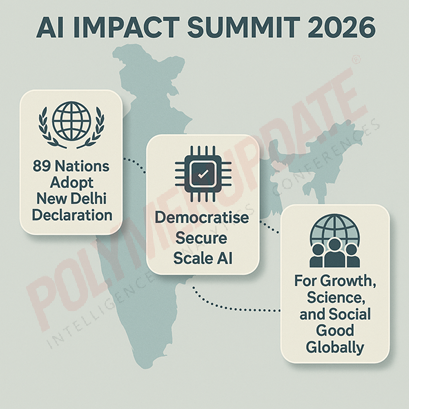 The event was attended by Emmanuel Macron, President of France, as the Chief Guest, along with several industrialists and top executives from leading global technology firms, including Sundar Pichai, Chief Executive Officer of Google; Mukesh Ambani, Chairman and Managing Director of Reliance Industries Ltd; and Gautam Adani, Chairperson of the Adani Group. Many of these executives identified Asia as a major driver of AI growth and announced significant investments to capitalise on emerging opportunities and expand their market presence.
The Declaration was endorsed by 89 countries and international organisations, reflecting broad global consensus on leveraging AI for economic growth and social good. The advent of AI marks an inflection point in the trajectory of technological evolution, and the choices made today will shape the AI-enabled world inherited by future generations. Complementing existing international initiatives, the Declaration seeks to foster a shared understanding — while respecting national sovereignty — of how AI can be harnessed to serve humanity, drawing on initiatives across the seven “Chakras” (pillars) of the Summit.
Guided by the principle of “Sarvajan Hitaya, Sarvajan Sukhaya” (Welfare for All, Happiness for All), the Declaration underscores that the benefits of AI must be equitably shared across humanity. It emphasises strengthening international cooperation and multi-stakeholder engagement, respecting national sovereignty, and advancing AI through accessible and trustworthy frameworks. The Declaration is structured around seven Chakras (key pillars), which form the foundation of global AI cooperation: Democratizing AI Resources; Economic Growth and Social Good; Secure and Trusted AI; AI for Science; Access for Social Empowerment; Human Capital Development; and Resilient, Efficient and Innovative AI Systems.
Democratizing AI Resources
Robust digital infrastructure, along with meaningful and affordable connectivity, is a prerequisite for deploying AI and unlocking its full potential. Inspired by the principle of “Vasudhaiva Kutumbakam” (the world is one family), the importance of enhancing the affordability of and access to AI resources is recognised, as these are critical to enabling all countries to develop, adopt, and deploy AI for the benefit of their citizens.
In this regard, note has been taken of the Charter for the Democratic Diffusion of AI as a voluntary and non-binding framework aimed at promoting access to foundational AI resources, supporting locally relevant innovation, and strengthening resilient AI ecosystems, while respecting national laws.
Secure and Trusted AI
Advancing secure, trustworthy, and robust AI is fundamental to building trust and maximising societal and economic benefits. Noting that deepening human understanding of potential security risks remains important, the Declaration recognised the significance of security in AI systems, industry-led voluntary measures, the adoption of technical solutions, and appropriate policy frameworks that enable innovation while promoting the public interest throughout the AI lifecycle.
The Declaration also recognised the development of the voluntary and non-binding Trusted AI Commons — a collaborative platform that consolidates technical resources, tools, benchmarks, and best practices that stakeholders can access and adapt to their respective contexts — along with its accompanying voluntary guidance note.
Science
Removing structural barriers to, and increasing the availability of, AI research infrastructure can promote the use of AI in scientific research and development across countries. International scientific collaborations can unlock AI’s full potential in research and development by bringing together diverse expertise, perspectives, and resources. The Declaration noted the great significance of the voluntary and collaborative International Network of AI for Science Institutions as a platform to connect scientific communities and pool AI research capabilities across regions among participating institutions, with the aim of accelerating the impactful adoption of AI.
AI holds the potential to uplift all sections of society by enabling individuals to access knowledge, cross-border AI solutions, information, services, and opportunities, while enhancing participation in social and economic activities. The Declaration recognises the importance of collaborations that facilitate AI adoption for social empowerment. The development of a voluntary and collaborative platform is therefore considered important to enable the exchange of learning, knowledge, and scalable best practices to advance AI adoption for social empowerment.
Human capital
Realising the full promise of AI requires equipping individuals with relevant skills by expanding AI-focused human resource development. This includes targeted initiatives in education, AI workforce development, training of public officials, enhancing public awareness of AI capabilities, increasing AI literacy, and upgrading vocational education and training ecosystems.
While encouraging international collaboration on meaningful AI skilling and reskilling initiatives, the Declaration takes note of the voluntary guiding principles for reskilling in the age of AI and the playbook on AI workforce development, which aim to support stakeholders in preparing for a future AI-driven economy.
Resilience, Innovation, and Efficiency
Recognising the growing demands of AI on energy, infrastructure, and natural resources, the Declaration underscored the importance of developing energy-efficient AI systems. Affordable AI systems can expand access to AI and accelerate local innovation, thereby advancing shared developmental aspirations.
The Voluntary Guiding Principles on Resilient, Innovative, and Efficient Artificial Intelligence are intended to guide the development of resilient and efficient AI systems. Meanwhile, the Playbook on Advancing Resilient AI Infrastructure serves as a knowledge resource and may act as a reference to support resilient AI development.
Conclusion
The AI Impact Summit contributed to strengthening international cooperation and a multi-stakeholder approach to advancing shared priorities, as well as voluntary and non-binding guidelines and principles that can promote the responsible use of AI to ensure a prosperous future for humanity.
Participants remained committed to advancing their shared aspirations to realise the benefits of AI and expressed their intention to continue cooperating to translate these aspirations into concrete actions aligned with the three Sutras of the India AI Impact Summit 2026.
DILIP KUMAR JHA
Editor
dilip.jha@polymerupdate.com