Click the icon to add a specified price to your Dashboard list. This makes it easy to keep track on the prices that matter most to you.

India has revised its Plastic Waste Management Rules, introducing a more flexible regulatory framework aimed at bringing a larger number of businesses into the compliance net. The updated provisions relax penalty norms for companies that fall short of their recycling targets for the financial year 2025–26, allowing them to carry forward the deficit for up to three years. However, firms are required to progressively bridge the gap by clearing at least one-third of the shortfall annually, ensuring a phased path toward full compliance while easing immediate financial and operational pressures.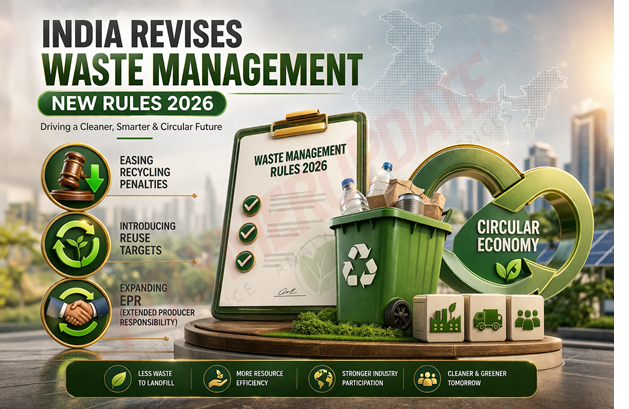 First introduced in 2016, the Plastic Waste Management Rules have undergone periodic amendments, with the latest notified on March 31, 2026. The revised framework seeks to strengthen the circular economy by mandating recycled content in rigid plastic packaging in the range of 30–60 percent by 2028–29. It also, for the first time, introduces mandatory reuse targets for rigid packaging, while retaining flexibility by allowing companies to carry forward compliance shortfalls for up to three years.
Recycling targets
The 2026 amendment retains a phased framework for recycled content and reuse targets in plastic packaging, continuing the trajectory initiated under the Extended Producer Responsibility (EPR) framework (2022), which, for the first time, introduced collection targets for producers, importers, and brand owners (PIBOs). For 2025–26, rigid plastic packaging (Category I) must contain at least 30 percent recycled material, rising to 60 percent by 2028–29.
Flexible plastics (Category II) are required to have 10 percent recycled content, increasing to 20 percent, while multi-layered plastics (Category III) must meet 5 percent, rising to 10 percent. Additionally, reuse targets for rigid packaging have been mandated, including 10 percent for small containers (0.9–4.9 litres), 70 percent for large water packaging, and 10 percent for large non-water packaging, with gradual increases over time. Notably, this marks the first time that explicit reuse targets for rigid plastic packaging have been introduced.
EPR obligations
The Plastic Waste Management Rules, 2026, expand the ambit of Extended Producer Responsibility (EPR) by bringing raw material suppliers under the compliance framework, thereby extending accountability across the plastics value chain. The revised rules also introduce a mandatory, digital, and verifiable tracking mechanism aimed at improving transparency and ensuring accurate reporting of recycling activities. This is expected to reduce discrepancies in compliance data while strengthening monitoring and enforcement.
The updated framework further strengthens EPR obligations by mandating reuse targets for rigid plastic packaging, signalling a shift from a purely recycling-centric approach to a more circular model. Distinct and clearly defined targets for reuse have been set alongside existing recycling requirements, pushing stakeholders to adopt more sustainable packaging practices and invest in systems that enable repeated use.
Tradable certificate system
The rules institutionalise a tradable credit mechanism that allows companies to meet their recycling obligations by purchasing certificates from entities that have exceeded their targets. While this system provides flexibility and helps reduce compliance costs, it also enables firms to offset shortfalls without directly recycling their own plastic waste. Concerns over the integrity of the mechanism have emerged, with the Central Pollution Control Board identifying over 600,000 fake certificates in 2023. The framework also includes exemptions in cases where other regulations restrict the use of recycled plastics—such as those issued by the Food Safety and Standards Authority of India (FSSAI)—potentially excluding large segments of the food and beverage packaging sector.
Compliance is monitored through a centralised EPR portal under the supervision of the Central Pollution Control Board, which oversees tracking, reporting, and enforcement. The rules mandate that companies collect and process 100 percent of the plastic they introduce into the market by 2024–25, marking the final phase of EPR implementation. However, there is limited publicly available evidence of full compliance, as reporting largely relies on self-declared data submitted through the portal, with no comprehensive system-wide verification in place.
According to the Environment Ministry, recycling levels have improved significantly under the EPR regime, but full coverage remains elusive. Since 2022, more than 20.7 million tonnes of plastic waste have reportedly been recycled; however, annual plastic waste generation continues to remain elevated at around 4.13 million tonnes (2022–23), underscoring the gap between targets and actual outcomes. India also implemented a nationwide ban on select single-use plastic items in 2022 as part of its broader waste management strategy.
Plastic waste categories under the rules are defined based on recyclability. Category I (rigid plastics), including High-Density Polyethylene (HDPE) and Polyethylene Terephthalate (PET) containers, are the easiest to collect and recycle. Category II (flexible plastics), such as carry bags and snack wrappers, present moderate challenges, while Category III (multi-layered plastics), including Tetra Pak cartons and foil-based packaging, are the most difficult to recycle due to their complex composition.
Added provisions
Under the amended rules, the definition of “sellers” has been expanded to include producers of raw materials such as resins and pellets, thereby widening accountability across the plastics value chain. The framework also introduces independent, Registered Environment Auditors to verify compliance, reducing reliance on self-reporting. For non-recyclable plastics, the end-of-life provisions promote energy recovery options, including co-processing in cement and steel industries, waste-to-oil technologies, and use in road construction. In addition, products made from recycled plastics are required to comply with applicable Indian Standard norms for labelling.
The amended rules prescribe stringent penalties for non-compliance, ranging from Rs 10,000 to Rs 15,00,000, along with the possibility of suspension of registration. Compliance will be monitored through a centralised EPR portal to ensure tracking and enforcement. The framework also provides exemptions in cases where the use of recycled materials is restricted under other regulations, including specific applications in food, pharmaceutical, and pesticide packaging.
DILIP KUMAR JHA
Editor
dilip.jha@polymerupdate.com