Crude oil prices tumbled sharply so far this week, shedding nearly US$ 20 a barrel as easing geopolitical tensions between the United States and Iran triggered a swift reassessment of risk across energy markets. The decline followed Washington’s announcement of a temporary two-week pause in hostilities, which helped calm investor sentiment and unwind a significant portion of the risk premium built into crude. Benchmark prices, including Brent, moved lower on April 8 as traders reacted to the prospect of reduced immediate supply disruptions.
However, the relief may prove fleeting. Market participants remain wary of underlying structural challenges that continue to cloud the outlook for global energy supply. Analysts caution that while the truce has offered short-term stability, unresolved geopolitical frictions and persistent vulnerabilities in key supply routes could quickly reignite volatility, keeping oil markets highly sensitive to fresh developments.
Dharmakirti Joshi, Chief Economist, Crisil, said, “Asia-Pacific is the most exposed to the energy shock in West Asia. In Asia, while tech-driven export demand and resilient domestic activity support growth, the region faces intensifying pressure from the ongoing conflict in West Asia, rising energy prices and the shifting US tariff policy. Since many Asian countries are major net energy importers, relying heavily on supplies from West Asia, higher energy prices erode purchasing power and weaken domestic demand. The vulnerable ones include India, Indonesia, Japan, Malaysia and Thailand.”
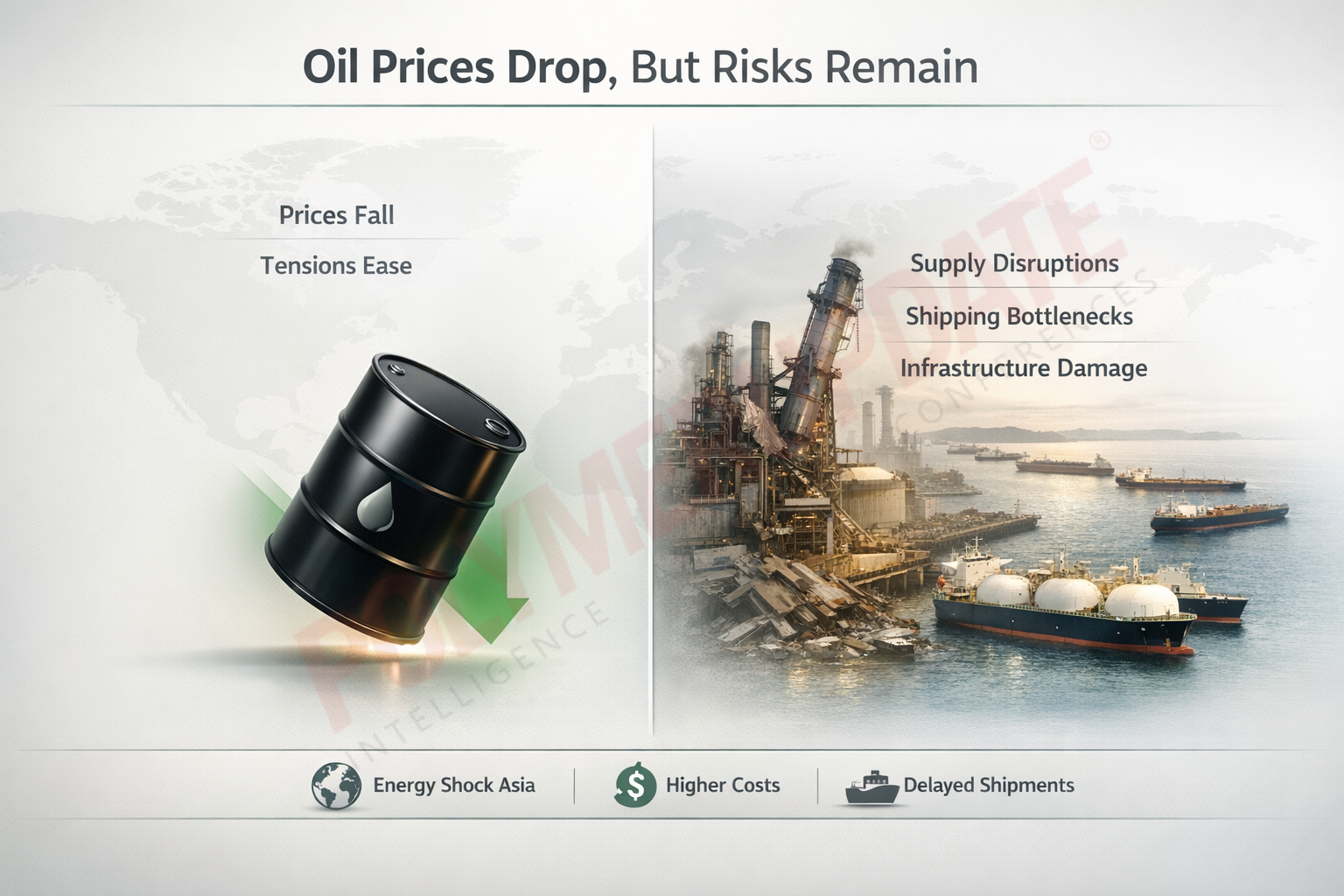 Unseen underlying damage
Although the sharp price decline dominated headlines, the situation on the ground presents a far more complex picture. The recent conflict has inflicted notable damage on critical energy infrastructure, including pipelines, storage facilities, and export terminals. In several instances, logistical bottlenecks have emerged as transport routes faced disruptions, delaying shipments and complicating supply chains across key producing regions.
These disruptions are not easily or quickly reversible. Repairing damaged infrastructure requires time, resources, and, importantly, sustained stability—something that remains uncertain given the fragile nature of the current truce. Even where physical damage is limited, heightened security risks and operational uncertainties continue to hinder normal activity, preventing a swift return to pre-conflict supply levels.
As a result, the apparent easing in prices may not fully reflect the underlying supply risks still embedded in the system. Market participants are increasingly aware that while sentiment can shift rapidly on diplomatic signals, the physical realities of energy production and distribution tend to adjust much more slowly. This disconnect suggests that volatility could resurface if disruptions persist or escalate, keeping the broader energy outlook cautiously balanced.
Critical shipping concernsShipping bottlenecks have emerged as a critical concern in the wake of recent geopolitical tensions, particularly around the Strait of Hormuz—one of the world’s most vital arteries for crude oil transit. Current estimates suggest that the passage is operating at barely 10 percent of its typical throughput, severely constraining the movement of oil from key producers in the Gulf to global markets. This sharp reduction has disrupted established trade flows and forced market participants to reassess supply availability despite the recent easing in headline tensions.
The slowdown is being driven by a combination of heightened security risks, stricter naval monitoring, and reluctance among shipping operators to navigate the region amid lingering uncertainties. Insurance premiums for vessels transiting the corridor have surged, while some tanker operators are opting to delay or reroute shipments altogether. These logistical frictions are compounding supply-side challenges, creating a mismatch between available production and actual deliverable supply in international markets.
As a result, the constrained throughput at this critical chokepoint continues to cast a long shadow over the energy outlook. Even if diplomatic efforts help sustain a temporary calm, the normalization of shipping activity is likely to take time, as confidence among shippers and insurers gradually rebuilds. Until then, the bottleneck at the Strait of Hormuz remains a key risk factor, with the potential to trigger fresh volatility in oil prices should conditions deteriorate further.
Production disruptionsProduction and refining disruptions continue to weigh heavily on the global energy balance, underscoring the deeper impact of the recent conflict. Global crude output is estimated to be trailing pre-conflict levels by nearly 7.7 million barrels per day, reflecting both direct supply interruptions and precautionary cutbacks by producers amid ongoing uncertainty. The shortfall highlights how quickly geopolitical tensions can translate into substantial losses in available supply.
At the same time, downstream constraints are compounding the imbalance. Around 1.6 million barrels per day of refining capacity in the affected region remains offline due to damage, maintenance challenges, and operational risks. This has created a bottleneck in processing crude into usable fuels, tightening availability in key product markets even where crude supply may still be accessible.
Together, the production and refining setbacks are amplifying stress across the energy value chain. While headline prices have softened on easing tensions, the underlying supply-demand dynamics remain fragile. The persistence of these disruptions suggests that any recovery in output and refining activity will likely be gradual, leaving markets exposed to renewed volatility if conditions fail to stabilize.
LNG headwindsLiquefied natural gas (LNG) markets are facing their own set of disruptions, adding another layer of strain to the global energy system. Shipments are currently caught in a state of limbo, with an estimated 1.15 million metric tons of LNG stranded aboard tankers near key Gulf export hubs. The backlog reflects the growing difficulty in coordinating cargo movements amid heightened geopolitical risks and logistical uncertainties.
The gridlock is being driven by a combination of delayed clearances, port congestion, and cautious navigation decisions by shipping operators. With security concerns still elevated, many vessels are opting to wait offshore rather than risk transit through sensitive routes, leading to a buildup of floating storage. This has disrupted delivery schedules and created uncertainty for buyers relying on timely cargo arrivals, particularly in energy-dependent regions.
As a result, the LNG bottleneck is tightening near-term supply availability even as cargoes technically remain within the system. The accumulation of idle shipments underscores the disconnect between production and deliverability, reinforcing the fragile state of global energy logistics. Until these vessels can safely resume transit and discharge, the gridlock is likely to persist, contributing to continued volatility across gas and broader energy markets.
Longering uncertaintyUncertainty continues to play a central role in shaping energy market costs, even as the ceasefire offers temporary relief. Risk premiums linked to the conflict remain firmly embedded, keeping shipping expenses elevated at roughly 1.5 times pre-conflict levels. Adding to these pressures, Tehran’s proposal to impose a US$ 2 million transit fee per vessel through the Strait of Hormuz has heightened concerns among traders and shipping companies, raising the prospect of structurally higher costs for maritime energy flows.
Gas markets, meanwhile, are sending mixed signals in response to the evolving situation. Spot LNG prices in Asia have eased by around 9 percent following the truce announcement, reflecting improved short-term sentiment. In contrast, Europe’s benchmark gas prices remain volatile after approaching US$ 17 per MMBtu, underscoring the region’s continued sensitivity to supply risks. This divergence highlights how, despite a cooling in immediate tensions, uncertainty continues to ripple across global energy markets.
The path to normalization in global energy logistics is likely to be gradual, with one of the most immediate challenges being the clearance of vessel backlogs near key transit routes such as the Strait of Hormuz. Currently, close to 500 ships remain delayed in and around the corridor, reflecting the scale of disruption caused by recent tensions. This congestion continues to hinder the smooth flow of crude and related energy shipments even as diplomatic efforts attempt to stabilize the situation.
Even if traffic begins to improve in the near term, the unwinding of this backlog will take time. Analysts suggest that it could be as late as the end of April before congestion levels ease fully and shipping schedules return to normal. Until then, the lingering delays are expected to keep supply chains strained, reinforcing short-term uncertainties and prolonging volatility across global energy markets.
OutlookThe recent decline in oil prices largely reflects a wave of short-term optimism among traders, driven by easing geopolitical tensions and expectations of improved supply conditions. However, the extent of physical damage to energy infrastructure across key producers in the Gulf region indicates that a full return to normalcy remains some distance away. In essence, while tensions may have temporarily subsided, the energy sector continues to grapple with deeper, longer-lasting disruptions—serving as a reminder that restoring price stability is far easier than rebuilding critical systems and supply chains.
DILIP KUMAR JHA
Editor
dilip.jha@polymerupdate.com