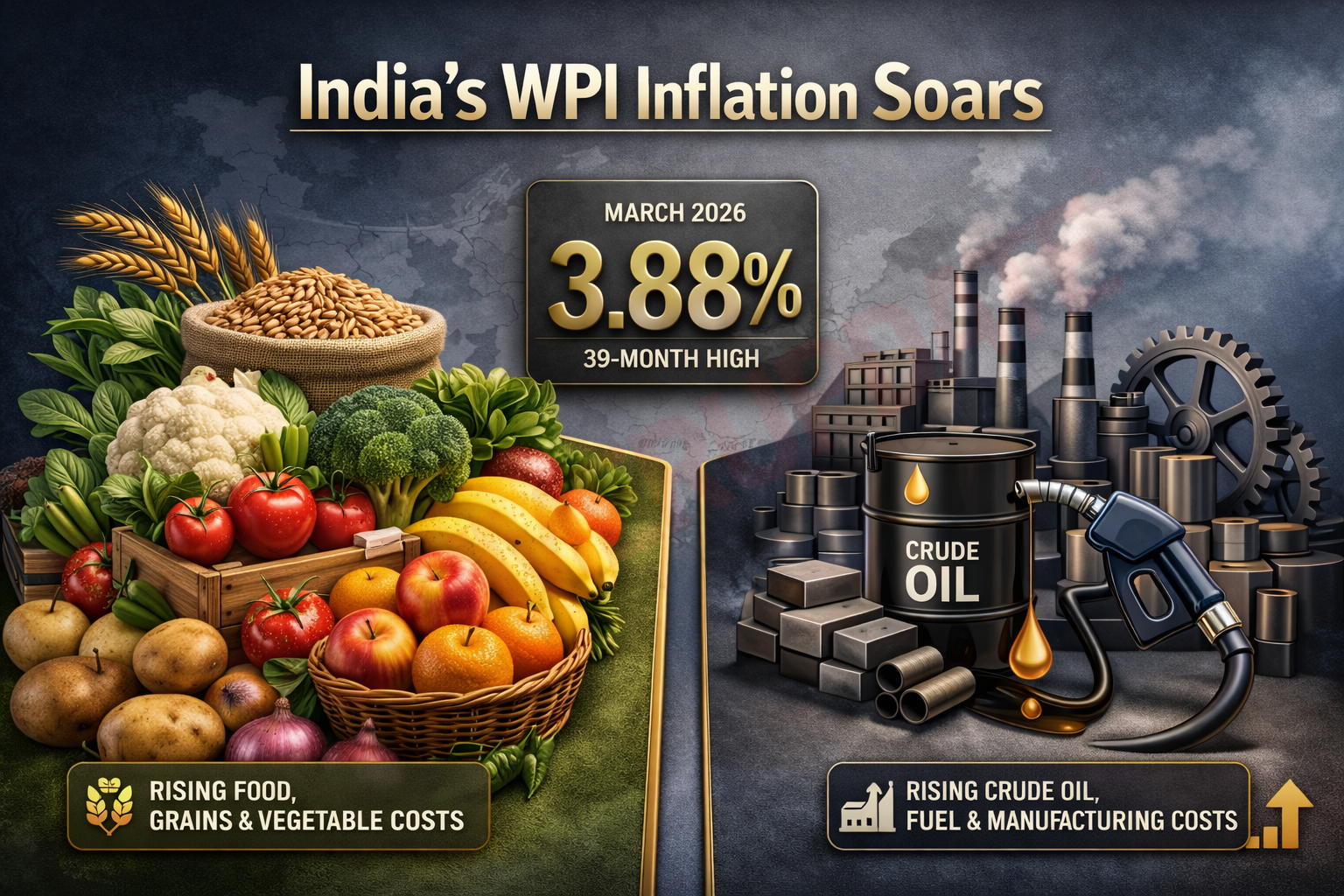
India’s wholesale inflation, measured by the Wholesale Price Index (WPI), rose the highest in 39 months to 3.88 percent in March, driven by soaring crude oil prices and their direct impact on transportation fuels and, subsequently, underlying products. The increase was largely led by a sharp rise in prices of fuel, power, and manufactured goods amid the ongoing crisis in West Asia. This marks a notable jump from 2.13 percent in February 2026 and 2.25 percent in March 2025.
A statement from the Ministry of Commerce & Industry said, “The annual rate of inflation based on the All India Wholesale Price Index (WPI) is 3.88 percent (provisional) for the month of March 2026 (over March 2025). The positive rate of inflation in March 2026 is primarily due to an increase in prices of crude petroleum and natural gas, other manufacturing, non-food articles, basic metals, and food articles. The month-on-month change in WPI for March 2026 stood at 1.64 percent, compared to February 2026.”
Rahul Agrawal, Senior Economist at ICRA Ltd, commented, “WPI inflation nearly doubled to a 38-month high of 3.88 percent in March 2026, up from 2.1 percent in February 2026, and was broadly in line with expectations of around 4 percent. While the uptick was broad-based, crude petroleum and natural gas, along with the fuel and power groups, witnessed a sizable hardening in their year-on-year inflation rates, reflecting the surge in global energy prices amid the West Asia crisis. Notably, these two groups together accounted for 150 basis points of the 175 basis points increase in the headline print in March 2026 compared to February 2026.”
 Marginal decline in food inflation
With an overall weight of 24.38 percent, the Food Index—comprising ‘Food Articles’ from the Primary Articles group and ‘Food Products’ from the Manufactured Products group—marginally decreased from 192.9 in February 2026 to 192.8 in March 2026. The year-on-year rate of inflation based on the WPI Food Index remained unchanged at 1.85 percent in March 2026. Bulk prices of cereals declined by 2.51 percent, while those of wheat and pulses fell by 4.6 percent and 5.17 percent, respectively. Potato prices in wholesale mandis crashed by a staggering 28 percent, while onion prices plunged by a steep 42.11 percent.
Prices of vegetables, however, recorded a marginal increase of 1.45 percent in March 2026, compared with a 15 percent decline in the corresponding month of the previous year. The WPI, also considered headline inflation, captures the rate at which wholesale prices of selected goods increase over time. The latest WPI data comes days after separate figures showed retail inflation at 3.4 percent in March 2026, up from 3.21 percent in February.
Madan Sabnavis, Chief Economist at Bank of Baroda, said, “The WPI inflation trajectory is more indicative of the impact of the war than Consumer Price Index (CPI)-based retail inflation, as considerable buffering is done in the latter, especially on the fuel side. That said, the rising trend in WPI is on expected lines and is likely to continue in the coming months due to both base effects and price increases across segments. WPI inflation at 3.9 percent reflects a continuation of the trend observed over the last three months, rising from 1.7 percent in January to 2.1 percent in February.”
Primary articles-the biggest gainerAccording to data from the Commerce Ministry, primary articles registered the highest increase of 6.4 percent, followed by manufactured products. Within the primary category, the crude oil segment surged by 51 percent. In the non-food segment, oilseeds witnessed a price increase of 23 percent. Manufactured goods recorded inflation of 3.4 percent, rising from 2.6 percent in January to 2.9 percent in February, largely driven by higher input costs. Metals saw an increase of 4 percent, while textiles rose by 4.9 percent.
Leather and chemicals also recorded higher inflation rates of 3 percent and 2.2 percent, respectively. The fuel and power segment registered inflation of 1 percent, turning positive after a prolonged period of deflation. This segment is likely to see further increases in the coming months. For FY26, WPI inflation is expected to be around 5 percent, given current trends along with the possibility of monsoon deficiencies, which could push up food prices.
Megha Arora, Director – Economics at India Ratings & Research, said, “The acceleration in March WPI inflation was driven by a broad-based increase across segments—primary articles, fuel, and manufactured products. The impact of high global crude prices was evident in the primary articles category, where inflation nearly doubled to 6.36 percent, with crude petroleum inflation recorded at 51.57 percent, in contrast to deflation in previous months. This reversal in crude inflation, along with its higher weight in the WPI basket, exerted upward pressure on headline inflation.”
Fuel and power followed a similar trajectory, moving from deflation to inflation on account of higher petrol and high-speed diesel prices. In the manufacturing group, while several sub-groups recorded inflation, food products, chemicals, and textiles exerted the most upward pressure.
Core inflationWhile food inflation remained steady, core WPI (non-food manufactured items) hardened to a 41-month high of 3.7 percent, up from 3.3 percent in February 2026. On a sequential basis, the core index rose by 0.7 percent in March 2026, in line with the average of the previous three months. Notably, the crude petroleum index in the WPI increased by 49 percent on a month-on-month basis in March 2026, mirroring the rise in Brent crude oil prices.
Interestingly, there was a change in the composition of the Indian crude oil basket in March 2026 compared with February 2026, with a higher weight assigned to Brent crude relative to sour West Asian grades, which have witnessed sharper price spikes amid the ongoing West Asia crisis.
OutlookLooking ahead, the adverse impact of the surge in global energy prices, along with elevated shipping, freight, and input costs, is expected to continue weighing on the landed cost of imports, thereby exerting upward pressure on the WPI print for April 2026. Economists expect WPI inflation to rise further to approximately 4.8 percent in April 2026. Assuming an average crude oil price of US$ 85 per barrel for FY2027, analysts peg WPI inflation to average around 3.5 percent for the fiscal, with significant upside risks, including those stemming from a deficient monsoon due to potential El Niño developments.
DILIP KUMAR JHA
Editor
dilip.jha@polymerupdate.com