In a significant setback for the Middle East–focused oil producers’ bloc Organization of the Petroleum Exporting Countries, the United Arab Emirates—widely seen as a key influencer within the group—has announced its exit. The UAE’s departure from the coalition, which plays a pivotal role in shaping global crude oil prices, is expected to deal a blow not only to the organisation but also to producers across the Gulf region. The move comes at a time when global energy markets remain volatile amid ongoing conflict in the Middle East, which has already triggered an energy shock.
The unexpected loss of the UAE, a long-standing member of OPEC, could disrupt internal cohesion and weaken the group’s ability to act collectively. Historically, OPEC has sought to project unity despite persistent differences over geopolitical alignments and production targets, but this development risks exposing deeper fractures within the alliance.
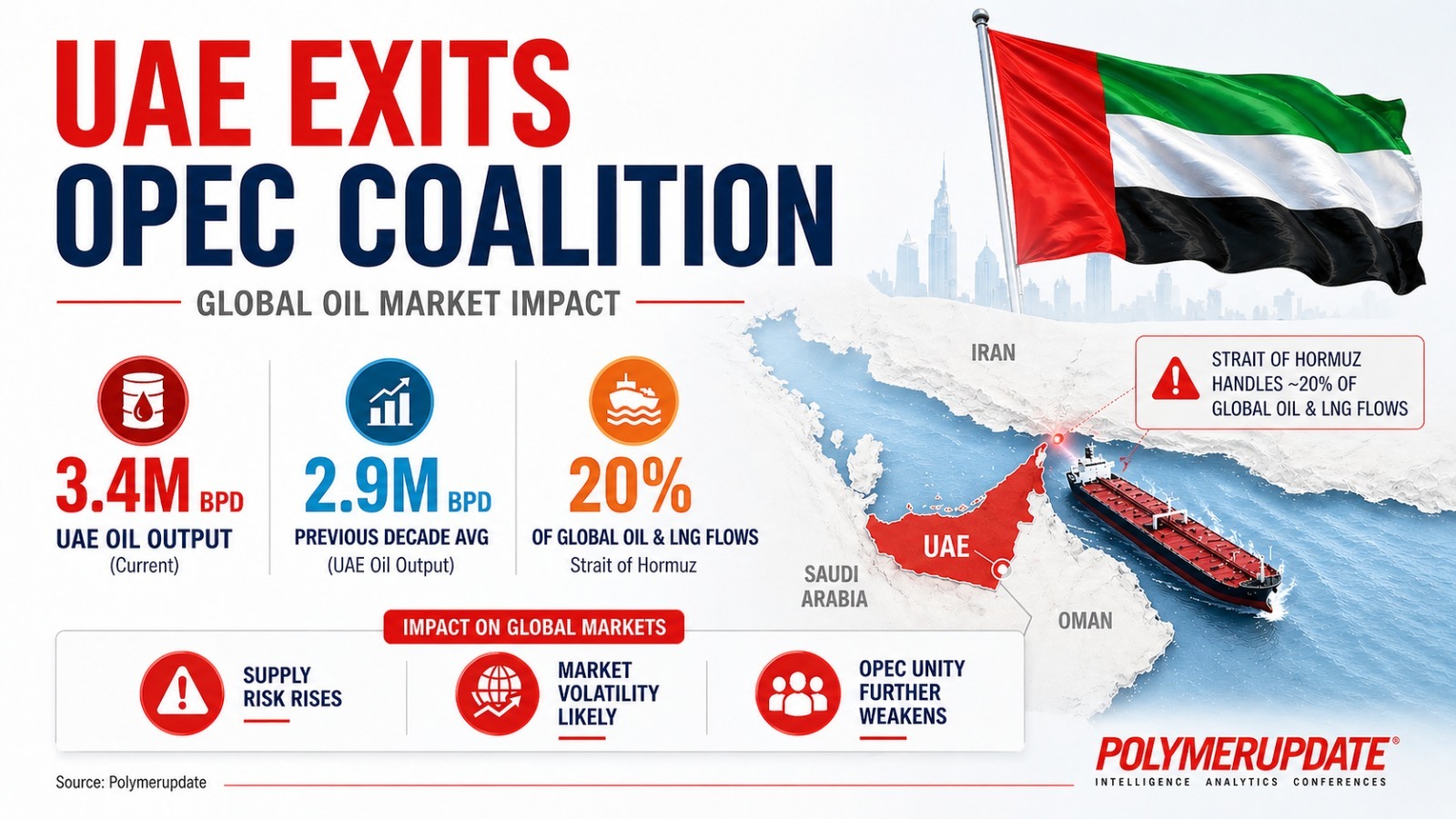
Meanwhile, Gulf-based OPEC producers are already grappling with logistical challenges in exporting crude through the Strait of Hormuz—a narrow passage between Iran and Oman that typically handles nearly one-fifth of global oil and liquefied natural gas flows. Heightened threats and attacks on vessels in the region have further complicated shipments, adding to the strain on producers.
 Significance of UAE
The United Arab Emirates holds considerable strategic weight within the OPEC due to its sizeable production capacity, financial strength, and ability to ramp output quickly. As one of the Gulf’s most efficient and low-cost producers, the UAE has often played a stabilising role in the coalition, supporting supply adjustments to manage price volatility. Its growing upstream investments and expansion plans have also positioned it as a forward-looking producer, capable of influencing both current output policy and long-term supply dynamics within OPEC.
Beyond production, the UAE has served as a pragmatic voice within OPEC, often balancing competing interests among member states. It has at times pushed for higher production quotas to reflect its capacity expansions, contributing to internal negotiations that shape the group’s policy direction. Its geopolitical alignment and relatively stable economic framework have further strengthened OPEC’s credibility in global energy markets, making its presence important not just for supply management but also for maintaining investor confidence and cohesion within the alliance.
As of early 2026, the United Arab Emirates remains a major force in global energy markets, producing roughly 3.4 million barrels per day (bpd) of crude oil, according to January estimates. Ranked among the world’s top ten producers, the country’s oil sector accounts for a substantial share of its GDP, with upstream and export operations largely overseen by Abu Dhabi National Oil Company.
Output stood close to 3.4 million bpd in early 2026, compared with an average of about 2.9 million bpd over the decade leading up to 2024. However, recent data points to heightened volatility, with occasional sharp short-term declines linked to regional tensions and possible infrastructure disruptions. The UAE has been a key Middle Eastern producer and, prior to announcing its exit, was among the largest contributors within the OPEC+ framework. It also serves as a critical export hub, frequently routing shipments through the Fujairah Port for global markets.
A strategic win for Donald TrumpThe United Arab Emirates’ departure from the Organization of the Petroleum Exporting Countries could be interpreted as a strategic win for Donald Trump, who has consistently accused the group of distorting global energy markets by keeping oil prices artificially elevated. The development may reinforce his long-standing argument that OPEC operates in a manner that disadvantages major consuming nations, particularly the United States, by exerting undue control over supply and pricing.
Trump has also linked U.S. military protection of Gulf countries to their oil pricing strategies, suggesting that Washington’s security umbrella is being leveraged without reciprocal economic consideration. He has argued that while the U.S. plays a crucial role in safeguarding the region, OPEC members continue to benefit by maintaining higher crude prices, a stance that has shaped his broader critique of the oil producers’ alliance.
DILIP KUMAR JHA
Editor
dilip.jha@polymerupdate.com