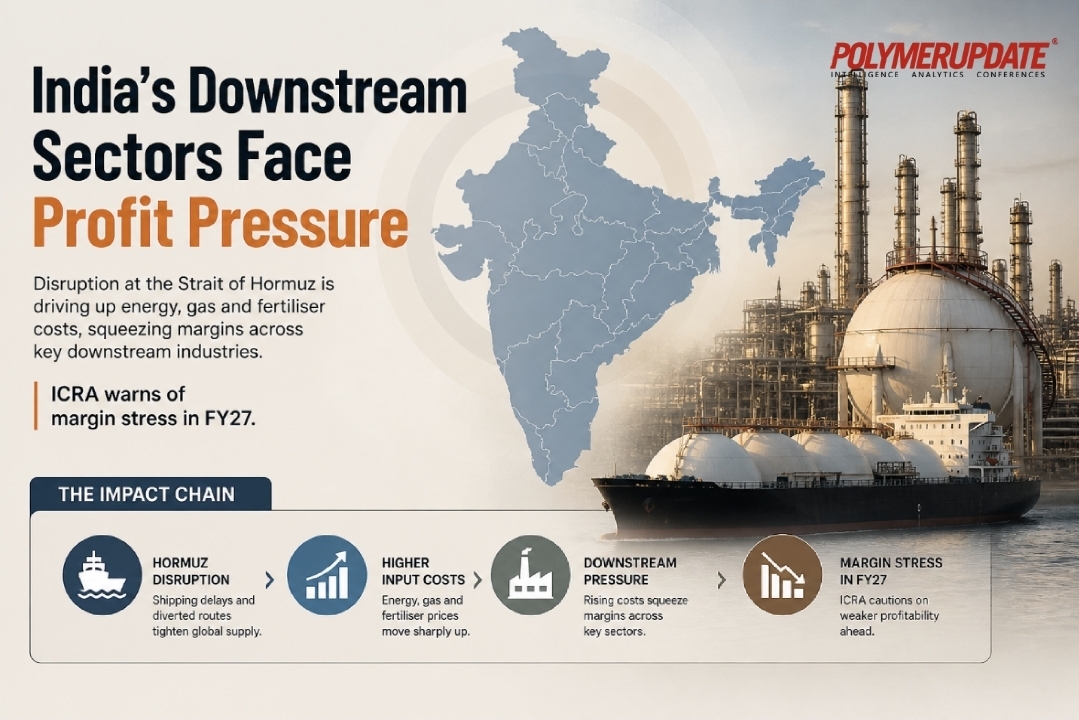
The profitability of India's downstream sector is likely to remain under pressure due to rising raw material costs stemming from supply disruptions caused by the ongoing West Asia crisis and the resulting closure of the Strait of Hormuz, a crucial maritime transit route that accounts for around one-fifth of global crude oil transport. Leading rating agency ICRA Ltd. forecasts that downstream segments such as oil marketing, fertilisers, chemicals, and City Gas Distribution (CGD) will see a hit to their bottom lines in FY2026–27 amid the continuing conflict.
The disruption in the Strait of Hormuz has impacted supplies of around 20 percent of global oil and LNG trade, as well as a sizeable share of various fertilisers and chemicals, thereby constraining availability. This has pushed up prices across commodities—crude oil, natural gas, chemicals, and fertilisers—exerting cost pressures on downstream industries. ICRA expects that the increase in chemical prices will be passed on to end users to some extent, while demand may correct once the initial phase of stockpiling subsides.
Prashant Vasisht, Senior Vice President and Co-Group Head at ICRA, said, "Stable pump prices for auto fuels amid elevated crude oil prices are impacting the profitability of oil marketing companies (OMCs), despite the recent reduction in excise duty. At crude prices of US$ 120–125 a barrel and long-term average crack spreads, marketing margins on petrol and diesel are estimated to be negative ₹14 per litre and ₹18 per litre, respectively. International liquefied petroleum gas (LPG) prices have surged due to the blockade of supplies from West Asia."
 Mechanism to address
The Strait of Hormuz remains one of the key routes for exporting crude oil, accounting for nearly 20 percent of global petroleum liquids consumption and about 20 percent of worldwide LNG trade. The prolonged closure of this route, along with disruptions to the operations of crude oil and LNG producers, could significantly increase energy prices globally. Furthermore, nearly 20 percent of global liquefied natural gas (LNG) exports originate from Qatar and the United Arab Emirates (UAE), with the Strait of Hormuz serving as the sole evacuation channel. A prolonged armed conflict in the region is likely to create supply shortages and push global energy prices even higher.
While LPG production has been increased by refining companies and additional cargoes have been procured from the United States, Australia, and other sources—addressing supply-side issues to some extent—under-recoveries on the sale of domestic LPG remain high for oil marketing companies (OMCs). ICRA estimates LPG under-recoveries at Rs 80,000 crore for the full year FY2027, assuming current levels persist throughout the year.
Fertiliser sectorThe fertiliser sector faces significant cost pressures driven by a rise in sulphur and ammonia prices, which, in turn, feed into other raw materials and finished products. For the urea segment, the pool price has risen to around US$ 19/mmbtu in April 2026 from US$ 13/mmbtu prior to the West Asia crisis. While a major share of the natural gas requirement is currently being met through imports of spot LNG cargoes, the availability of adequate natural gas on a sustained basis remains critical amid global LNG supply disruptions.
The profitability of phosphatic and potassic (P&K) fertiliser manufacturers and traders is expected to moderate, as the recent revision in Nutrient-Based Subsidy (NBS) rates does not fully reflect the cost pressures faced by the industry. As a result, part of the cost inflation has been passed on through retail price hikes across P&K fertiliser categories, barring di-ammonium phosphate (DAP).
Vasisht added, "Significant raw material price inflation, coupled with inadequate subsidy revisions, is set to moderate the profitability of P&K fertiliser players compared with FY2026 levels. The expected impact of El Niño on the monsoon in the upcoming kharif season may also affect farmers' ability to absorb price increases. With sharp raw material price inflation across both urea and non-urea fertiliser segments, ICRA estimates the subsidy requirement for FY2027 at Rs 2.05 trillion to Rs 2.25 trillion, with an upward bias. We expect the Government of India (GoI) to enhance the fertiliser subsidy allocation for FY2027 from the budgeted Rs 1.71 trillion to maintain a stable credit profile for the sector."
Polymer and othersAkin to fertilisers, global chemical and polymer prices have witnessed a spike due to disruptions in trade flows and rising fuel costs. While the current uncertainty has led to panic buying and stockpiling among chemical manufacturers and end users, demand is unlikely to be sustained at current levels in a prolonged environment of elevated prices. However, the impact will not be uniform, especially in the specialty chemicals sector, where players with limited exposure to the Middle East—both in terms of raw material procurement and exports—are less likely to experience major swings in business activity.
The City Gas Distribution (CGD) sector, although protected to some extent due to preferential natural gas allocation, continues to face rising cost pressures amid currency depreciation and increasing gas prices. For CGD entities, ICRA expects profitability in the PNG-Domestic (PNG-D) segment to remain stable, as demand is being met through preferential allocation of Administered Price Mechanism (APM) gas. However, in the CNG segment, margins are expected to face headwinds due to higher gas costs as well as currency depreciation, which may not be fully passed on to consumers.
Weigh on downstream sectorElevated energy and key input prices are set to weigh on the profitability of several major downstream sectors in FY2026–27. This moderation in profitability is expected to weaken the credit profiles of some sectors. Overall, ICRA's outlook on the crude oil refining segment remains stable, supported by adequate refining margins due to healthy product cracks, while the outlook on the fuel retailing segment remains 'negative', driven by steeply negative marketing margins on the sale of auto fuels.
Additionally, ICRA's outlook on the fertiliser, basic chemicals, and petrochemical sectors also remains 'negative', largely due to the expected moderation in profitability driven by a combination of factors—namely inadequate subsidies in the fertiliser sector, elevated raw material prices in the petrochemical sector, and global oversupply in the basic chemicals sector.
DILIP KUMAR JHA
Editor
dilip.jha@polymerupdate.com