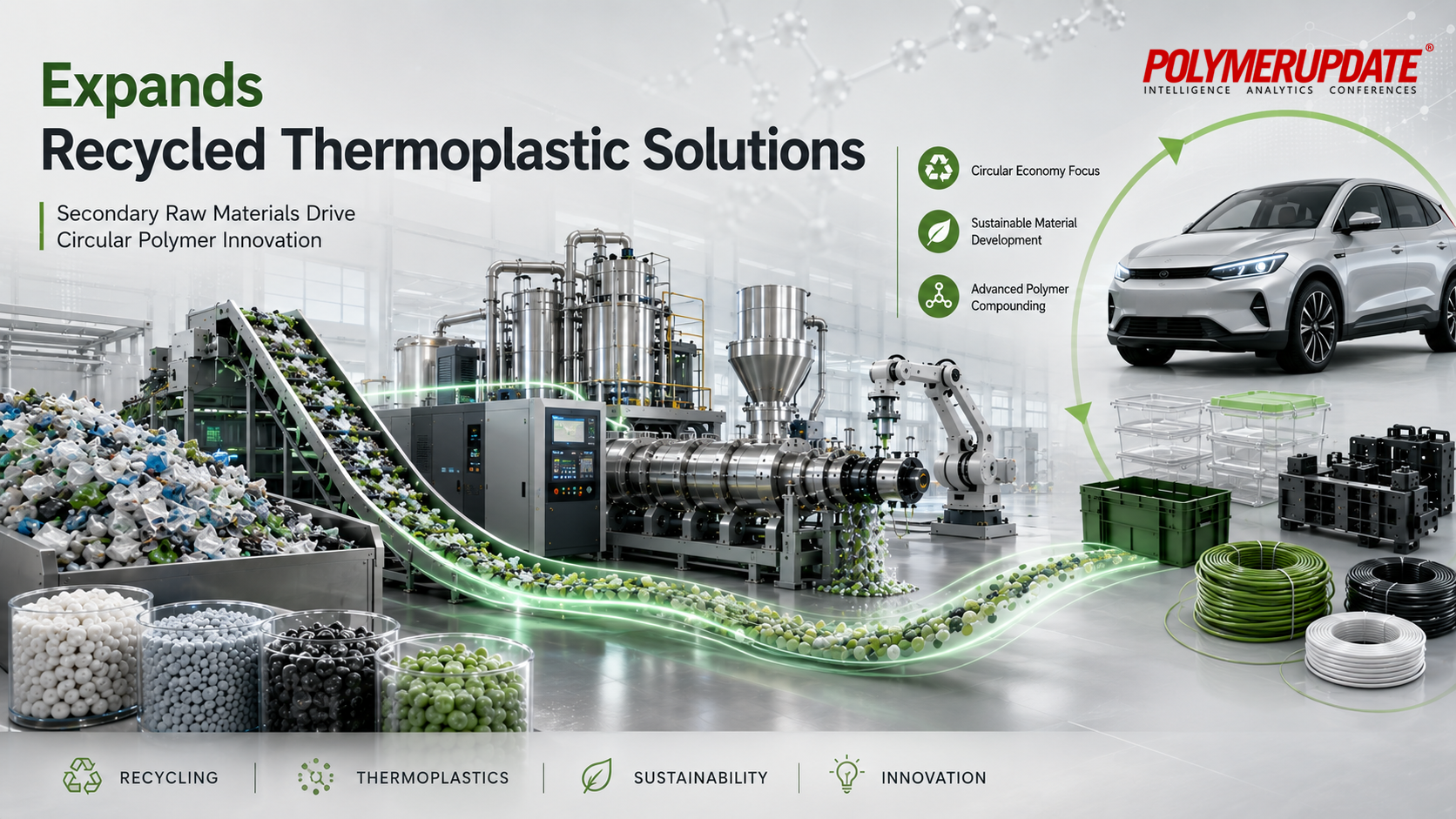
Europe-based leading thermoplastic solutions company – Benvic – is expanding to offer secondary raw materials to customers for their in-house plastic recycling and to deliver the next generation of polymers into the new circular economy. This transition comes in the wake of global challenges being faced by all industrial sectors with recycled content in plastics. As a compounder, Benvic is positioned to lead on questions of material technology and fitness-for-purpose.
Secondary raw materials (SRM) in plastic recycling are recycled plastic materials recovered from waste (post-consumer or industrial) that replace virgin plastic in manufacturing. These materials are processed—sorted, washed, and pelletized—to be used as raw inputs for new products, fostering a circular economy by conserving natural resources and reducing waste.
 Leading the transition
Benvic is a leading European-based company founded in 1963 that specializes in developing, producing, and marketing customized thermoplastic solutions. They are a top manufacturer of PVC compounds, bio-polymers, and engineering compounds used in sectors like building, medical, automotive, packaging, and cabling.
Rigid PVC is now moving forward into the regulation zone, not just for windows, doors and building components, but for all rigid PVC-based applications. Bespoke and recycled reformulations from Benvic can give customers immediate help in overcoming all such regulation challenges across any application. Soft PVC grades present a more challenging prospect, but Benvic's innovation has many solutions in the pipeline for the near future.
Customer-centric approachThe company has adopted a customer-centric approach for its entire product solution segments for all existing, and future potential clients. Above all, Benvic PVC compounding science leads to customised solutions. Every customer, every industrial segment is different, and the introduction of recycled content into pre-existent processes is never a one-size-fits-all solution. Instead, each market segment and each polymer application needs fresh eyes on how all materials – recyclate included - will successfully interact together within the production process.
Some new skills are needed here; typically more production monitoring, in order to tweak the volume and properties of the recyclate within traditional polymer processing. The production aim is the same as before - to achieve consistent and repeatable product quality. Now, however, the product also incorporates various percentages of recyclate as required by law.
Benvic has many roles to play in the following segments including: designing material flows and formulations; ensuring smooth processability of polymer compound and also helping ensure that various material streams – polymer recyclate included – can be relied upon as a secure supply for the customer. These activities mean that Benvic’s very diversified material portfolio is increasingly driven by the addition of recycled content, especially in the case of polypropylene (PP) compounds.
Expanding recycled contentIt is also taking steps to expand its portfolio of talc-filled and glass fibre-reinforced compounds with percentages of recycled content. In a short space of time Benvic has become expert in adapting these formulations in order to meet specific performance requirements, such as ultraviolet (UV) resistance, emissions, flame retardancy, or colour matching. Consequently, Benvic’s DotR PP series is a perfect match for new automotive or electrical application requirements.
Benvic is also developing recycled content for a range of engineering plastics - such as ABS or PA – in order to be perfectly positioned as a one-stop shop provider for those industry segments that are now subject to the End-of-Live (ELV) and Ecodesign for Sustainable Products Regulation (ESPR) directives in the European Union.
DILIP KUMAR JHA
Editor
dilip.jha@polymerupdate.com