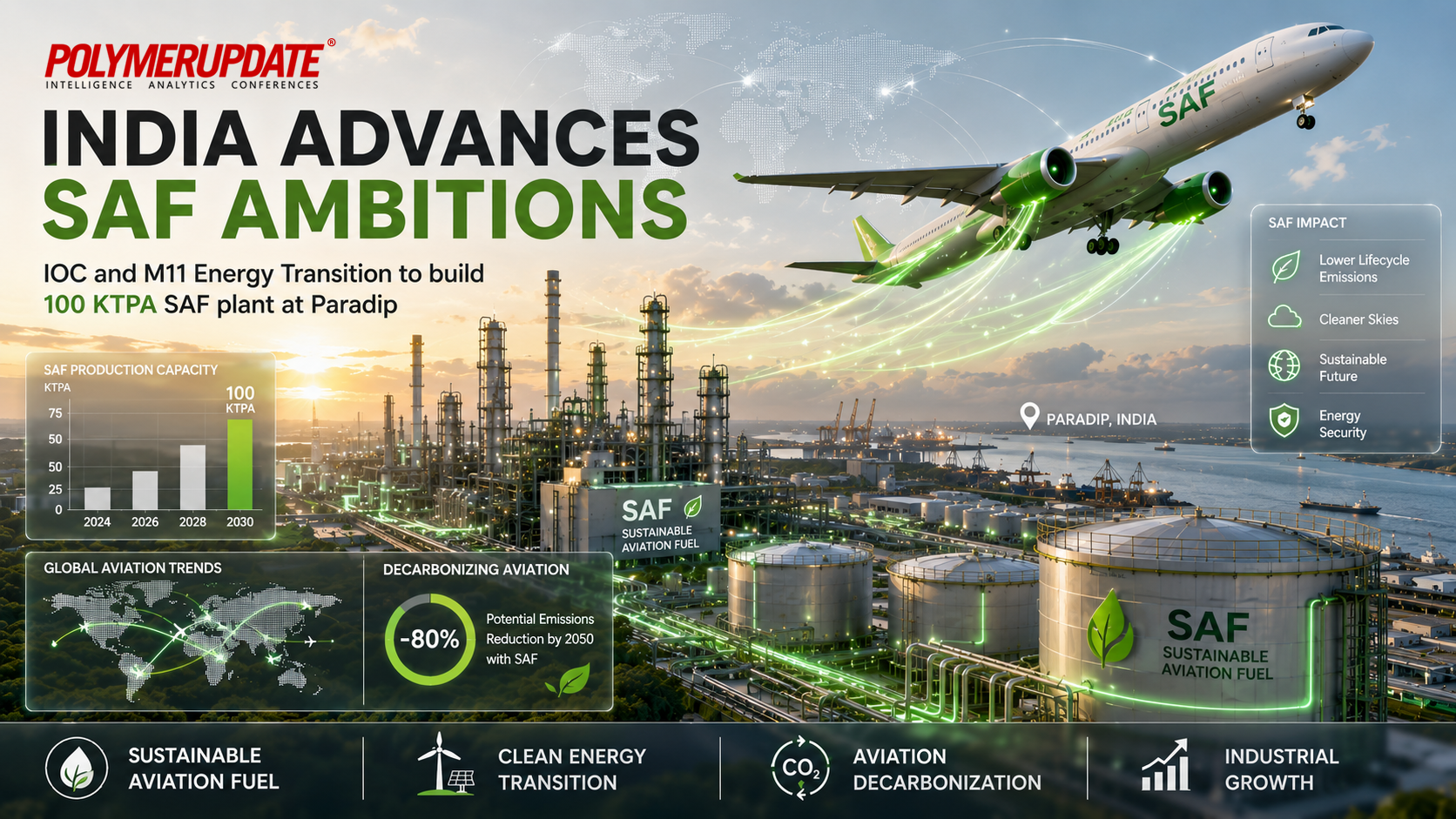
Indian Oil Corporation Ltd. (IOCL), India’s largest oil refining and fuel marketing company, has taken a major step towards supporting the country’s clean energy transition with the approval of a new Sustainable Aviation Fuel (SAF) project at Paradip in Odisha. The company’s Board of Directors, at its meeting held on May 18, 2026, approved the formation of a 50:50 Joint Venture Company with M11 Energy Transition Pvt. Ltd. for setting up a 100 KTPA HEFA-based SAF production facility.
The proposed project marks one of India’s significant initiatives in the sustainable aviation fuel segment and reflects the growing focus on reducing carbon emissions from the aviation sector, which remains among the hardest industries to decarbonise globally. The upcoming plant will be based on HEFA (Hydroprocessed Esters and Fatty Acids) technology, which is currently considered one of the most commercially mature pathways for SAF production worldwide.
 Significance of HEFA technology
HEFA (Hydroprocessed Esters and Fatty Acids) technology is currently among the most commercially advanced and widely adopted pathways for producing Sustainable Aviation Fuel (SAF) globally. The process involves converting renewable feedstocks such as used cooking oil, vegetable oils, animal fats, and other lipid-based waste materials into aviation-grade fuel through hydroprocessing. During the process, impurities and oxygen molecules are removed under high temperature and pressure using hydrogen, resulting in a cleaner-burning fuel that closely resembles conventional jet fuel in chemical composition and performance characteristics.
One of the key advantages of HEFA-based SAF is its ability to significantly reduce lifecycle greenhouse gas emissions compared to traditional fossil-based aviation turbine fuel. Depending on the feedstock used and production pathway, emissions reductions can range from 50 percent to over 80 percent. In addition to lowering carbon emissions, HEFA-derived SAF can also help reduce sulphur emissions and particulate matter from aircraft operations. Since the fuel is compatible with existing aircraft engines and airport infrastructure, it offers an immediate and practical solution for decarbonising the aviation sector without requiring major technological modifications.
The locationThe project will be established at Paradip, where IOCL already operates one of its major refining and petrochemical complexes. The location is expected to provide strategic advantages in terms of infrastructure, logistics, feedstock handling, and integration with existing refining operations. Paradip’s coastal location may also support future export opportunities as global demand for sustainable aviation fuel rises rapidly.
The 100 KTPA capacity project comes at a time when governments and aviation companies across the world are aggressively pursuing low-carbon aviation solutions to meet net-zero emission targets. Several countries have already announced SAF blending mandates, while global airlines are increasingly entering into long-term procurement agreements to secure future SAF supplies.
India, too, has begun laying the groundwork for SAF adoption as part of its broader energy transition strategy. The aviation industry has been under growing pressure to curb emissions amid rising passenger traffic and increasing environmental concerns. Sustainable aviation fuel is widely viewed as one of the most viable near-term solutions because it can be blended with conventional aviation turbine fuel and used in existing aircraft engines without requiring major modifications.
Strong long-term potentialIndustry experts believe India possesses strong long-term potential in SAF production due to the availability of agricultural residues, used cooking oil, and other renewable feedstocks. The country’s refining sector is also increasingly exploring opportunities in biofuels and low-carbon fuels as energy demand evolves over the coming decades.
For Indian Oil Corporation, the latest venture aligns with its broader strategy to diversify into cleaner energy businesses while strengthening its position in emerging fuel technologies. The company has already been expanding its presence across various green energy segments, including biofuels, green hydrogen, renewable energy, and petrochemical integration projects.
The partnership with M11 Energy Transition Pvt. Ltd. is expected to combine Indian Oil’s refining expertise and infrastructure capabilities with the partner’s focus on energy transition solutions. While detailed financial investment figures and commissioning timelines have not yet been disclosed, the Board approval indicates that the project has now moved into an advanced planning phase.
On a growth pathThe global Sustainable Aviation Fuel (SAF) market is expected to witness rapid expansion over the coming decade as governments, airlines, and energy companies intensify efforts to reduce carbon emissions from the aviation sector. Several countries have already introduced SAF blending mandates, tax incentives, and carbon reduction policies aimed at accelerating adoption of cleaner aviation fuels. At the same time, major international airlines are entering into long-term supply agreements with SAF producers to secure future fuel availability amid expectations of strong demand growth. Industry analysts believe global SAF production capacity will need to increase substantially over the next 10 to 15 years to meet emerging regulatory requirements and climate commitments.
According to aviation industry estimates, Sustainable Aviation Fuel could contribute nearly two-thirds of the total emissions reductions required for the aviation sector to achieve net-zero carbon emissions by 2050. Unlike other decarbonisation technologies that may require major aircraft redesigns or infrastructure upgrades, SAF offers an immediate solution as it can be blended with conventional jet fuel and used in existing aircraft engines without significant modifications. As a result, SAF is increasingly being viewed as the cornerstone of the aviation industry’s long-term decarbonisation strategy, particularly for long-haul flights where alternative technologies such as battery-powered aircraft remain commercially challenging.
However, one of the biggest challenges for SAF remains limited production capacity and higher costs compared to conventional jet fuel. Large-scale investments such as the Paradip project are therefore seen as critical to improving supply availability and achieving economies of scale that can eventually lower production costs. The Indian government has also been encouraging domestic biofuel development under various policy frameworks aimed at reducing fossil fuel dependence, lowering import bills, and supporting climate commitments. The SAF sector is expected to become an important component of India’s long-term clean energy roadmap, especially as international aviation regulations tighten in the coming years.
OpportunitiesAnalysts believe projects like the one proposed by IOCL could also create opportunities for the development of feedstock supply chains involving used cooking oil collection, waste management, and rural biomass aggregation. This may provide additional economic benefits alongside emissions reductions. The announcement also comes amid growing momentum in global energy markets towards alternative fuels and low-carbon technologies. Oil marketing companies and refiners worldwide are increasingly investing in renewable diesel, SAF, hydrogen, and carbon reduction projects as part of their long-term business transformation strategies.
Once operational, the Paradip SAF facility is expected to strengthen India’s domestic sustainable aviation fuel production capabilities and reduce reliance on imported low-carbon aviation fuels in the future. The project could also position India as an emerging participant in the rapidly expanding global SAF value chain.
With aviation demand expected to continue growing steadily over the next decade, investments in sustainable aviation fuel infrastructure are likely to play a crucial role in balancing economic growth with environmental sustainability. Indian Oil’s latest move therefore represents not only a strategic business expansion but also a significant step towards supporting cleaner and more sustainable aviation in India.
DILIP KUMAR JHA
Editor
dilip.jha@polymerupdate.com