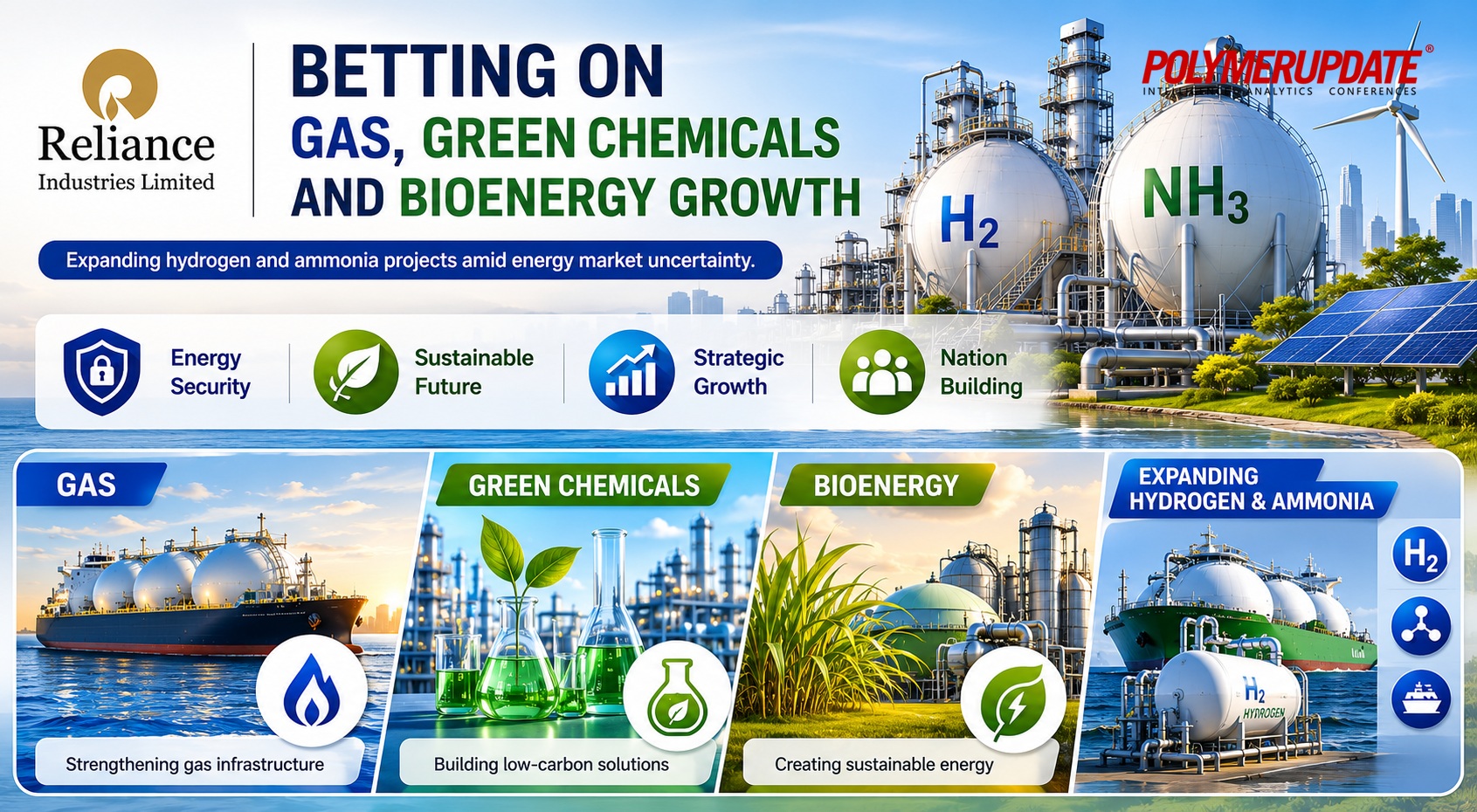
Reliance Industries Ltd (RIL), India’s largest private-sector company with consolidated revenue of US$ 125.3 billion, is betting big on gas and green chemicals for growth in FY2026-27 amid uncertainty in the global energy markets caused by the prolonged closure of the Strait of Hormuz and supply disruptions from the Middle East. A further 60-day extension of the US-Iran ceasefire, despite ongoing drone and missile strikes by both sides, has added to volatility in the crude oil market, forcing import-reliant downstream chemical manufacturers to seek sustainable long-term growth drivers.
Oil and gas exploration and production account for approximately 4.35 percent of Reliance Industries’ standalone turnover. The broader Oil-to-Chemicals (O2C) segment represents 92.37 percent of turnover. Green chemicals and new energy ventures are still in the scaling phase and do not yet constitute a measurable standalone share of total turnover. Increasing focus on the import of natural gas is likely to increase its share in India’s energy mix to 15 percent by 2030 from 6 percent currently. Accordingly, RIL’s share in India’s natural gas production is estimated to increase to 30 percent.
The Fortune 500 company is preparing in advance for a potential decline in future energy demand, as projected by the International Energy Agency (IEA), as the world transitions towards alternative fuels. In addition, elevated crude oil prices have increased the cost of manufacturing and transporting downstream products, making end-products less competitive in the market. Exports have also become challenging due to the continued closure of the Strait of Hormuz amid persistent geopolitical tensions. Therefore, Reliance believes that the outlook for FY2026-27 remains vulnerable to geopolitical, macroeconomic, and policy risks.
 Green energy
RIL is developing a fully integrated new energy platform spanning renewable energy, energy storage, green hydrogen, and downstream green fuels and chemicals, supported by in-house manufacturing of critical clean-energy technologies. A central pillar of RIL’s new energy ecosystem is the indigenisation of critical clean-energy technologies in India, including solar modules, Battery Energy Storage Systems (BESS), and electrolyser systems, in line with the Government of India’s vision for self-reliance and domestic manufacturing leadership.
By integrating these capabilities within a single ecosystem, RIL aims to deliver green energy solutions that are competitive, scalable, and reliable for global markets while strengthening India’s industrial base. The agreement with Samsung C&T is the first in a series of long-term offtake partnerships aimed at supporting the scale-up of RIL’s new energy platform.
Green ammonia pactStepping towards its targeted goal, RIL entered into a binding long-term Supply and Purchase Agreement (SPA) with Samsung C&T Corporation, South Korea, in March this year for the supply of green ammonia over a 15-year period commencing in the second half of FY2029. The SPA, valued at more than US$3 billion, is one of the world’s largest binding long-term green ammonia offtake agreements. The agreement sets a new benchmark in the global energy landscape, with India emerging as an exporter of green fuels produced through an end-to-end value chain anchored within the country, including the domestic manufacturing of critical clean-energy equipment, in line with India’s National Green Hydrogen Mission (NGHM).
Anant Ambani, Executive Director of Reliance Industries Limited, said, “We are proud to partner with Samsung C&T to supply green ammonia that is cost-competitive and reliable. This partnership marks an important step in India’s clean-energy journey. RIL’s New Energy initiative aims not only to advance the energy transition but also to build a strong industrial platform for India by integrating the country’s renewable resources with its manufacturing leadership, world-class talent, and innovation to produce value-added green fuels and chemicals at scale.”
Ambani further added, “At the heart of this vision is our commitment to indigenising the critical technologies of the energy transition — solar, Battery Energy Storage Systems, and electrolysers — under a strong Make-in-India framework. Partnerships such as this will help scale our green hydrogen ecosystem and giga factories, while contributing to India’s ambition of becoming a global hub for green hydrogen and its derivatives.”
Current activitiesReliance’s activities span hydrocarbon exploration and production, petroleum refining and marketing, petrochemicals, advanced materials and composites, renewables (solar and hydrogen), retail, digital services, and media and entertainment. Through its New Energy business, Reliance is building one of the world’s most integrated clean-energy platforms: a mega-scale solar and storage project in Kutch providing round-the-clock renewable power, feeding integrated green hydrogen and ammonia production at Jamnagar, anchored by the Dhirubhai Ambani Green Energy Giga Complex — a 5,000-acre advanced manufacturing hub housing giga factories for solar modules, batteries, electrolysers, fuel cells, and power electronics.
Reliance has committed to achieving net carbon neutrality by 2035. Currently ranked 88th, Reliance is the largest private-sector company from India to feature in Fortune’s Global 500 list of the “World’s Largest Companies” for 2025. The company also ranks 45th in the Forbes Global 2000 list of the “World’s Largest Public Companies” for 2025, the highest among Indian companies. Reliance has also been recognised in Time’s list of the “100 Most Influential Companies” of 2024, making it the only Indian company to have received this honour twice.
Bioenergy foraySince its inception in 2023, Reliance Bioenergy has rapidly emerged as India’s largest bioenergy producer. At the forefront of transforming waste into energy, the company is pioneering a circular-economy approach to achieving net carbon neutrality. Its journey began with the establishment of two demonstration Compressed Biogas (CBG) units in Jamnagar. Subsequently, RIL completed the construction of its first commercial-scale CBG plant in Barabanki in a record 10 months.
Building on this success, the company is focused on establishing CBG plants across India and plans to expand with multiple facilities, in line with its commitment to achieving net carbon neutrality by 2035. Reliance Bioenergy is committed to leading the way in sustainable energy solutions. Through innovative technology, dedication to environmental stewardship, and a digital-first approach, RIL aims to provide reliable and sustainable energy solutions that benefit both the environment and the economy.
DILIP KUMAR JHA
Editor
dilip.jha@polymerupdate.com