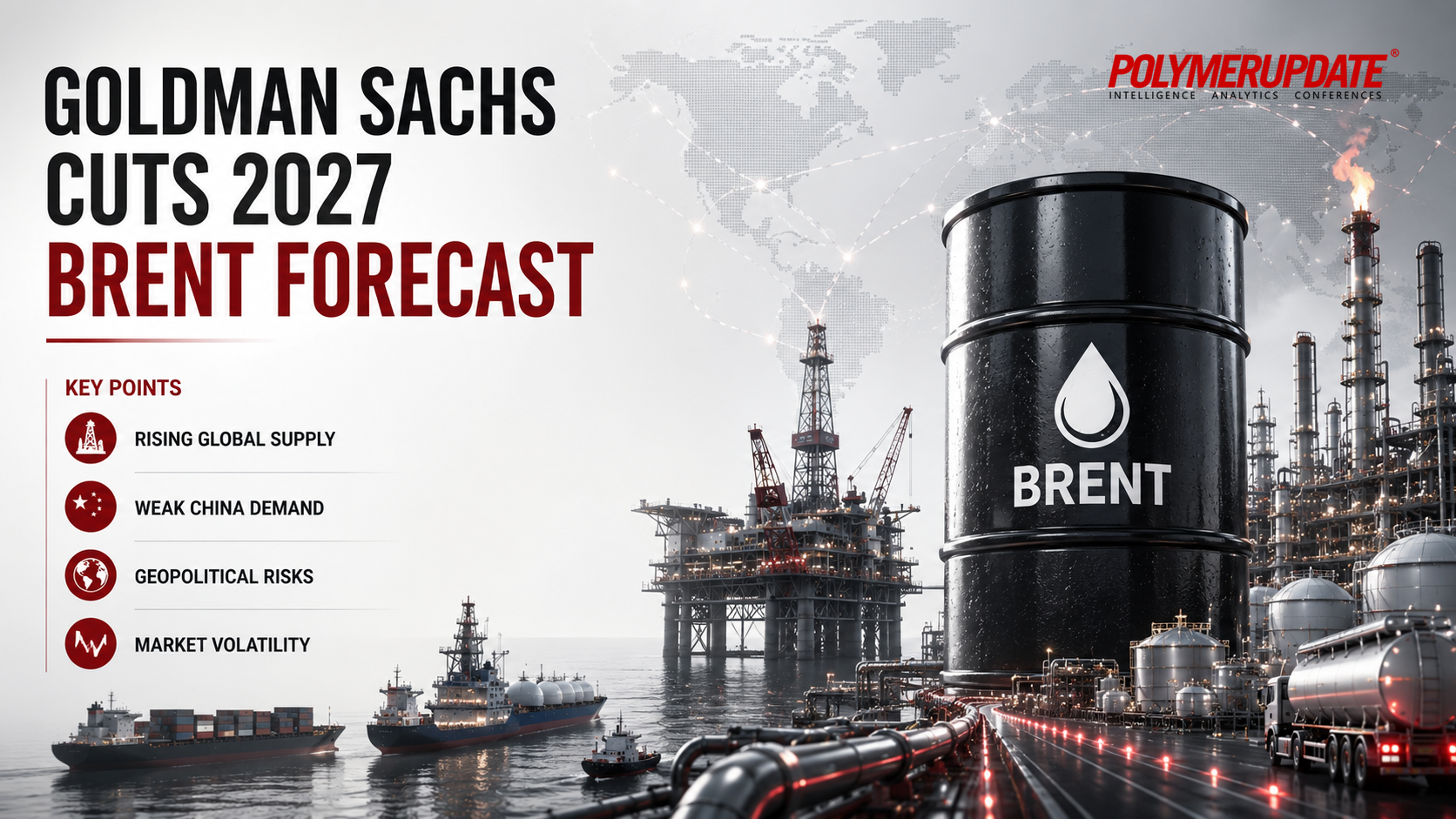
Global crude oil markets may be heading toward a more balanced phase after several years of supply disruptions and geopolitical uncertainty, leading global multinational investment bank and financial services firm Goldman Sachs said in its latest report. The investment bank has lowered its average Brent crude oil price forecast for 2027 to US$ 80 a barrel, citing stronger-than-expected supply growth from major producing countries and continued weakness in global oil demand, particularly from China.
The global crude oil market has faced recurring supply disruptions from Russia amid its more than four-year-long conflict with Ukraine. As part of its strategy to weaken Moscow's economic and military capabilities, Ukraine has repeatedly targeted Russian oil fields, refineries, storage facilities and export infrastructure, disrupting crude production and supply flows while reducing oil-related revenues, a key source of funding for Russia's war effort.
In response, Russia has carried out extensive strikes on Ukraine's energy infrastructure, including power plants, fuel depots and transmission networks, aiming to undermine the country's economic activity and industrial operations. The continued attacks by both sides have added uncertainty to global energy markets, periodically raising concerns over supply security and contributing to volatility in crude oil prices.
Goldman Sachs’ revised forecast reflects its view that expanding production from the United States, Brazil, Guyana, Venezuela and the United Arab Emirates will gradually ease supply constraints and create a more comfortable market balance. While geopolitical tensions in the Middle East continue to influence short-term price movements, the bank believes that growing output from these producers will play a larger role in shaping the long-term trajectory of oil prices.
 A sensitive market
The downgrade comes at a time when crude oil markets remain highly sensitive to developments surrounding the Strait of Hormuz, one of the world's most strategically important energy chokepoints. The waterway handles a significant portion of global crude oil and liquefied natural gas shipments, making any disruption to tanker traffic a major concern for energy markets. However, Goldman Sachs noted that the impact of recent supply disruptions has been partially offset by weaker-than-expected demand growth and the availability of spare production capacity elsewhere.
A key factor behind the bank's more cautious long-term outlook is the changing nature of oil demand in China, the world's second-largest consumer of crude. Goldman Sachs believes that structural shifts in the Chinese economy, including slower industrial growth, rising energy efficiency and increasing adoption of electric vehicles, are likely to restrain future oil consumption growth. These trends are expected to reduce China's contribution to global demand expansion compared with previous decades, thereby limiting upward pressure on oil prices.
Weak demand forecastThe demand outlook has also become less supportive due to broader concerns about the global economy. Several energy agencies and market observers have recently revised their demand forecasts lower, reflecting the impact of higher energy costs, slower economic growth and changing consumption patterns. OPEC, for instance, recently trimmed its 2026 global oil demand growth forecast for a second consecutive month, highlighting the challenges facing the demand side of the market.
Despite lowering its 2027 forecast, Goldman Sachs remains constructive on oil prices in the near term. The bank continues to expect Brent crude to average around US$90 per barrel during the fourth quarter of 2026. This relatively bullish outlook is based on the assumption that disruptions to Gulf oil exports and shipping routes will persist longer than previously anticipated, keeping a geopolitical risk premium embedded in crude prices. Goldman now expects exports through the Strait of Hormuz to normalize only by late August, a later timeline than earlier projections.
Depleting inventoriesThe bank also pointed to declining global oil inventories as a source of support for prices. Although additional supply from non-OPEC producers is expected to improve market availability over time, inventories remain vulnerable to any prolonged disruptions in the Middle East. The balance between recovering supply and fragile inventories is likely to keep oil markets volatile in the coming quarters.
Goldman Sachs outlined a wide range of potential outcomes for crude prices depending on how geopolitical and supply-related risks evolve. In a scenario where export disruptions persist for longer than expected and supply recovery remains slow, Brent crude could average above US$ 110 a barrel in late 2026. A more severe scenario involving prolonged disruptions in the Strait of Hormuz could push prices as high as US$ 140 a barrel in 2027, reflecting the significant role that Middle Eastern exports continue to play in global energy markets.
Conversely, the bank believes that faster normalization of exports, combined with weaker global demand growth, could exert substantial downward pressure on prices. Under this scenario, Brent crude could fall to around US$ 70 per barrel by late 2026 and decline further to approximately US$ 60 per barrel in 2027. Such an outcome would likely be driven by rising production outside OPEC, improving supply availability and continued softness in global oil consumption.
OutlookThe outlook underscores the increasingly complex forces shaping the global oil market. While stronger production growth from key exporters is expected to moderate prices over the longer term, geopolitical tensions, shipping disruptions and inventory trends continue to create significant uncertainty. As a result, oil markets are likely to remain highly volatile, with prices responding quickly to both supply developments and changes in the global demand outlook.
For now, Goldman Sachs' revised forecast suggests that the era of structurally higher oil prices may gradually give way to a more balanced market. However, as recent events in the Middle East have demonstrated, geopolitical risks remain capable of dramatically altering the outlook and driving sharp price swings in either direction.
DILIP KUMAR JHA
Editor
dilip.jha@polymerupdate.com