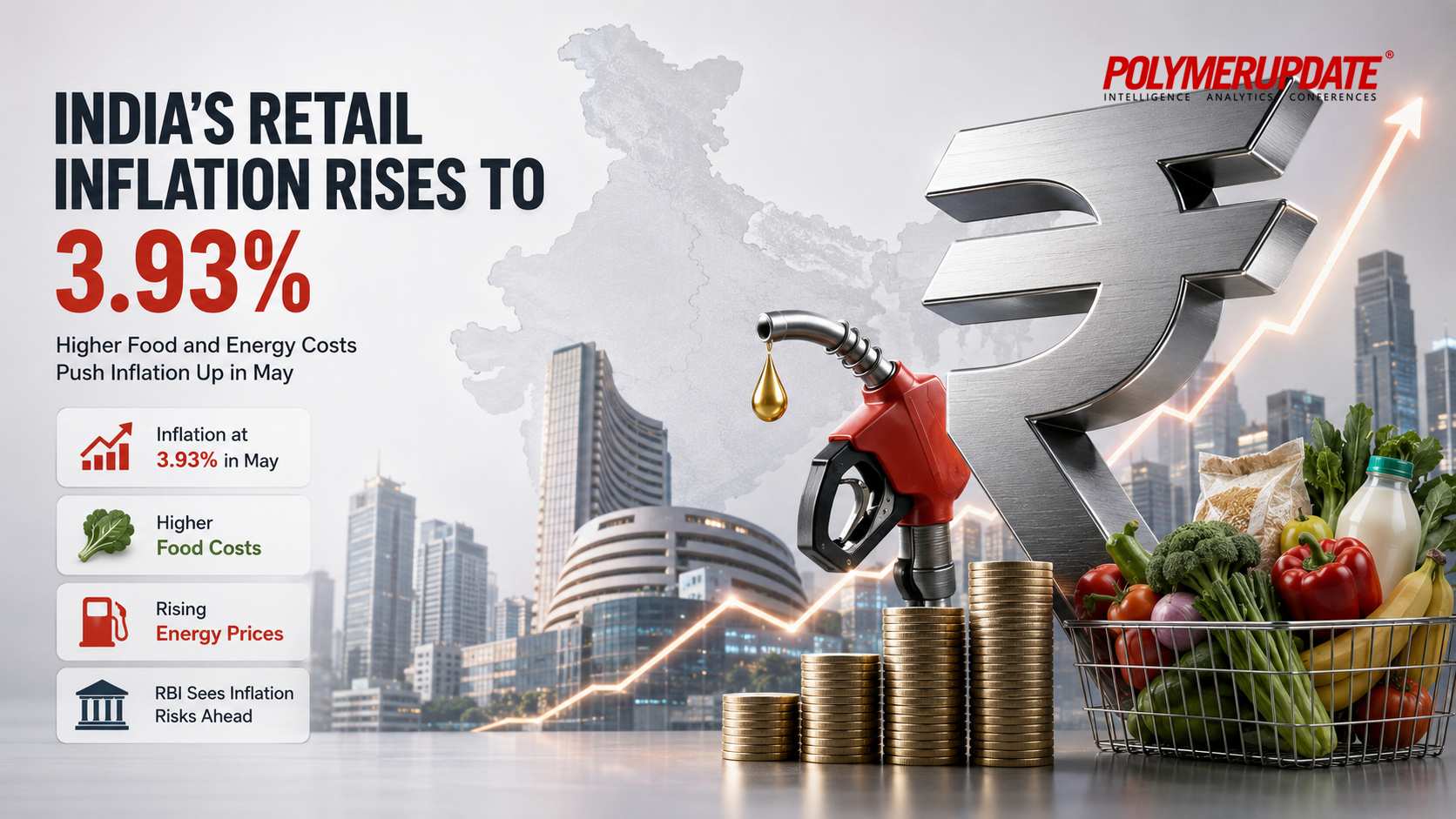
India’s retail inflation measured by the Consumer Price Index (CPI) inched marginally higher to 3.93 percent year-on-year (yoy) in May, registering the fifth consecutive monthly increase, due to a substantial increase in the prices of food and additives such as tomato with energy costs remaining resilient. The increase marked the highest print so far this year with the retail inflation started rising from 2.74 percent in January this year.
May’s retail inflation print works out to marginally higher than 3.48 percent in April, but almost 40 percentage point increase from 2.82 percent reported a year ago, i.e. in May 2025. However, the inflation print in May still works out to within the Reserve Bank of India’s (RBI’s) comfortable range of 4 percent with a tolerance band of +/-2 percent.
India’s Ministry of Statistics & Programme Implementation (MoSPI) said in a statement, “Year-on-year inflation rate based on All India Consumer Price Index (CPI) with base year 2024 for the month of May, 2026 over May 2025 is 3.93 percent (provisional). Corresponding inflation rates for rural and urban are 4.25 percent and 3.53 percent, respectively. Inflation rate based on All India Consumer Food Price Index (CFPI) for May 2026 over May 2025 is 4.78 percent (provisional). Corresponding inflation rates for rural and urban are 4.85 percent and 4.66 percent, respectively.”
Madan Sabnavis, Chief Economist, Bank of Baroda, commented, “India’s CPI inflation for May works out to marginally lower than our forecast. Inflation is expected to move upwards at a differential pace in the coming months depending on transmission of higher energy prices to different products. And subsequently, the monsoon impact will get reflected in food products prices. The monsoon is already delayed and advice given to farmers was to wait for the rains to arrive before sowing their seeds for the relevant crops. The inflation numbers are interesting as the higher inflation number of 3.9 percent against 3.5 percent in April was still driven by food prices with inflation being 4.8 percent.”
 Food inflation up
The acceleration in headline inflation during the month was primarily driven by a sharp increase in food prices across both rural and urban regions. Rural food inflation rose to 4.85 percent from 3.74 percent in the previous month, reflecting higher prices of essential food items and continued pressure on household budgets. Urban food inflation also witnessed a notable increase, climbing to 4.66 percent from 3.16 percent in April. The broad-based rise in food costs underscores the vulnerability of inflation to fluctuations in agricultural output, weather conditions and supply chain dynamics.
Food price inflation has been high due to specific products witnessing higher prices such as tomato even as other showed declines. Food and beverages showed an average price increase of 4.55 percent, while paan, tobacco, and intoxicants shot up by 4.83 percent. MoSPI data showed average tomato price increased by a staggering 48.43 percent in May following a 35.26 percent in April. Tomato enjoys a weight of 0.4961 in the overall basket of commodities. Edible oils continue to witness higher price increases.
More reflectionsAt the broader level, inflationary pressures remained more pronounced in rural areas, where headline inflation stood at 4.25 percent, compared with 3.53 percent in urban centres. The divergence suggests that rural households continue to face relatively stronger price pressures, particularly from food-related components that carry a larger weight in the consumption basket. Meanwhile, housing inflation remained largely stable at 2.12 percent, marginally lower than 2.15 percent recorded in April, indicating that shelter costs continued to exert only limited influence on the overall inflation trend. The stability in housing prices helped partially offset the impact of rising food inflation, although food remains the dominant driver of consumer price movements.
Among other things, silver jewellery reported a price increase of 155.23 percent, while gold/diamond/platinum jewellery prices shot up 32.49 percent in May. The personal care group has inflation of 18.5 percent mainly due to gold and silver prices. But this should ease sharply in the coming months with the price of these metals coming down. However, the higher duty imposed would continue to exert pressure on prices.
Across other major categories, inflation in clothing and footwear edged higher to 2.98 percent from 2.80 percent in the previous month, while inflation in restaurant and accommodation services surged to 5.75 percent from 4.20 percent, indicating stronger price pressures in the hospitality sector. In contrast, inflation in the health segment eased to 1.49 percent from 1.64 percent, and information and communication services inflation moderated to 0.30 percent from 0.50 percent, reflecting relatively subdued cost increases in these categories.
Meanwhile, the personal care and miscellaneous goods and services category continued to register elevated inflation, rising to 18.46 percent from 17.66 percent in April. The persistent increase in this segment remained one of the key contributors to overall price pressures, highlighting sustained cost escalation across a range of consumer services and discretionary spending categories.
Impact of high energy pricesThe direct impact of the price increases of fuel products starting with liquefied petroleum gas (LPG), compressed natural gas (CNG), petrol and diesel is revealed in higher prices of transport of goods, transport by own vehicle, and glass products. The other area within services where prices have gone up sharply was restaurants with inflation of 5.8 percent. This is a direct impact of energy prices going up as well as food raw materials which has caused them to increase prices.
The state wise inflation numbers remain fairly stylized with the four southern states witnessing higher numbers- Tamil Nadu, Andhra Pradesh, Telangana and Odisha. Interestingly most of the north eastern states have witnessed inflation of less than 3 percent with Mizoram having the lowest of 1 percent.
OutlookLast week, RBI observed the partial pass-through of high global crude oil prices to domestic pump prices of petrol and diesel started since May. Prices of several inputs such as commercial LPG, industrial raw materials, chemicals, base metals, rubber, and plastic products, among others, have increased. These could exert upward pressure on CPI inflation in the coming months as firms pass on higher input costs. Given all prevailing fundamentals, the central bank projects India’s CPI inflation for 2026-27 at 5.1 percent, RBI said. Against that Bank of Baroda expects retail inflation for the year to range between 5.2-5.5 percent on the assumption of oil being on an average US$ 90-100 a barrel.
DILIP KUMAR JHA
Editor
dilip.jha@polymerupdate.com