The ongoing energy shock triggered by the crisis in West Asia is expected to cast a shadow over India's economic growth this fiscal year, as rising crude oil and natural gas prices increase production costs across key sectors such as manufacturing, transportation, petrochemicals, mining and construction. Leading credit rating agency Crisil projects India’s economic growth at 6.6 percent, similar to the one estimated by the Reserve Bank of India (RBI) in its latest Monetary Policy Committee (MPC) meeting held early this month. India’s gross domestic product (GDP) growth stood at 7.7 percent last financial year. The risks remain tilted to the downside if oil prices stay elevated for an extended period.
While energy markets have stabilized somewhat following the announcement of a memorandum of understanding (MoU) between the United States and Iran on June 15, concerns remain over the pace of recovery in energy flows through the Strait of Hormuz, one of the world's most critical oil transit routes. Analysts believe that operational bottlenecks and lingering geopolitical risks could keep energy prices elevated for much of the year, posing fresh challenges for an economy that remains heavily dependent on imported fossil fuels. The proposed US-Iran peace MoU is expected to be signed on June 19.
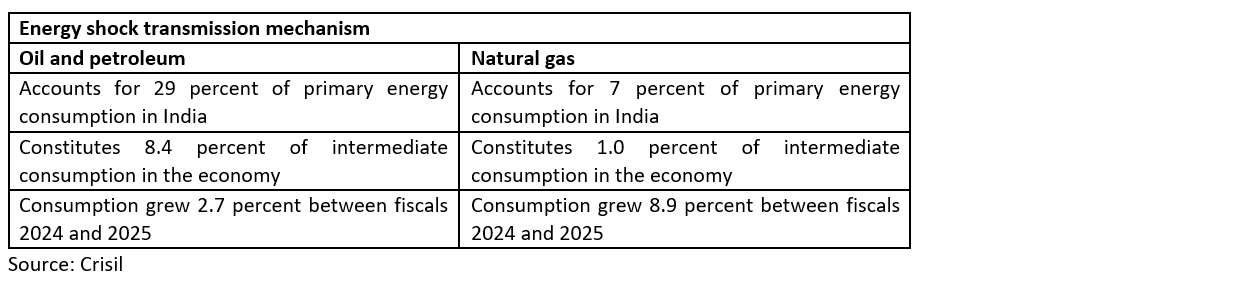
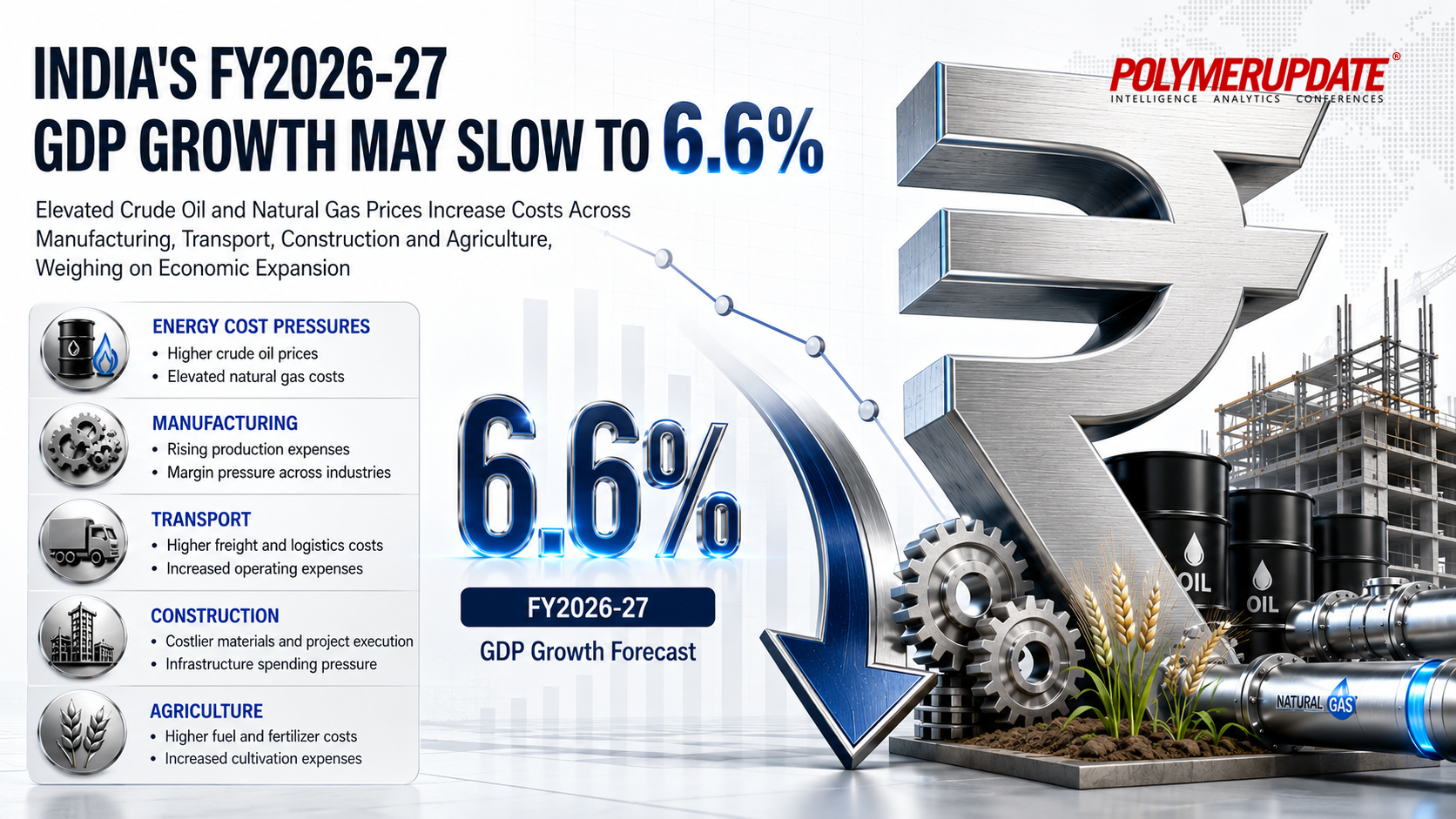
The Crisil report titled ‘How a sustained energy shock can ripple through the industry’ released Wednesday, reads, “Higher energy and input costs are expected to weigh on India’s growth this fiscal. Based on the most exposed sectors as per the National Statistics Office’s (NSO) Supply and Use Table (SUT) data, India’s gross domestic product (GDP) growth is likely to slow to 6.6 percent this fiscal, compared with 7.7 percent last fiscal, with downside risks A crude shock poses a broader economy-wide risk than natural gas, given the larger proportion of crude and petroleum products in input costs for domestic production at 8.4 percent vs 1.0 percent for gas.”
 Crude oil remains the biggest risk
Although natural gas has become increasingly important in India's energy mix, crude oil remains the dominant transmission channel through which energy shocks affect the economy. Data from the Supply and Use Table (SUT) indicate that crude oil and petroleum products account for approximately 8.4 percent of intermediate consumption across the economy, compared with just 1 percent for natural gas. As a result, a sustained rise in crude prices has far-reaching implications across agriculture, industry and services.
The impact was particularly severe during the first two months of fiscal 2027, when Brent crude oil prices averaged more than US$40 per barrel above fiscal 2026 levels, while liquefied natural gas (LNG) prices were around US$4 per million British thermal units higher. Although crude prices have retreated from recent peaks, they continue to remain above last year's average levels.
As oil and gas serve as essential inputs for production, transportation and logistics, higher prices have pushed up operating costs for businesses. Some companies may be able to pass these increases on to consumers through higher retail prices, while others may be forced to absorb the costs, leading to margin compression and weaker investment activity.
Sectors most vulnerableThe impact of rising energy costs is uneven across the economy. Oil refining stands out as the most energy-intensive sector, with more than 80 percent of its inputs directly exposed to energy-related cost pressures. However, the sector contributes only about 1 percent to India's gross value added (GVA), limiting its overall impact on economic output. More significant are the effects on sectors that serve as core inputs for the broader economy.
Land transport, mining, chemicals, rubber and plastic products are among the most exposed industries, with energy-related products accounting for a substantial share of their production costs. Refineries, land transport and mining derive more than 30 percent of their costs from crude oil, petroleum products and natural gas. Across most sectors, petroleum products account for a much larger share of costs than natural gas.
Manufacturing, mining and construction are particularly vulnerable because nearly 40 percent of their cost structures are linked directly or indirectly to energy-intensive inputs. Since these sectors are major contributors to economic activity and employment, rising costs could have widespread consequences. In contrast, financial services, real estate and professional services—which collectively account for roughly a quarter of India's GVA—face relatively limited direct exposure to energy price shocks.
Transport costs amplify the shockOne of the most important channels through which rising fuel prices spread through the economy is transportation. Road transport accounts for nearly 71 percent of India's freight movement and more than half of total logistics costs. Fuel represents the largest expense component for trucking operators, accounting for roughly 42 percent of operating costs.
As diesel prices rise, transportation costs increase across supply chains, affecting a wide range of industries. Sectors particularly vulnerable to transport cost escalation include agriculture, mining, chemicals and construction materials such as cement and ceramics. These higher transportation expenses eventually feed into the prices of goods and services throughout the economy, creating second-round inflationary pressures that extend far beyond the energy sector itself.
Agriculture faces additional challengesAgriculture remains another area of concern. Although the government's fertiliser subsidy programme offsets around 24 percent of the sector's input costs and authorities continue to prioritise fertiliser imports and domestic production, rising global energy prices have increased the cost of fertiliser manufacturing and imports.
The sector is also heavily dependent on petroleum products, particularly diesel, which accounts for around 9 percent of agricultural input costs. Higher diesel prices could raise farming expenses significantly this year, especially if below-normal monsoon conditions increase reliance on irrigation pumps and mechanised farming equipment. Any increase in agricultural production costs could eventually translate into higher food prices, adding further pressure on inflation.
OutlookThe current energy shock differs from previous episodes because it is not only raising fuel prices but also increasing the cost of several energy-intensive intermediate goods used across the economy. During the past three years, relatively low energy prices helped support robust growth, particularly in manufacturing. The present environment, however, is reversing those gains as producers grapple with higher input costs and weaker profitability.
Manufacturing and construction are expected to bear the greatest burden due to their dependence on transport-linked and energy-intensive inputs. With consumer demand remaining uneven, businesses may find it difficult to pass on the full increase in costs, leading to pressure on margins and investment. As the effects ripple through supply chains, the broader economy is likely to experience slower growth momentum. While India remains one of the world's fastest-growing major economies, sustained energy market disruptions in West Asia could emerge as a significant headwind in fiscal 2026-27.
DILIP KUMAR JHA
Editor
dilip.jha@polymerupdate.com