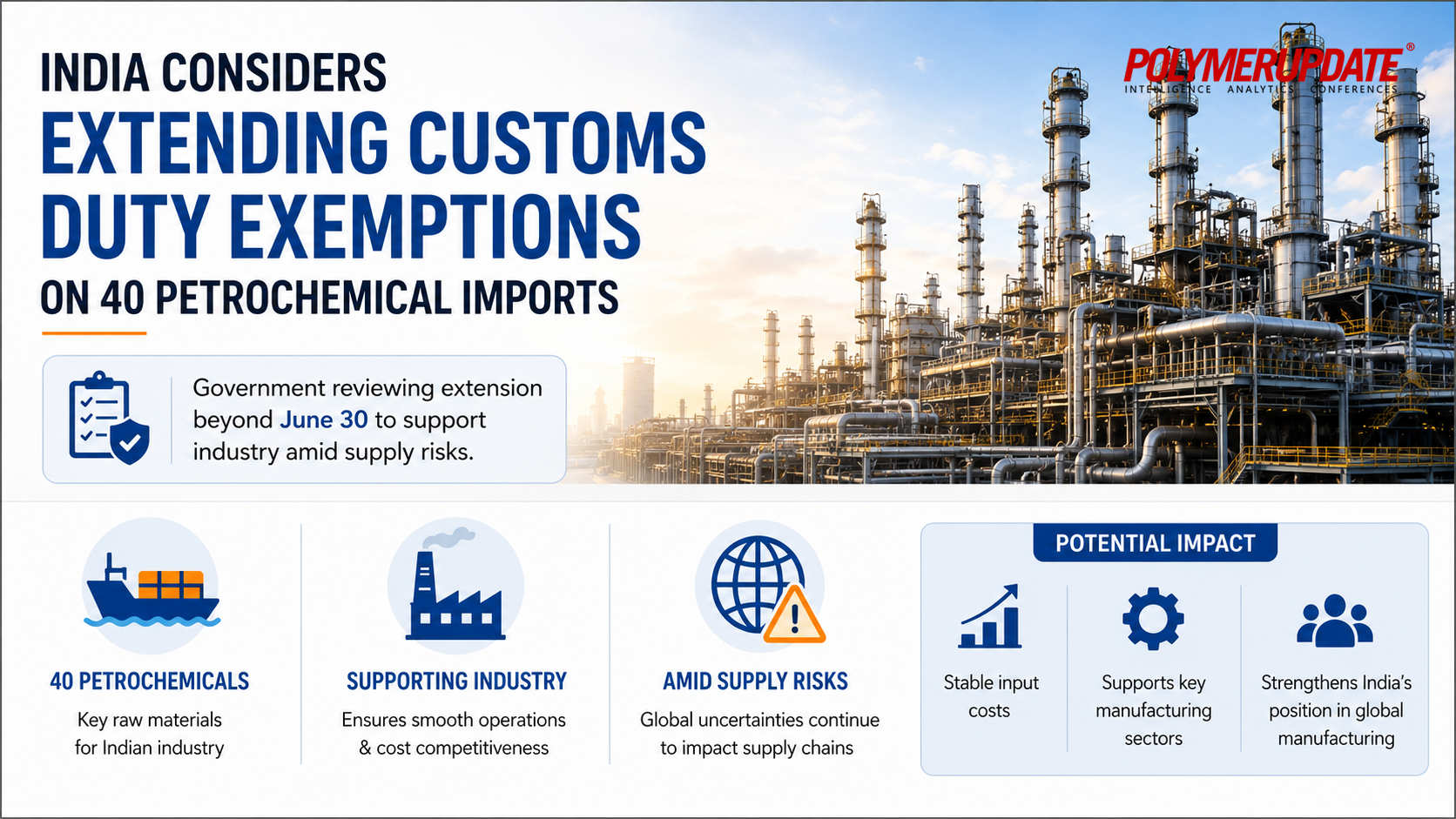
The Indian government is assessing whether to extend the temporary customs duty exemption granted on 40 key petrochemical products beyond June 30, amid continuing concerns over supply chain disruptions linked to geopolitical tensions in West Asia, a senior government official said on condition of anonymity. Introduced in April as an emergency relief measure for the domestic downstream producers, the exemption was aimed at ensuring uninterrupted availability of critical petrochemical feedstocks and intermediates used across sectors such as plastics, pharmaceuticals, textiles, packaging, chemicals, and automotive manufacturing.
Officials are currently reviewing developments in the region, particularly the impact on trade routes and cargo movement through the strategically important Strait of Hormuz, before taking a final decision. The deliberations underscore the government's challenge of balancing support for domestic industry with its fiscal objectives. While extending the exemption could help manufacturers contain input costs and maintain competitiveness in both domestic and export markets, it would also entail a loss of customs revenue at a time when the government is targeting higher tax collections.
Industry stakeholders have argued that continued duty relief remains necessary as global petrochemical markets remain vulnerable to supply disruptions and price volatility. Meanwhile, policymakers continued to evaluate whether the benefits to downstream industries outweigh the fiscal costs of prolonging the measure.
 Three-month exemption
India removed customs duty on a range of petrochemical and chemical imports with effect from April 2, providing temporary relief to domestic industries facing supply-chain challenges and rising input costs. In a notification issued on April 1, the government said the exemption was being granted in the public interest under the provisions of the Customs Act, 1962. The move was aimed at ensuring the uninterrupted availability of critical raw materials and intermediates used across key manufacturing sectors, including plastics, pharmaceuticals, chemicals, textiles, packaging, and automotive components.
As part of the relief package, the government also exempted ammonium nitrate imports from the Agriculture Infrastructure and Development Cess (AIDC) for the same period. The decision was intended to reduce the cost burden on downstream industries and maintain stable supplies amid disruptions in global trade flows and heightened geopolitical tensions in West Asia. Industry participants viewed the measure as a timely intervention to cushion manufacturers from volatility in international markets and safeguard production activity during a period of uncertainty.
Petrochemical products under import duty exemption list include anhydrous ammonia, toluene, styrene, dichloromethane (methylene chloride), vinyl chloride monomer, methanol (methyl alcohol), methanol (methyl alcohol), vinyl acetate monomer, purified terephthalic acid (PTA), ethylenediamine, di ethanolamine and mono ethanolamine, polymers of ethylene (including ethylene-vinyl acetate copolymers), polypropylene, polystyrene, styrene-acrylonitrile (SAN) copolymers, acrylonitrile-butadiene-styrene (ABS) copolymers, polyvinyl chloride (PVC), polytetrafluoroethylene, poly (vinyl acetate), poly (vinyl alcohol), poly (methyl methacrylate), epoxy resins, polycarbonates, poly (ethylene terephthalate) (PET) chips, poly (butylene terephthalate), polyurethanes, amongst others.
Impact analysisThe decision comes at a crucial juncture for India's manufacturing sector, which relies heavily on imported petrochemical feedstocks and intermediates used in a wide range of industries, including plastics, pharmaceuticals, textiles, packaging, chemicals, and automotive components. Industry stakeholders have urged the government to continue the relief measure, warning that premature withdrawal could raise production costs and disrupt supply chains already strained by regional instability.
The Centre had announced the full customs duty exemption in April as a temporary measure to mitigate the impact of supply disruptions caused by escalating tensions in West Asia. The conflict, particularly involving Iran, led to concerns over the security of cargo movements through the Strait of Hormuz, one of the world's most important maritime trade corridors for crude oil, petrochemicals, and other industrial raw materials.
The exemption, which remains valid until June 30, covers 40 petrochemical products considered critical for domestic manufacturing. Among the products benefiting from duty-free imports are methanol, anhydrous ammonia, toluene, styrene, vinyl chloride monomer, dichloromethane, polybutadiene, styrene-butadiene rubber, and unsaturated polyester resins. These materials serve as essential inputs for numerous downstream industries and are widely used in the production of plastics, synthetic fibres, packaging materials, pharmaceuticals, paints, adhesives, automotive components, and specialty chemicals.
Active considerationGovernment officials indicated that the extension proposal remains under active consideration. According to Ravi Teja, Deputy Director in the Department of Commerce, authorities are closely monitoring geopolitical developments before taking a final call. "The Ministry of Commerce is monitoring the situation. A final decision on the extension will be taken only after assessing the geopolitical situation and whether the ministry feels it remains necessary," Teja said recently.
The policy review reflects the continuing uncertainty surrounding global supply chains despite some easing of tensions in the region. While maritime traffic through the Strait of Hormuz has improved in recent weeks, concerns persist over potential disruptions that could once again tighten supplies and increase costs for importing nations such as India. India remains a net importer of several petrochemical derivatives despite possessing substantial domestic production capacity. Local manufacturers produce petrochemicals using feedstocks such as naphtha, liquefied petroleum gas (LPG), and ethane. However, domestic output alone is often insufficient to meet the growing demand generated by India's rapidly expanding manufacturing and consumer sectors.
Supply constraintsThe situation became more challenging following the outbreak of hostilities involving Iran earlier this year. In response to concerns over LPG availability, the government directed some domestic producers to divert petrochemical feedstocks toward cooking gas production, further tightening supplies available for industrial use. Industry representatives argue that the customs duty waiver has played a vital role in stabilising raw material costs during a period of exceptional volatility. The measure has helped manufacturers avoid sharp increases in input costs that could otherwise have been passed on to consumers through higher prices for finished goods.
Sectors such as pharmaceuticals and plastics have been among the primary beneficiaries. Pharmaceutical manufacturers rely on several imported petrochemical intermediates for the production of active ingredients and formulations, while plastic processors require a steady supply of feedstocks to maintain operations and meet demand from packaging, infrastructure, and consumer goods industries. However, extending the exemption is not without fiscal implications. The government has set an ambitious customs revenue target of Rs 2.71 trillion for the current financial year, compared with collections of Rs 2.64 trillion in FY26. Officials are therefore carefully assessing the potential revenue loss associated with prolonging the duty waiver.
The broader fiscal environment has also become more challenging due to elevated global prices of crude oil, food commodities, and fertilisers. Any reduction in customs collections could complicate efforts to maintain fiscal discipline while continuing to support economic growth. Analysts note that the government faces a delicate balancing act. On one hand, maintaining the exemption would provide continued relief to industries confronting supply uncertainty and cost pressures. On the other, restoring customs duties could help strengthen revenue collections but may increase production costs across multiple manufacturing sectors.
To enhance export competitivenessAn extension could also support India's export competitiveness. Many downstream manufacturers compete in international markets where input costs significantly influence pricing power. Higher raw material costs resulting from the re-imposition of import duties could reduce margins and make Indian exports less competitive compared with those from other manufacturing hubs. At the same time, policymakers must consider the interests of domestic petrochemical producers, some of whom may face increased competition from duty-free imports. The government has traditionally sought to strike a balance between protecting domestic manufacturing and ensuring adequate supplies of essential industrial inputs.
A final decision is expected before the exemption expires at the end of June. Industry participants are closely watching developments, as the outcome will influence procurement strategies, inventory management, and production planning for the months ahead. The ongoing review highlights India's growing exposure to global supply chain disruptions and the increasing importance of policy flexibility in responding to geopolitical shocks.
OutlookWhether the government opts to extend the waiver or allow it to lapse, the decision will serve as an important indicator of how policymakers intend to balance industrial resilience, trade competitiveness, and fiscal priorities in an increasingly uncertain global economic environment.
DILIP KUMAR JHA
Editor
dilip.jha@polymerupdate.com