India's factory output, measured by the Index of Industrial Production (IIP), rose 5.1 percent year-on-year (YoY) in May 2026, driven by a significant improvement in the manufacturing sector, according to data released by the Ministry of Statistics and Programme Implementation (MoSPI). The second monthly factory output data released under the newly adopted IIP series showed an improvement over the revised growth of 4.9 percent recorded in the previous month.
"The IIP growth rate for the month of May 2026 is 5.1 percent as compared with May 2025. The growth rates of the four sectors—mining & quarrying, manufacturing, electricity & gas supply, and water supply, sewerage & waste management—for May 2026 are (-)1.6 percent, 5.5 percent, 9.9 percent and 5.5 percent, respectively. The Quick Estimate of the IIP stands at 122.7 against 116.7 in May 2025. The indices of industrial production for mining & quarrying, manufacturing, electricity & gas supply, and water supply, sewerage & waste management for May 2026 stand at 112.9, 122.6, 129.6 and 145.1, respectively," the MoSPI said in a statement.
Commenting on the data, Madan Sabnavis, Chief Economist at Bank of Baroda, said, "IIP growth of 5.1 percent in May is quite impressive and indicates that the economy is on the right track. This follows a growth rate of 4.9 percent in April. There has also been a change in the methodology, with Producer Price Index (PPI) deflators now being used for 234 of the 463 items included in the index. The performance is encouraging, as it suggests that the economy is on a higher growth trajectory despite an uncertain global environment. This can largely be attributed to resilient domestic demand."
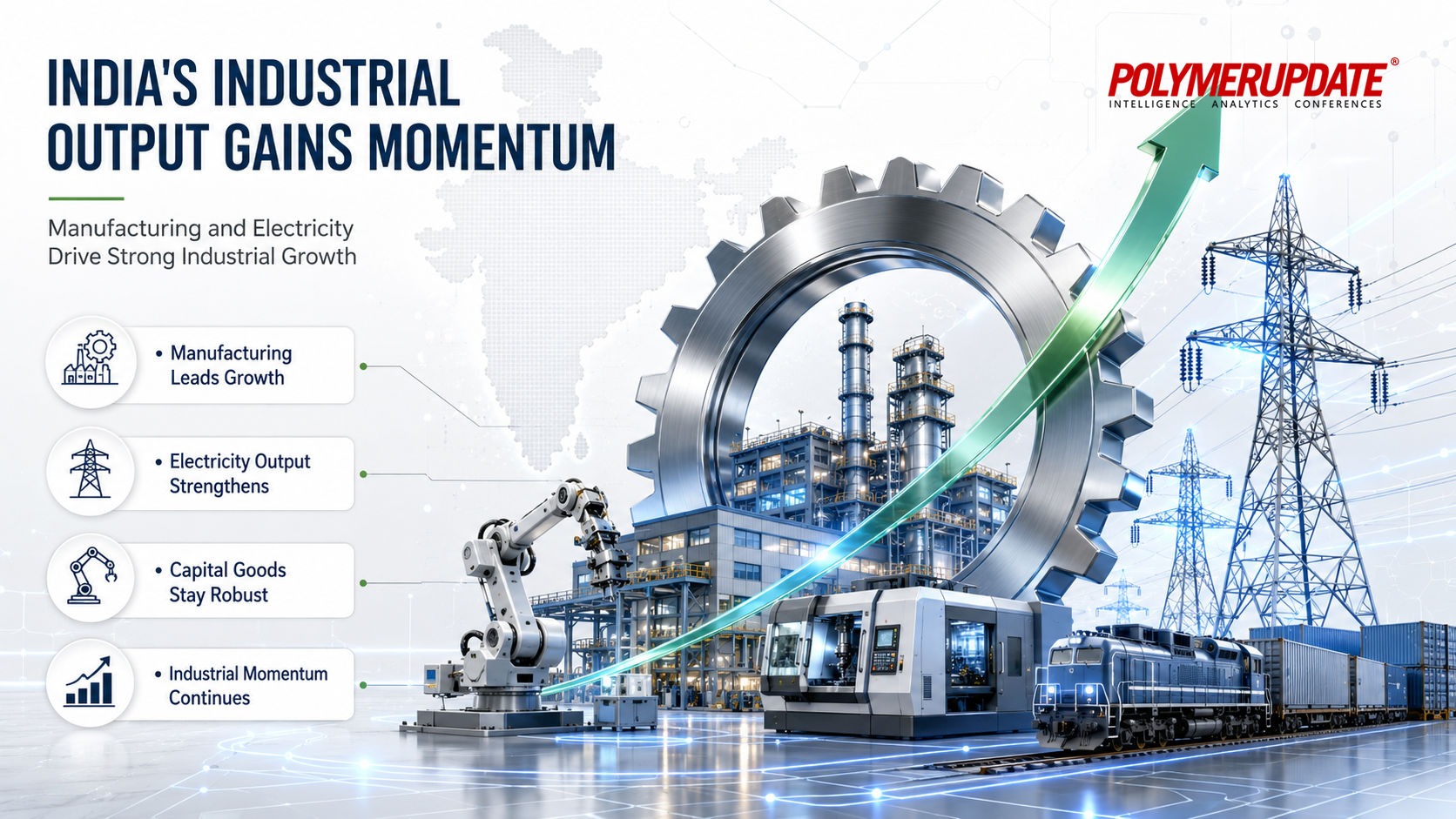 Manufacturing sector performance
The manufacturing sector reported growth of 5.5 percent, which can be attributed to a revival in consumption. Both durable and non-durable consumer goods recorded healthy growth of 7.2 percent and 3.6 percent, respectively. Within the consumer durables segment, the automobile industry once again led the expansion, followed by computers and other electronic products. Growth in the fast-moving consumer goods (FMCG) segment is particularly significant, as it has lagged behind in recent years. Clearly, lower inflation in recent months has supported consumption growth. However, it remains to be seen whether this momentum can be sustained in the coming months.
Production of wearing apparel, wood products, printing materials and refined petroleum products declined during the month. Part of this weakness can be attributed to subdued export demand amid an uncertain global environment. The signing of Free Trade Agreements (FTAs) with various countries is expected to help reverse this trend in the coming months. Meanwhile, capital goods production emerged as the strongest performer, expanding 12.9 percent, driven by robust output of both electrical and non-electrical machinery. This is consistent with the ongoing infrastructure push, supported by investments from both the government and the private sector. Infrastructure and construction goods also recorded healthy growth of 5.9 percent, reinforcing this trend.
Electricity and gas output posted robust growth of 9.9 percent, driven by a combination of strong demand and expanding renewable energy generation. The sharp rise in temperatures during the heat wave significantly boosted electricity consumption, particularly for cooling needs, while increased renewable energy capacity supported a 17 percent rise in clean power generation. Although part of the strong growth reflected a favourable base effect from the previous year, the continued expansion of renewable energy sources played a key role in meeting higher demand and sustaining overall growth in the electricity and gas sector.
Megha Arora, Director at India Ratings and Research, said, "In May 2026, the IIP grew 5.1 percent year-on-year, driven primarily by strong growth in the electricity and gas sector, followed by manufacturing and the newly introduced water supply category. The manufacturing sector, which accounts for more than three-fourths of the IIP, recorded growth of 5.5 percent, compared with 6.1 percent in the previous month. Mining and quarrying continued to contract, although at a slower pace of 1.6 percent, compared with a decline of 3.8 percent earlier. Within the electricity and gas supply segment, growth was led by electricity generation, while the impact of the West Asia crisis remained visible in the contraction of gas supply, albeit at a slower pace."
Satisfactory investmentOf the six use-based segments, capital goods maintained its lead, recording the highest year-on-year growth of 12.9 percent in May, compared with 12 percent in the previous month. It was followed by infrastructure and construction goods, indicating that investment activity in the economy remains robust. Four of the six use-based segments recorded improved performance compared with April 2026, while growth in intermediate goods slowed considerably.
Along with the latest data release, the Ministry of Statistics and Programme Implementation (MoSPI) replaced the Wholesale Price Index (WPI)-based deflator with the new Output Producer Price Index (Output PPI) deflator, both with the base year 2022–23. The transition is expected to improve the accuracy of value-based production estimates, provide more granular pricing information and align the IIP methodology with international best practices.
MoSPI had released the new series of the All India Index of Industrial Production (IIP) with the base year 2022–23 on June 1, 2026, initially using the Wholesale Price Index (WPI) as the deflator. Subsequently, the Department for Promotion of Industry and Internal Trade (DPIIT) under the Ministry of Commerce and Industry released the Output Producer Price Index (Output PPI) series, also with the base year 2022–23, on June 15, 2026. As the Output PPI is a new and important indicator for measuring producer-level prices, its adoption has significant implications for the compilation of the IIP by providing a more accurate reflection of changes in producers' output prices.
OutlookEconomists expect IIP growth to improve to 5.7 percent in June 2026, supported by a favourable base effect that is likely to help sustain the growth momentum. The decline in crude oil prices, following the fragile easing of tensions in West Asia, is also expected to support industrial activity during the month. In addition, the government's continued capital expenditure (capex) is likely to sustain the growth momentum in the capital goods and infrastructure/construction goods segments throughout FY2026–27 (FY27).
DILIP KUMAR JHA
Editor
dilip.jha@polymerupdate.com