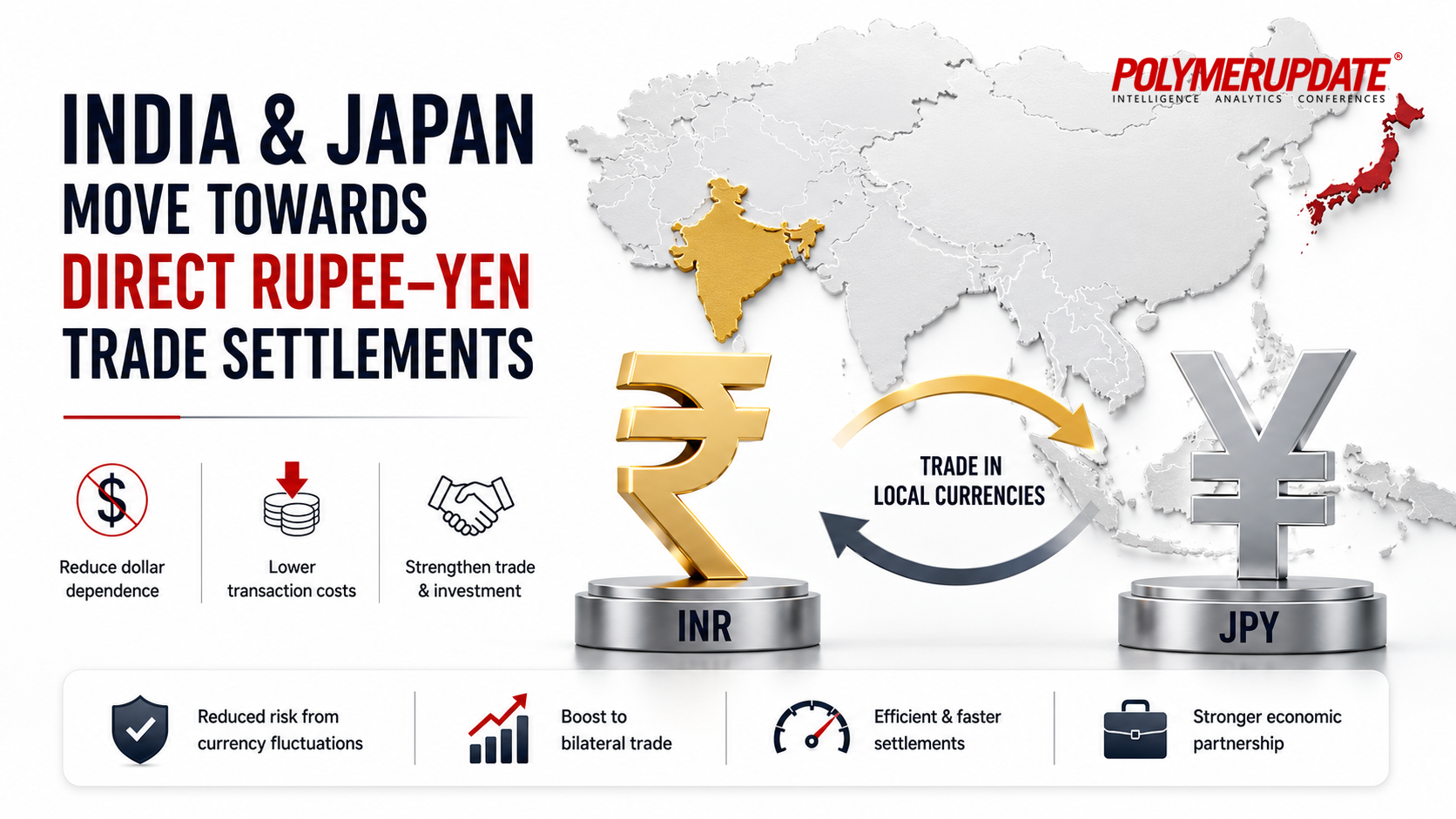
India and Japan are set to take a significant step towards strengthening their economic partnership by introducing a local-currency settlement framework that will enable bilateral trade to be conducted directly in Indian rupees and Japanese yen. The initiative would promote use of local currency and eventually reduce dependence on the U.S. dollar. The proposed arrangement, expected to feature prominently during the 16th India-Japan Annual Summit in New Delhi, marks a major milestone in financial cooperation between the two strategic partners.
An effective step was warranted due to increasing use of the US dollar which pulled both local currencies i.e. the Yen and the Rupee to the historic level. The Indian rupee is trading currently at 94.68 against the US dollar after breaching the intra-day psychological barrier of 96.90 on May 20, 2026, while Japanese Yen touched its weakest level since 1986 to trade currently at 162.69 against a dollar. Historically, the Yen’s absolute weakest record was set in 1971 when it reached 358 against the dollar.
 Japan PM visits India
The initiative comes as Japanese Prime Minister Sanae Takaichi begins a three-day official visit to India from July 1 to July 3, where she will hold wide-ranging discussions with Prime Minister Narendra Modi on trade, investment, infrastructure, energy security, defence cooperation and emerging technologies. According to official data, bilateral trade between India and Japan reached approximately US$ 27.5 billion during the 2025-26 fiscal year, while Japanese foreign direct investment in India amounted to around US$ 3.2 billion between April and December 2025.
If implemented, the mechanism will allow businesses in both countries to settle cross-border transactions directly in their respective currencies, eliminating the need to route payments through the U.S. dollar. The move is expected to reduce transaction costs, improve payment efficiency and provide greater protection against global currency volatility.
Simplified payment mechanismTraditionally, bilateral trade between India and Japan has relied on the U.S. dollar as the intermediary currency. For instance, an Indian importer purchasing machinery from Japan would first convert rupees into dollars before the payment is converted into yen for the Japanese exporter. This two-step process increases transaction costs through multiple currency conversions and exposes businesses to fluctuations in the dollar exchange rate.
Under the proposed framework, Indian importers will be able to make payments directly in rupees, while Japanese importers will settle transactions in yen. Banks in both countries will facilitate these payments through Special Rupee Vostro Accounts, enabling direct settlement without involving the U.S. dollar.
The simplified payment mechanism is expected to lower foreign exchange conversion charges, shorten settlement timelines and improve liquidity for businesses engaged in bilateral trade. Japanese financial institutions and companies would also be permitted to open accounts with Indian banks, making it easier to conduct transactions under the new system.
Financial cooperationThe proposal represents a natural progression of the broader financial cooperation outlined in the Japan-India Joint Vision for the Next Decade announced during Prime Minister Modi's visit to Tokyo in August 2025. According to reports, this will be the first time that currency cooperation is formally incorporated into a joint statement issued by the leaders of the two countries. While the swap arrangement primarily serves as a crisis-management tool, the proposed local-currency settlement framework is designed to facilitate day-to-day commercial transactions and support long-term trade and investment flows.
The initiative also builds upon the strong financial safety net already existing between India and Japan through the US$ 75-billion Bilateral Currency Swap Arrangement maintained between the Reserve Bank of India (RBI) and the Bank of Japan. The swap facility allows either country to exchange its domestic currency for the other's during periods of financial stress or foreign exchange shortages, helping stabilise financial markets and ensuring liquidity during times of economic uncertainty.
Promotion of local currenciesReducing dependence on the U.S. dollar has emerged as a common objective for several major economies seeking to insulate themselves from global financial volatility and rising geopolitical uncertainties. Conducting bilateral trade in domestic currencies can help businesses avoid exchange-rate risks associated with the dollar and reduce exposure to fluctuations in global financial markets. For India and Japan, whose economic relationship has expanded steadily over the past decade, the move is expected to enhance financial resilience while promoting greater use of local currencies in international commerce.
Japan has already implemented similar local-currency settlement arrangements with other Asian economies. Its framework with Indonesia, introduced in 2019, has witnessed steady growth, with bilateral transactions reaching approximately US$ 7.7 billion in 2025. Tokyo is also exploring a comparable arrangement with Malaysia as part of its broader efforts to promote regional financial integration. The proposed India-Japan mechanism is expected to encourage greater investment by simplifying cross-border financial transactions. Japan remains one of India's largest foreign investors, particularly in infrastructure, manufacturing, clean energy and advanced technology sectors.
Fresh investmentsJapan has also committed to investing 10 trillion yen in India over the next decade under the Japan-India Joint Vision, reinforcing its long-term commitment to India's economic development. Japanese investment has played a pivotal role in several flagship infrastructure projects, including the Mumbai-Ahmedabad High-Speed Rail Corridor, one of India's most ambitious transportation initiatives.
Japanese corporations continue to deepen their presence in India across sectors such as automobiles, electronics, engineering, logistics and financial services. More than 1,400 Japanese companies currently operate in India, nearly half of them engaged in manufacturing activities. Recent investments, including a US$ 1.6-billion acquisition of a 20 per cent stake in Yes Bank by Japanese investors, underscore growing corporate confidence in India's long-term growth prospects.
Cost-effectivenessThe proposed currency settlement framework is expected to make it easier for these companies to manage cross-border payments, reduce hedging costs and improve cash-flow management. Indian exporters, particularly small and medium-sized enterprises, could also benefit from simplified payment procedures and lower transaction expenses.
Beyond trade and investment, the summit is expected to focus on strengthening cooperation in economic security, energy transition, supply chain resilience, semiconductors, critical technologies and defence. Both countries continue to view their Special Strategic and Global Partnership as central to promoting a free, open and rules-based Indo-Pacific region.
As global trade increasingly adapts to shifting geopolitical and financial realities, the proposed direct yen-rupee settlement mechanism represents more than a technical change in payment systems. It signals India's and Japan's shared commitment to building a more resilient bilateral economic architecture, facilitating smoother commercial engagement while laying the foundation for deeper financial integration in the years ahead.
DILIP KUMAR JHA
Editor
dilip.jha@polymerupdate.com