Click the icon to add a specified price to your Dashboard list. This makes it easy to keep track on the prices that matter most to you.

| India’s methanol imports (%) | ||||||
| Particulars | March | April | May | |||
| 2025 | 2026 | 2025 | 2026 | 2025 | 2026 | |
| Share of imports from Middle East | 100 | 52 | 100 | 54 | 97 | 46 |
| Volume change in supplies from Middle East (on-year) |
| (-)29 |
| (-)69 |
| (-)82 |
| Volume change in total imports (on-year) |
| 35 |
| (-)43 |
| (-)63 |
Source: Crisil Research
Note: Middle East comprises Oman, Saudi Arabia, Bahrain and Qatar. Source: Directorate General of Foreign Trade (DGFT), Crisil Intelligenc
During the last fiscal year, India imported around 3.57 million tonnes of methanol. Before the outbreak of the conflict in West Asia, the Middle East accounted for nearly 88 percent of India's methanol imports between April 2025 and February 2026. However, as production outages, logistical bottlenecks and shipping risks intensified across the Gulf region, the Middle East's share declined sharply to about 51 percent during the March-May 2026 period. The shift reflects a rapid realignment in procurement strategies as Indian buyers sought to reduce supply risks and contain soaring import costs, a Crisil Intelligence report finds.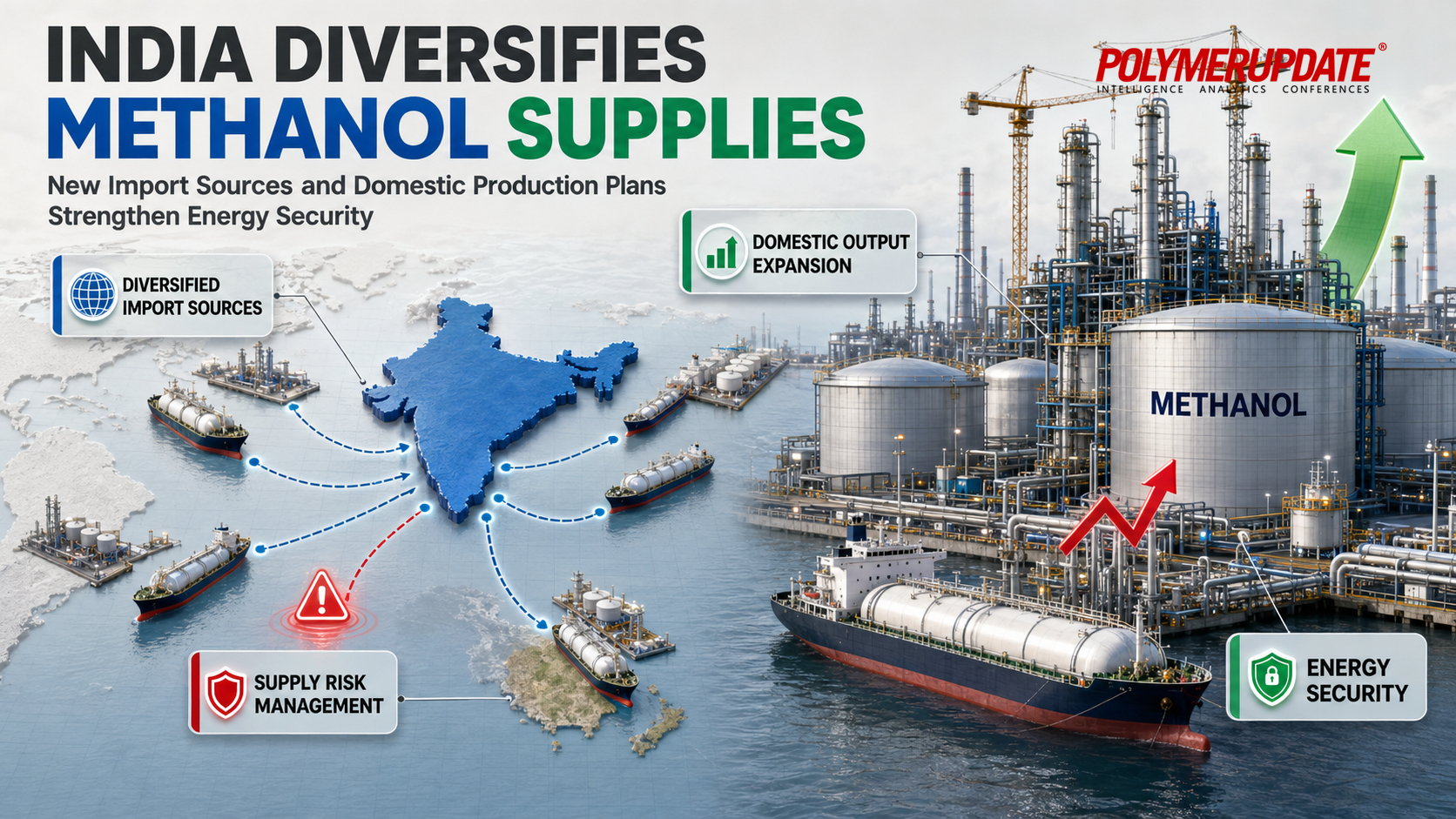
Steepest decline from Saudi Arabia
Among individual suppliers, Saudi Arabia witnessed the steepest decline. Its share in India's methanol imports fell dramatically to 6 percent in March from around 34 percent in February 2026 before disappearing completely in May, compared with nearly 22 percent in the corresponding month last year. Oman, however, emerged as one of the biggest beneficiaries of the supply realignment. Imports from Oman almost doubled, rising 95 percent month-on-month by volume, primarily because its export facilities are located outside the conflict-sensitive Strait of Hormuz. This geographical advantage enabled uninterrupted shipments even as shipping companies avoided the troubled Gulf transit routes.
Indian importers also broadened their procurement base beyond the Middle East. China supplied approximately 12 percent of India's methanol imports in April, with its share increasing to nearly 26 percent in May. Additional cargoes arrived from Venezuela, Malaysia, Russia, Japan and Algeria during the March-May period, highlighting India's efforts to diversify supply sources in response to the evolving geopolitical situation.
Conflict alters flows
The conflict significantly altered global methanol trade flows. Prior to the crisis, the Middle East accounted for roughly 28 percent of global methanol exports, followed by the United States with 21 percent and Trinidad and Tobago with 15 percent. However, production disruptions and transportation challenges across the Gulf have since reshaped international supply dynamics. Industry estimates suggest that by the end of May, more than 4.5 million metric tonnes of global methanol production had been affected as leading Gulf producers declared force majeure and curtailed operations.
The temporary closure of the Strait of Hormuz further aggravated supply concerns. The strategic waterway handles roughly one-third of global seaborne methanol trade, and its disruption forced many shipowners to avoid the route because of escalating security risks. The resulting increase in freight charges and war-risk insurance premiums sharply pushed up the landed cost of methanol imports into India. The supply shock was particularly severe during April and May when imports declined amid production outages and higher shipping costs. China emerged as an important alternative supplier during this period, supported by its well-established coal-based methanol industry.
Coal gasification in China
Unlike most global producers that rely on natural gas as feedstock, nearly 70-75 percent of China's methanol output is produced through coal gasification. The country's abundant coal reserves and mature gasification technology have enabled it to maintain stable production despite disruptions in global natural gas markets. India, in contrast, remains at an early stage of coal gasification development. Domestic methanol production has long been constrained by limited natural gas availability, the principal feedstock for conventional methanol manufacturing.
The availability of relatively cheaper imported methanol has further undermined the competitiveness of domestic producers, forcing many plants to reduce operating rates or suspend production altogether. Currently, only one major domestic methanol producer continues operations, benefiting from access to natural gas resources in eastern India. The recent supply disruptions have, however, reinforced the importance of strengthening domestic manufacturing capabilities.
The government has been promoting coal and lignite gasification as part of its broader strategy to improve energy security, reduce import dependence and expand indigenous methanol production. Downstream consumers also felt the impact of the unprecedented market volatility. During the initial phase of the conflict, buyers largely adopted a cautious procurement strategy, purchasing only essential volumes as prices surged and supply uncertainties persisted. Demand from the formaldehyde industry, one of the largest consumers of methanol, remained relatively stable during the early months of the crisis before weakening in June as seasonal monsoon-related demand slowed.
The supply disruptions translated into an unprecedented surge in methanol prices.
Import cost jumps
Cost-and-freight (CFR) India methanol prices increased approximately 130 percent year-on-year in April and 141 percent in May as elevated freight charges and insurance premiums inflated import costs. Domestic methanol prices climbed even more sharply, rising around 182 percent year-on-year to Rs 73,950 per tonne in May. The situation began to stabilise in June following an easing of geopolitical tensions and the signing of a memorandum of understanding between the United States and Iran.
Improved sentiment reduced war-risk premiums and eased concerns over supply disruptions, allowing methanol prices to retreat from their peak levels. Despite the correction, prices remain significantly above historical averages. CFR India methanol prices averaged US$ 569 per metric tonne during the first quarter of the current fiscal year, representing an increase of approximately 114 percent compared with the corresponding period last year.
To cushion the impact on domestic industries, the government announced a three-month waiver of import duties on methanol and 40 critical petrochemical products in early April. The relief measure was subsequently extended until July 15. Looking ahead, methanol prices are expected to remain elevated through FY27, with CFR India prices projected to average between US$ 380 and US$ 420 per metric tonne as global supply-demand conditions remain tight and geopolitical uncertainty persists. The sustainability of current price levels will depend largely on developments in West Asia and the pace at which global methanol production and trade routes normalise.
Outlook
Over the longer term, India's Rs 37,500 crore coal and lignite gasification programme, along with investments in green methanol and e-methanol projects, could substantially reduce the country's dependence on imports. As these initiatives gather momentum, they are expected to strengthen energy security, expand domestic methanol production capacity and shield downstream industries from future global supply disruptions and price volatility
DILIP KUMAR JHA
Editor
dilip.jha@polymerupdate.com