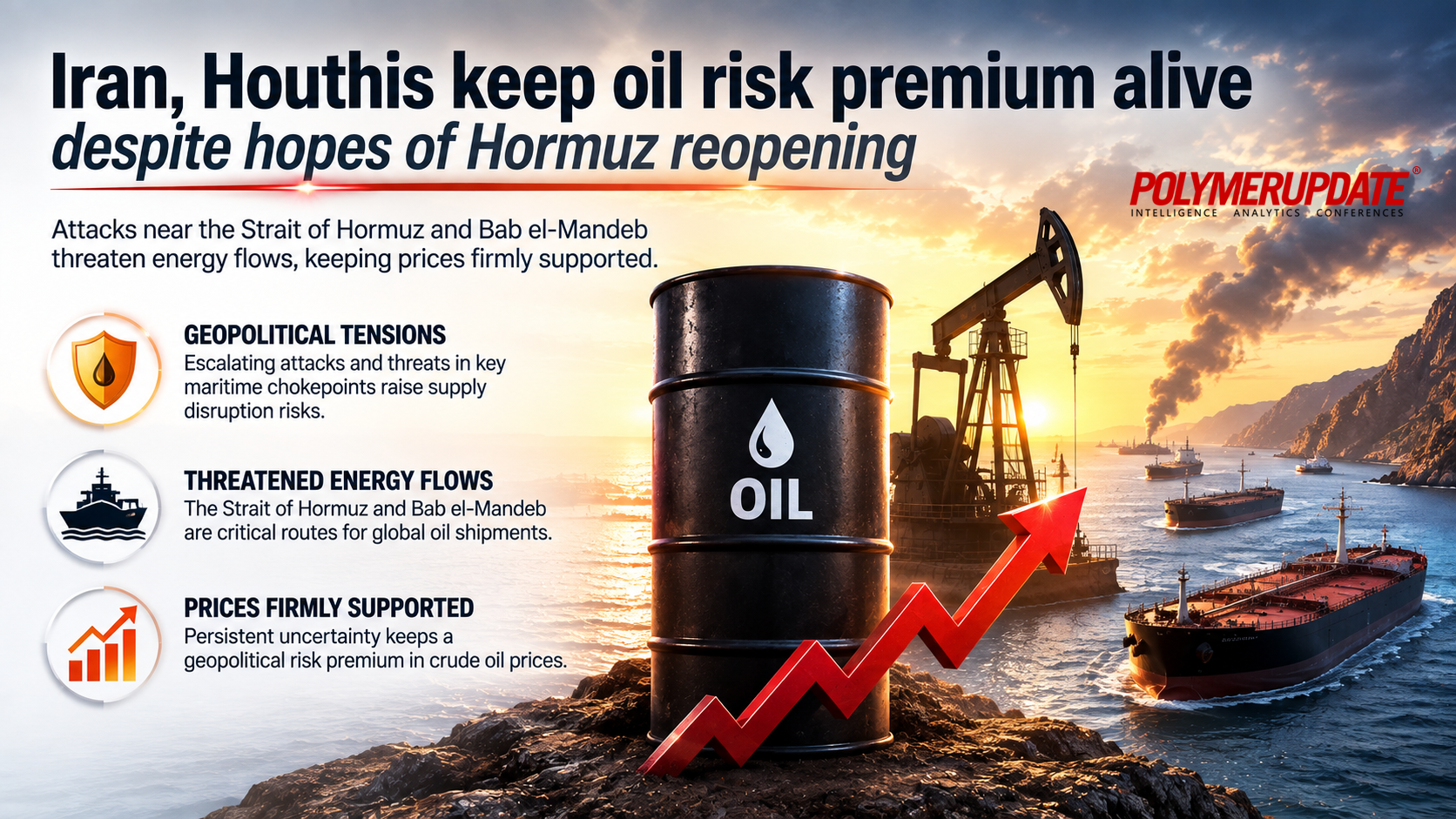
Crude oil markets may face a more persistent geopolitical risk premium than previously expected as Iranian forces, including the Islamic Revolutionary Guard Corps (IRGC), and Yemen’s Iran-aligned Houthis intensify attacks and threats against commercial shipping and energy infrastructure along two critical maritime routes in the Middle East—the Strait of Hormuz and the Bab el-Mandeb Strait. The latest escalation came on August 8, when the United Arab Emirates said an Abu Dhabi National Oil Company (ADNOC)-linked vessel was struck by an Iranian missile while transiting the Strait of Hormuz. No casualties were reported.
The company said in a statement, “ADNOC can confirm that one of its vessels was targeted by a missile while transiting the Strait of Hormuz in the early hours of Saturday, August 8. The incident resulted in no injuries, and the situation has been brought under control.” ADNOC said the incident brought the number of attacks involving its vessels since the conflict began to 15, while other reports put the tally at 16.
ADNOC stated in a separate statement, “We remain firmly focused on meeting customer requirements despite an exceptionally challenging environment. We continue to be significantly impacted by unprovoked attacks on our people and our assets. Since the beginning of the conflict, 15 of our vessels have been attacked by missiles and drones while transiting the Strait of Hormuz, including three vessels this week alone. Tragically, these attacks have resulted in one fatality and 20 injuries to crew members.”
Earlier, on July 14, ADNOC Logistics and Services plc confirmed that the crude oil tankers Al Bahyah and Mombasa B were struck by projectiles while transiting the Strait of Hormuz. Tragically, one seafarer lost his life, while several others were injured in the attacks. Al Bahyah, an ADNOC L&S-owned Very Large Crude Carrier (VLCC), and Mombasa B, a VLCC operated by ADNOC L&S under a time-charter arrangement, sustained significant damage.
ADNOC’s crude oil production capacity currently stands at approximately 4.85 million barrels per day (bpd). While its core upstream oil fields have largely avoided direct catastrophic damage, the regional conflict and associated strikes have heavily targeted downstream and processing hubs, including the temporary shutdown of the 922,000-bpd Ruwais refinery complex and security-related disruptions at the Habshan gas complex. These disruptions have been compounded by attacks on 15 ADNOC vessels by missiles and drones while transiting the Strait of Hormuz.
Focus on oil flowsThe attack is significant for oil markets because it comes at a time when traders are increasingly focused on the prospect of restoring normal shipping through the Strait of Hormuz. Any sustained improvement in vessel traffic through the waterway could encourage the market to unwind some of the geopolitical premium built into crude prices. However, the latest attack suggests that a return to normality could be slower and more complicated than anticipated.
Iran’s IRGC has repeatedly warned commercial vessels against using the strategic waterway and has targeted tankers attempting to transit the strait. In July, the IRGC said it had immobilised two oil tankers attempting to use a southern route through the Strait of Hormuz, reinforcing concerns among shipowners about the safety of commercial navigation. The risks are not confined to Hormuz. The Houthis have simultaneously stepped up pressure on shipping and energy infrastructure along the Red Sea and Bab el-Mandeb corridor. The group has claimed responsibility for attacks on Saudi oil facilities, including the Jazan refinery, and has threatened commercial vessels as part of its declared naval blockade.
For crude oil markets, simultaneous pressure on the Strait of Hormuz and the Red Sea creates a potentially important floor under prices. Even if diplomatic efforts succeed in reopening Hormuz, concerns over alternative maritime routes could prevent the complete removal of the geopolitical risk premium. The Strait of Hormuz remains the most important maritime chokepoint for global energy trade. Any disruption to the waterway can restrict the movement of crude oil, refined products and LNG, forcing exporters and buyers to seek alternative arrangements. The Red Sea and Bab el-Mandeb provide another important route for energy shipments, particularly cargoes moving between the Middle East and Europe.
Key issuesThe combination of risks means oil traders will increasingly look beyond the formal status of the Strait of Hormuz. The key question will be whether tankers are actually willing and able to sail through the waterway without facing unacceptable security, insurance or operational risks. This distinction could prove critical for both Brent and WTI. A diplomatic agreement allowing commercial vessels to transit Hormuz could initially trigger a sharp decline in crude prices as traders price in the restoration of supply flows. However, if vessel movements remain subdued because of security concerns, the initial sell-off could prove difficult to sustain.
Brent is likely to carry a greater immediate geopolitical premium because of its stronger linkage to international seaborne crude markets. WTI could also come under pressure if global prices decline following a perceived improvement in Middle East supply risks, although the U.S. benchmark is relatively less exposed to direct disruptions in regional physical flows. Conversely, any fresh attack on tankers or energy infrastructure could quickly reverse market expectations of normalisation. A prolonged disruption would raise concerns about crude availability in key consuming regions and could push Brent sharply higher, particularly if commercial inventories remain relatively tight.
Risk premiumsShipping economics could provide an important transmission mechanism. Higher war-risk insurance premiums, increased freight rates and longer voyage times would raise the cost of transporting crude even if physical production remains largely intact. Shipowners could also demand higher compensation before entering waters considered vulnerable to attack. This means the market could face a situation in which oil supply is technically available but increasingly expensive and difficult to transport. Such a scenario would support regional and international crude differentials and could keep Brent prices elevated relative to WTI.
The Houthi threat adds another layer of uncertainty. If vessels attempting to avoid the Strait of Hormuz encounter heightened risks in the Red Sea and Bab el-Mandeb, the scope for rerouting would become more limited. Longer voyages around the Cape of Good Hope could remain necessary for some cargoes, adding days to shipping schedules and increasing freight and fuel costs. For oil traders, the focus will therefore shift from diplomatic announcements to physical evidence of normalisation. Tanker movements through Hormuz, vessel bookings, insurance premiums, port activity and crude export volumes will be closely watched for signs that the geopolitical risk premium can be sustainably removed.
Supply disruptionsA genuine return to normal shipping could push Brent and WTI lower as fears of prolonged supply disruptions fade. Brent could face particular pressure if large volumes of Middle Eastern crude begin moving freely through the Strait of Hormuz and the market starts anticipating a rebuilding of inventories. However, the downside may remain limited if attacks continue along either maritime corridor. In that scenario, traders could maintain a meaningful geopolitical premium even as production recovers, preventing crude prices from fully retracing the gains generated during the crisis.
The latest developments therefore reinforce a key message for oil markets: reopening the Strait of Hormuz is necessary but may not be sufficient to restore normal energy trade. The market will need sustained evidence that vessels can safely transit both Hormuz and the wider regional maritime network before geopolitical risk premiums are fully unwound. Until then, crude prices are likely to remain highly headline-driven, with every development involving Iranian forces, the Houthis, tanker traffic or diplomatic negotiations capable of triggering sharp moves in Brent and WTI.
ConclusionFor now, the balance of risks remains two-sided. A durable diplomatic breakthrough and a sustained recovery in shipping could accelerate the decline in crude prices. However, renewed attacks or prolonged restrictions on commercial navigation could quickly revive fears of supply disruptions, putting a floor under prices and potentially triggering another leg higher.
DILIP KUMAR JHA
Editor
dilip.jha@polymerupdate.com