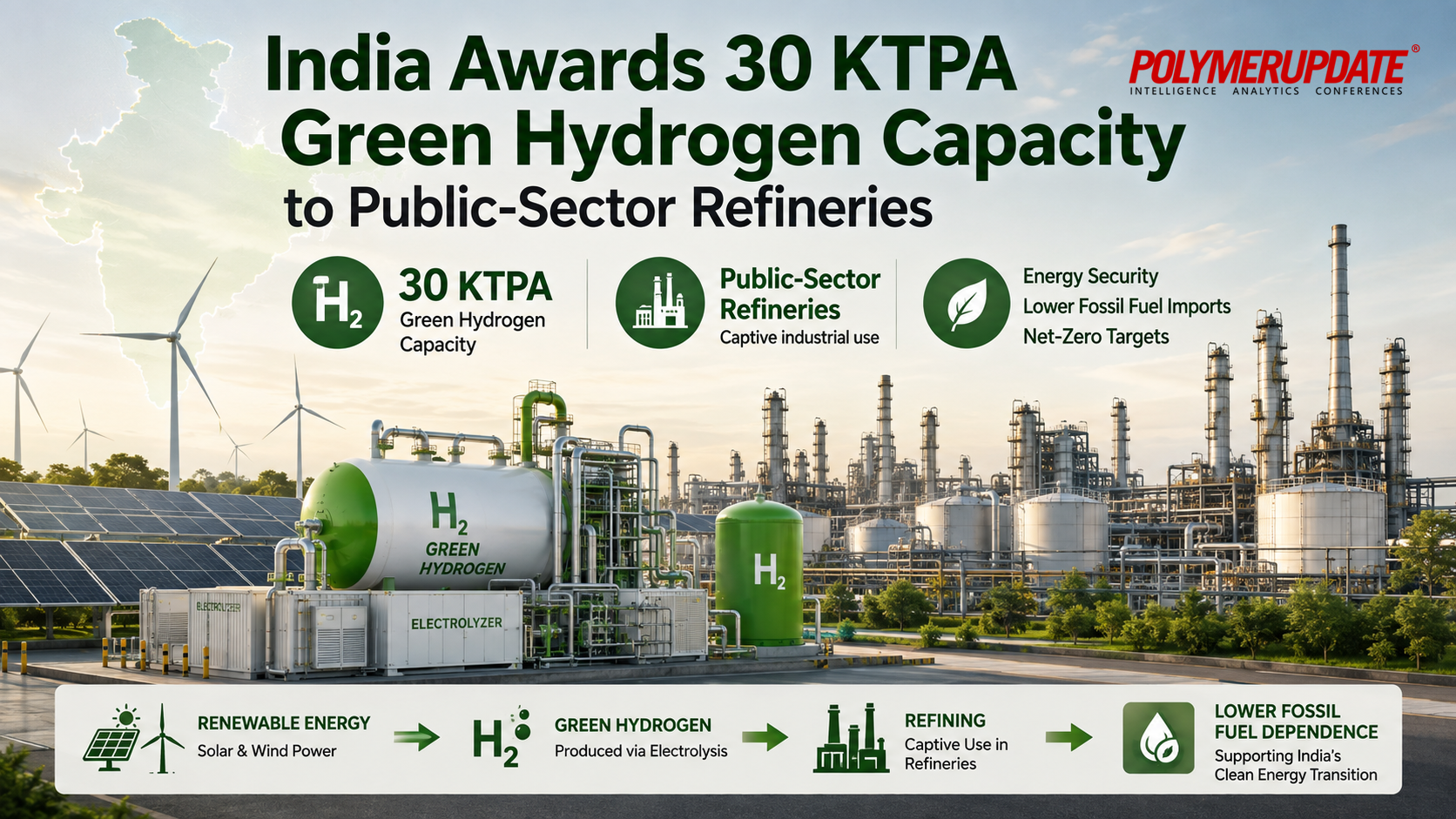
India’s government-owned refineries have been awarded a combined green hydrogen production capacity of 30 kilotonnes per annum (KTPA), reflecting the rapid adoption of green fuels by public-sector companies at their various production facilities. The move is aimed at reducing the country’s dependence on imported fossil fuels, enhancing energy security, supporting the clean energy transition and advancing net-zero objectives. Primarily intended for captive consumption at refining facilities, the green hydrogen capacity is expected to help companies develop long-term sustainable strategies and plan their output and supply commitments accordingly.
In a written reply to the Rajya Sabha, India’s Minister of State for New and Renewable Energy, Shripad Yesso Naik, said, “The Government of India is implementing the National Green Hydrogen Mission (NGHM) with the objective of making India a global hub for the production, usage and export of green hydrogen and its derivatives. Under the SIGHT (Strategic Interventions for Green Hydrogen Transition) Mode-2B scheme of the NGHM, green hydrogen production capacity of 30 KTPA has been awarded for refineries.”
He further said, “The projects are being implemented through BOO (Build-Own-Operate) arrangements by private developers, with project-specific investments from the concerned developers. Domestic production and utilisation of green hydrogen is expected to reduce dependence on imported fossil fuels, enhance energy security, and support India’s clean energy transition and net-zero objectives.”
Indian Oil Corporation Ltd (IOCL) has been awarded 10 KTPA of capacity for its Panipat refinery, while Bharat Petroleum Corporation Ltd (BPCL) and Hindustan Petroleum Corporation Ltd (HPCL) have been allocated 5 KTPA each for their Bina and Vizag refineries, respectively. Another 10 KTPA project has been awarded to Numaligarh Refinery Ltd (NRL) for its Numaligarh refinery. Reports indicate that several other refineries and independent producers have also proposed setting up dedicated green hydrogen production units.
 Green hydrogen introduction
Green hydrogen is hydrogen produced using renewable energy sources such as solar and wind power, rather than fossil fuels. The most common method involves electrolysis, in which electricity generated from renewable sources is used to split water into hydrogen and oxygen. Under standards notified by the Government of India, hydrogen produced through such processes is classified as “green” if the total greenhouse gas emissions associated with its production do not exceed 2 kg of CO₂ equivalent for every 1 kg of hydrogen produced.
Green hydrogen can also be produced from biomass, including agricultural waste, provided the resulting emissions remain within the same threshold of 2 kg of CO₂ equivalent per kg of hydrogen. By enabling hydrogen production with significantly lower emissions, these processes can help reduce the carbon intensity of sectors that are difficult to electrify directly, including refining, chemicals, fertilisers and heavy industry.
MissionLaunched in January 2023, the National Green Hydrogen Mission (NGHM) is aimed at building the capacity, infrastructure and ecosystem needed to position India as a global leader in green hydrogen production, use and exports. The Mission has an initial outlay of Rs 19,744 crore through financial year 2029-30, including Rs 17,490 crore for the Strategic Interventions for Green Hydrogen Transition (SIGHT) programme, Rs 1,466 crore for pilot projects, Rs 400 crore for research and development (R&D), and Rs 388 crore for other Mission components. Its implementation is centred on four key pillars: a supportive policy and regulatory framework, demand creation, R&D and innovation, and the development of enabling infrastructure and an ecosystem for the sector.
By 2030, the Mission is expected to be supported by around 125 GW of new renewable energy capacity dedicated to green hydrogen production, backed by investments exceeding Rs 8 lakh crore. The government estimates that the Mission could create more than 6 lakh jobs, reduce fossil fuel imports by over Rs 1 lakh crore and help avoid nearly 50 million tonnes (MMT) of greenhouse gas emissions annually by 2030. These targets are intended to strengthen domestic green hydrogen production while creating opportunities for its wider adoption across energy-intensive industries and for exports to international markets.
Progress under the Mission has already gathered momentum. As of May 2025, 19 companies had been allocated a cumulative annual green hydrogen production capacity of 862,000 tonnes, while 15 firms had been awarded a combined annual electrolyser manufacturing capacity of 3,000 MW. The government has also launched pilot projects to demonstrate the use of green hydrogen in sectors such as steel, mobility and shipping. These initiatives are expected to help develop commercially viable applications, build domestic manufacturing capabilities and accelerate the transition towards a low-carbon industrial economy.
Long-term visionIndia has set an ambitious target of producing 5 million tonnes (MMT) of green hydrogen annually by 2030 as part of its broader energy transition. The country is reducing its dependence on fossil fuels while expanding domestic clean energy production, in line with its vision of becoming a developed nation by 2047 and achieving net-zero emissions by 2070. Green hydrogen is emerging as a clean and scalable fuel alternative that can help decarbonise hard-to-abate sectors, reduce dependence on imported fossil fuels and strengthen India’s energy security and industrial competitiveness.
The government has been advancing green hydrogen applications through pilot projects across key sectors. A port-based green hydrogen pilot has been commissioned at V.O. Chidambaranar Port, while the Deendayal Port Authority at Kandla has commissioned a megawatt-scale indigenous green hydrogen facility. In the mobility sector, hydrogen pilot projects have been launched across 10 routes, involving 37 fuel-cell and hydrogen internal combustion engine vehicles. These initiatives are aimed at demonstrating the technical and commercial viability of green hydrogen and building the infrastructure and capabilities required for its wider adoption.
The launch of the National Green Hydrogen Mission (NGHM) in 2023 marked a major step in India's efforts to establish a comprehensive green hydrogen ecosystem and catalyse a systemic response to the opportunities and challenges in the sector. The Mission goes beyond being an energy initiative, representing a strategic pathway towards greater industrial competitiveness, lower fossil fuel import dependence and long-term energy security. By linking sustainability with self-reliance, India seeks to develop green hydrogen into an important pillar of its clean energy transition while creating new opportunities for domestic manufacturing, investment and economic growth.
DILIP KUMAR JHA
Editor
dilip.jha@polymerupdate.com