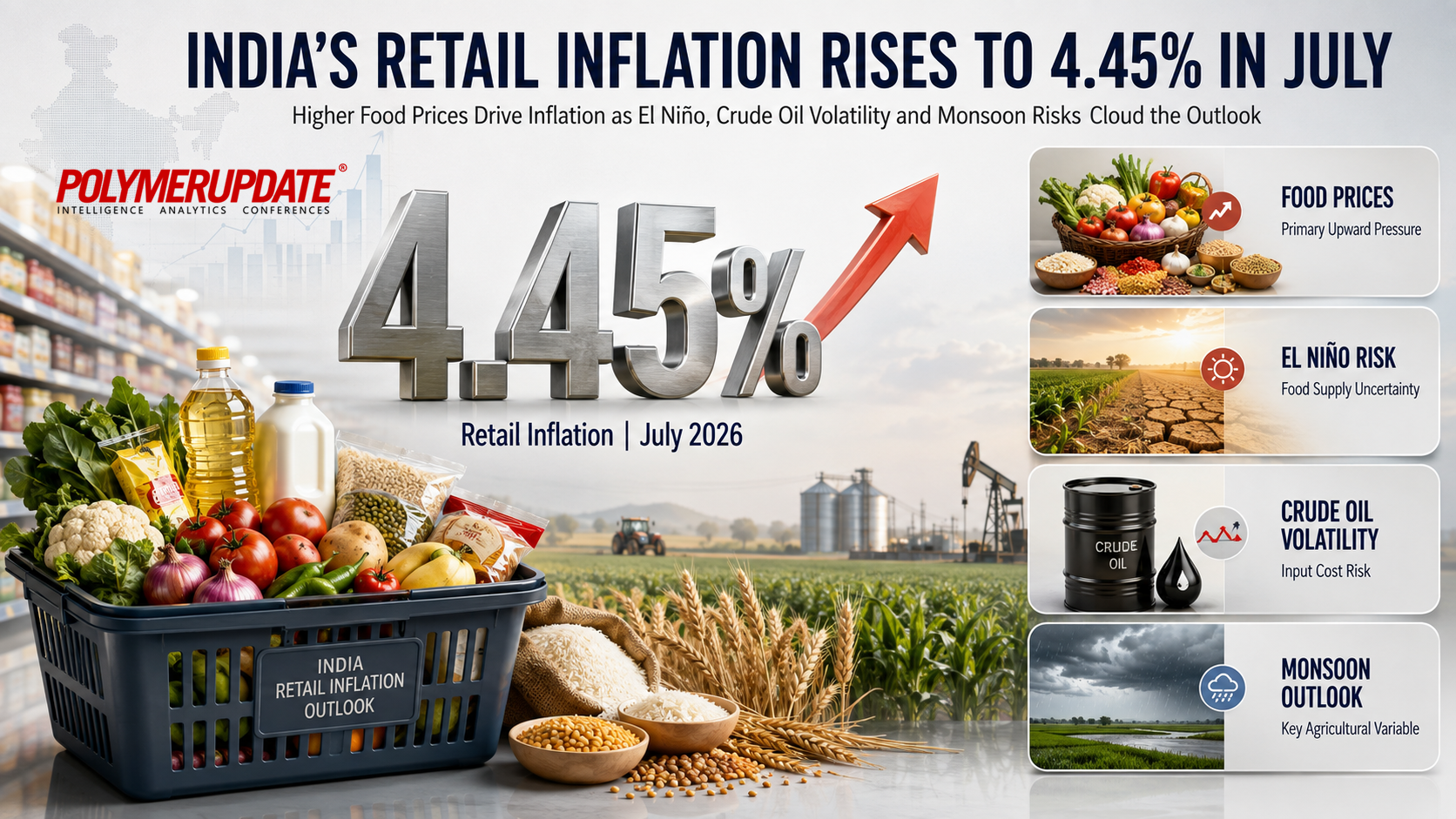
India’s Consumer Price Index (CPI)-based retail inflation inched higher to 4.45 percent in July, driven by a substantial increase in food prices, amid the impact of El Niño on the temporal and spatial distribution of rainfall so far this season. However, the impact of the unfavourable monsoon season has remained somewhat contained due to proactive supply management and adequate foodgrain stocks in the buffer from previous seasons.
Data compiled by the Ministry of Statistics & Programme Implementation (MoSPI) showed that India’s retail inflation rose marginally in July, with rural and urban inflation at 4.84 percent and 3.96 percent, respectively. CPI inflation in June 2026 stood at 4.38 percent, with the respective urban and rural inflation rates at 4.74 percent and 3.93 percent. Notably, India’s retail inflation in July 2025 was reported at 1.55 percent, its lowest level in eight years.
Madan Sabnavis, Chief Economist at Bank of Baroda, commented, “CPI inflation came in at 4.45 percent, similar to our forecast. This is virtually unchanged from June, when it was at 4.4 percent. We do, however, see the potential for higher inflation in the future, given the state of the monsoon and the area under cultivation. While the monsoon has recovered substantially in July, there has been news of crop damage due to excess rainfall. This, combined with a longer cropping period and, hence, a delayed harvest, will push up prices of pulses in particular. Global prices of edible oils are also high, which is being felt in domestic markets.”
 Higher food inflation
According to MoSPI data, the year-on-year inflation rate based on the All India Consumer Food Price Index (CFPI) for July 2026 over July 2025 was reported at 5.52 percent (provisional). The corresponding inflation rates for rural and urban areas were 5.79 percent and 5.05 percent, respectively. While inflation in food and beverages rose to 5.24 percent, the inflation print for paan, tobacco and intoxicants surged to 4.79 percent. Retail inflation for clothing and footwear stood at 3.38 percent, while inflation for restaurant and accommodation services worked out to 7.72 percent. Inflation for personal care, social protection and miscellaneous goods and services stood at 14.77 percent.
Food inflation remains high at 5.5 percent and is expected to continue on an upward trend. However, price movements vary depending on crop sizes: prices of potatoes and tomatoes have declined due to higher production, while onion prices have increased due to lower production. Food items such as onion, garlic and ginger witnessed a sharp increase in prices in July. Government data showed a substantial 22.54 percent increase in onion prices in July, compared with a 4.73 percent increase in June. Similarly, retail inflation for ginger and garlic jumped to 83.62 percent in July, compared with 50.41 percent in June, and 35.36 percent in July, compared with 17.93 percent in June, respectively.
In contrast, prices of potatoes, lady’s finger, peas and tomatoes declined by an average of 16.56 percent in July, compared with a 20.34 percent decline in June; 5.52 percent, compared with a 5.54 percent increase in June; 5.27 percent, compared with a 9.67 percent decline in June; and 5.49 percent, compared with a sharp 31.92 percent increase in June, respectively. Prices of bullion and jewellery have increased significantly in India, following a proportionate rise in international prices.
Above RBI’s targetThe latest CPI inflation print remained above the Reserve Bank of India’s (RBI’s) medium-term target of 4 percent. Retail inflation crossed the central bank’s target in June after remaining subdued for a prolonged period. The RBI is mandated to maintain India’s headline inflation at 4 percent, while allowing it to move within a tolerance band of 2–6 percent, for a five-year period from April 1, 2026, to March 31, 2031. This also marks the highest reading since India adopted its revised CPI series, with a new base year and updated consumption basket, earlier this year.
The RBI said while releasing the findings of the Monetary Policy Committee (MPC) earlier this month, “While CPI inflation increased to 4.4 percent in June 2026 after remaining below the target for 16 consecutive months, it was 30 basis points (bps) lower than projected for the April-June 2026 quarter. The increase in June was driven primarily by higher food and fuel inflation, as well as fuel-induced inflation in select categories, such as restaurant services. Going forward, the impact of El Niño on the temporal and spatial distribution of rainfall continues to pose a major risk, although proactive supply management and adequate foodgrain stocks should provide some comfort.”
Global crude oil prices have remained highly volatile, with sharp two-way movements triggered by geopolitical developments, clouding the near-term outlook. Although broad-based inflationary pressures have remained modest so far, the risk of second-round effects from higher food, fuel and other input costs translating into more widespread inflation persists.
War impactThe impact of the war on prices can be seen in higher inflation for restaurants and food services, where higher fuel prices have prompted businesses to increase prices. While there has been some normalisation in fuel supply, prices remain elevated and tend to be inelastic on the downside. The impact of the war can also be seen in glass products, which have recorded a 5 percent increase within the furnishings category, as the industry uses gas as a fuel.
Within personal care products and other items, gold and silver, which have a combined weight of around 0.9 percent, continue to exert pressure, with global prices remaining elevated and sticky over the past few months. This trend is likely to continue in the coming months as well. Within the transport category, inflation increased for fuel used by both households and for the transportation of goods, while inflation for vehicles themselves declined. The increase in fuel pump prices will continue to be reflected in inflation readings in subsequent months.
Inflation has remained benign in housing, water, gas and other fuels, health, information and communication, and furnishings, while it has been slightly elevated in education at 3.6 percent and clothing and footwear at 3.4 percent.
OutlookSabnavis projected India’s retail inflation to remain at 5.2 percent in the current financial year, 2026–27, with an upward bias, and expects one rate hike during the year. This is also in line with the RBI’s inflation forecasts for the October–December 2026 and January–March 2027 quarters, as well as the April–June 2027 quarter, which are all above 5 percent and average 5.5 percent.
DILIP KUMAR JHA
Editor
dilip.jha@polymerupdate.com