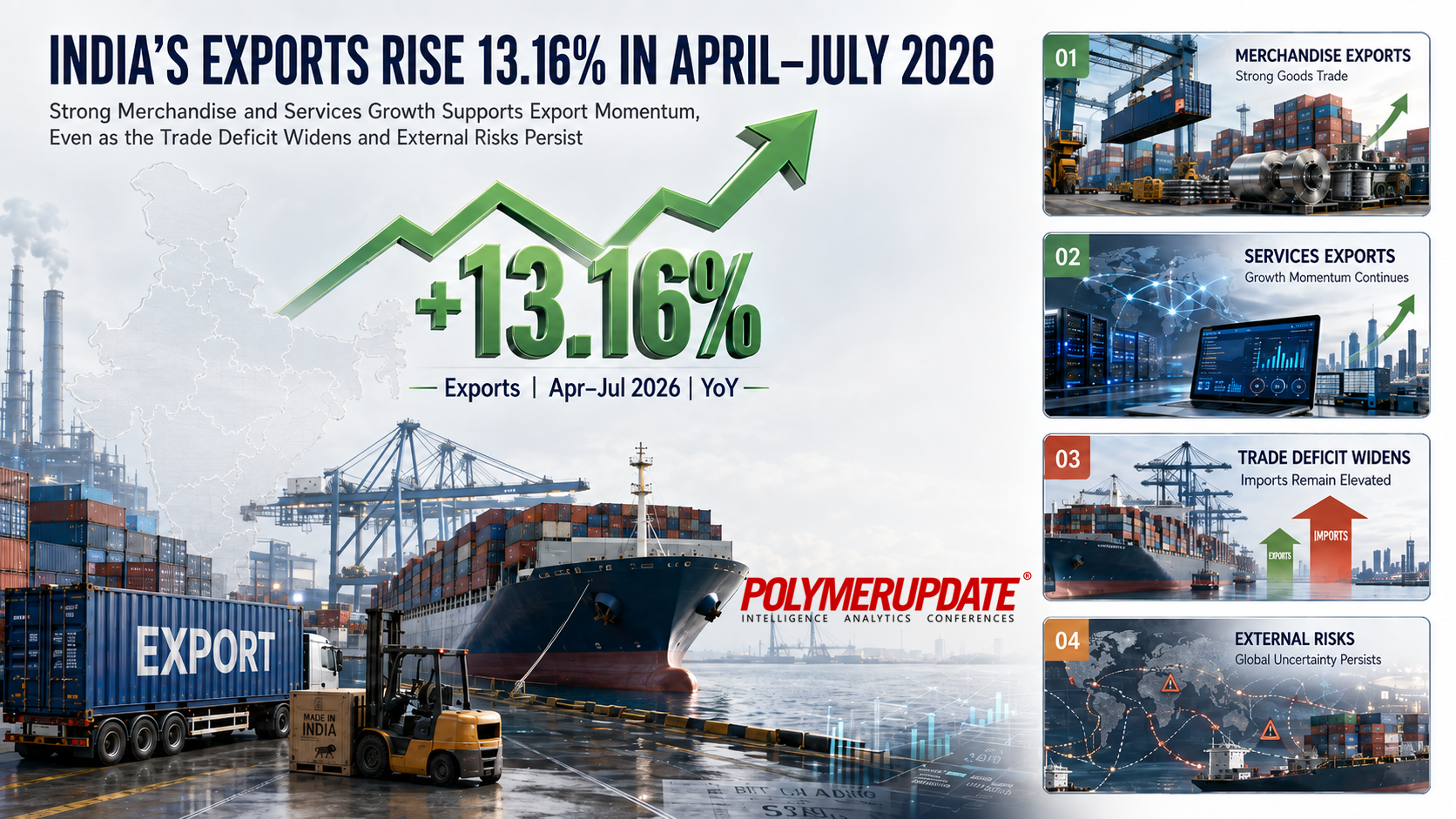
India’s cumulative exports of merchandise and services rose 13.16 percent year-on-year during April-July 2026 despite global headwinds stemming from the geopolitical conflicts in the Middle East and transport disruptions through the Strait of Hormuz, the critical maritime route connecting the Persian Gulf to the Gulf of Oman and the Arabian Sea. The Indian government expanded market access through the signing Free Trade Agreements (FTAs) with various trade partners during the ongoing challenging times when a number of countries especially in the Gulf region face multiple headwinds.
Data compiled by the Ministry of Commerce and Industry showed India’s overall exports reaching an estimated US$ 316.42 billion during April-July 2026-27 period, compared with US$ 279.63 billion in the corresponding period of 2025-26, supported by robust growth in merchandise shipments and a strong performance by key export sectors. However, the faster pace of import growth widened the country’s overall trade imbalance. Total imports during the first four months of 2026-27 are estimated at US$ 365.85 billion, up 17.28 percent from the year-earlier period, resulting in an overall trade deficit of about US$ 49.43 billion.
 Merchandise trade up
Merchandise exports remained a key contributor to the improvement in India’s external trade performance. Merchandise exports during April-July 2026-27 increased 17.04 percent to US$ 173.78 billion from US$ 148.48 billion a year earlier. Merchandise imports, however, rose even faster, increasing to US$ 292.38 billion from US$ 245.14 billion, pushing the merchandise trade deficit to US$ 118.60 billion from US$ 96.66 billion in the corresponding period.
Non-petroleum exports maintained a healthy growth trajectory during April-July 2026-27, rising 12.79 percent year-on-year to US$ 143.61 billion from US$ 127.32 billion in the corresponding period of 2025-26. The robust increase indicates that India’s overall export growth was broad-based and not driven solely by higher petroleum product shipments, with non-oil sectors continuing to make a significant contribution to the country’s export performance.
July trade growthThe momentum was particularly visible in July, when India’s combined merchandise and services exports were estimated at US$ 80.14 billion, representing a 13.31 percent increase from US$ 70.72 billion in July 2025. Imports, meanwhile, climbed 15.83 percent to US$ 95.16 billion from US$ 82.14 billion. Consequently, the total trade deficit widened to US$ 15.03 billion in July from US$ 11.43 billion in the same month last year.
Merchandise exports rose sharply in July, reaching US$ 44.24 billion compared with US$ 36.98 billion a year earlier. Merchandise imports increased to US$ 76.22 billion from US$ 64.86 billion, resulting in a merchandise trade deficit of nearly US$ 32 billion during the month. Services continued to provide an important cushion to the overall trade balance. Services exports increased to US$ 35.89 billion in July from US$ 33.74 billion a year earlier, while services imports rose to US$ 18.94 billion from US$ 17.30 billion. The services surplus of around US$ 16.95 billion therefore partially offset the merchandise trade deficit.
Sectoral performanceThe sectoral composition of merchandise exports also pointed to broad-based strength. Petroleum products emerged as the fastest-growing major export category in July, with shipments jumping 67.64 percent to US$ 6.92 billion from US$ 4.13 billion in July 2025. Electronic goods exports continued their strong expansion, rising 57.40 percent to US$ 5.92 billion from US$ 3.76 billion. The sustained growth in electronics exports highlights the increasing importance of the sector in India’s merchandise export basket, supported by expanding domestic manufacturing and global supply-chain integration.
Engineering goods exports, another major component of India’s merchandise shipments, increased 17.71 percent to US$ 12.24 billion in July from US$ 10.40 billion a year earlier. The category remained one of the largest contributors to the month’s export growth, reflecting continued demand for Indian industrial and manufactured products in overseas markets. Exports of organic and inorganic chemicals rose 14.39 percent to US$ 2.80 billion from US$ 2.45 billion, while exports of cotton yarn, fabrics, made-ups and handloom products increased 8.40 percent to US$ 1.11 billion from US$ 1.02 billion.
The broader export picture also remained positive when petroleum and gems and jewellery were excluded. Non-petroleum and non-gems and jewellery exports stood at US$ 35.00 billion in July 2026, compared with US$ 30.47 billion a year earlier, marking a substantial increase and suggesting that underlying merchandise export growth remained relatively resilient.
Import trendOn the import side, non-petroleum and non-gems and jewellery imports rose to US$ 51.82 billion in July from US$ 43.07 billion in July 2025. The increase reflects continued domestic demand for industrial inputs, capital goods and other products, but also contributed to the widening trade deficit.
The latest trade figures therefore present a mixed picture for India’s external sector. Strong growth in merchandise and services exports, particularly in petroleum products, electronics, engineering goods and chemicals, points to improving export competitiveness and diversification. At the same time, imports are expanding at a faster pace than exports, keeping pressure on the trade balance.
With cumulative exports growing by more than 13 percent in the first four months of 2026-27, the export sector has begun the financial year on a strong footing. Sustaining this momentum will, however, depend on global demand conditions, commodity prices, geopolitical developments and the ability of Indian manufacturers and services providers to expand their presence in international markets. The widening trade deficit remains a key indicator to watch as the year progresses.
DILIP KUMAR JHA
Editor
dilip.jha@polymerupdate.com