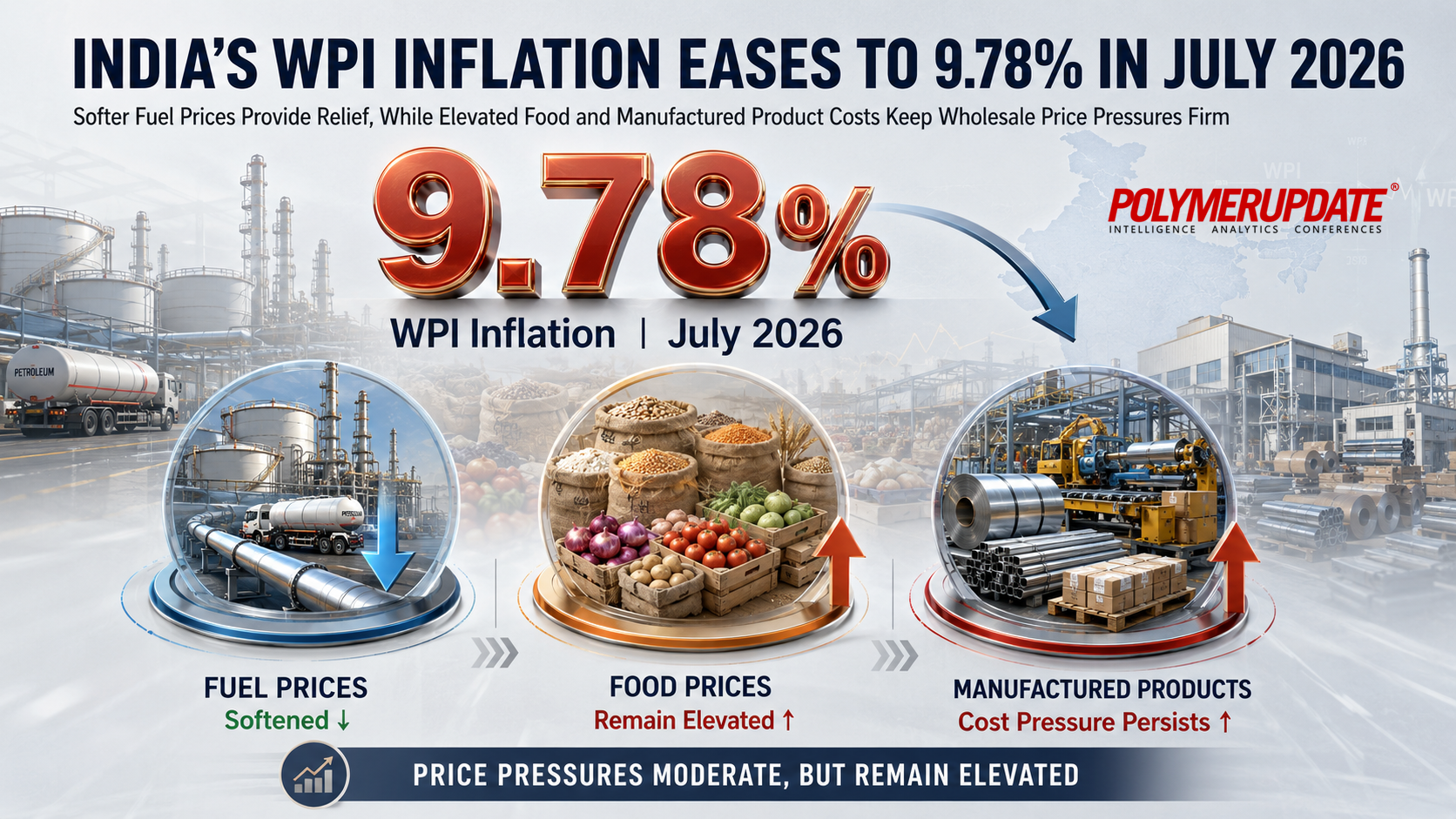
India’s wholesale inflation, measured by the Wholesale Price Index (WPI), softened marginally to 9.78 percent in July, primarily due to a decline in fuel and power prices following easing crude oil prices in international markets amid talks of restoring supplies through the Strait of Hormuz, the strategic waterway currently controlled by Iran’s Islamic Revolutionary Guard Corps (IRGC). The wholesale inflation reading was slightly lower than the 9.87 percent recorded in June but significantly higher than the deflation of 0.58 percent recorded in July 2025.
A statement issued by the Ministry of Commerce and Industry on Friday stated, “Wholesale prices remained lower across all groups, including mineral oils (containing petroleum products), food articles, manufacture of basic metals, non-food articles, manufacture of food products, and manufacture of chemicals and chemical products, but remained elevated in July 2026. The index for All Commodities for July 2026 stands at 110.0, whereas it was 110.2 in June 2026.”
Rajani Sinha, Chief Economist at Care Ratings Ltd, said, “WPI inflation moderated marginally to 9.78 percent in July from 9.87 percent in June. There was a sharp decline in fuel and power inflation, but it remains high at 20 percent. The moderation was driven by lower prices of mineral oils and crude petroleum and natural gas, reflecting the sequential softening in global energy prices during July. However, the global geopolitical scenario remains volatile, and the future trajectory of fuel and power inflation will continue to hinge on global energy market dynamics. The overall moderation in WPI was limited by an uptick in inflation across manufactured products, which could be attributed to the pass-through of higher input prices.”
Although WPI inflation does not directly influence the Reserve Bank of India’s (RBI’s) interest-rate decisions, it remains significant as it can provide an indication of emerging price pressures that may eventually be reflected in Consumer Price Index (CPI)-based retail inflation, typically with a lag of one to two months. WPI captures broad-based price trends across major commodity groups during the period under consideration.
 Food inflation
The food index, comprising ‘food articles’ under the primary articles major group and ‘manufacture of food products’ under the manufactured products major group, recorded year-on-year inflation of 6.65 percent in July 2026, up from 6.14 percent in June. The increase indicates a renewed build-up in food-related price pressures during the month. On the food front, although inflation in vegetables and fruits eased due to improved availability and seasonal factors, higher prices of food grains and protein-rich items kept food inflation elevated at 5.4 percent in July.
The persistence of price pressures in essential food categories remains a key factor influencing the overall inflation trajectory, particularly as higher grain and protein prices can have a broader impact on household consumption costs. Meanwhile, in line with elevated wholesale price inflation, output producer price inflation remained high at 9.6 percent in July, unchanged from the previous month. The sustained increase points to continued price pressures across the production chain, with producers facing elevated costs despite some moderation in select food categories.
A persistently high output producer price inflation also suggests that underlying cost pressures remain significant across manufacturing and other production-linked sectors. If sustained, these pressures could eventually feed into downstream prices, although the extent of pass-through would depend on demand conditions, input costs and producers’ ability to absorb higher expenses.
Other categoriesIndia’s wholesale price inflation remained elevated in July 2026, with price pressures broadening across major segments of the economy. Year-on-year inflation in primary articles rose to 8.52 percent in July from 7 percent in June, while inflation in manufactured products increased to 8.29 percent from 7.48 percent. In contrast, inflation in the fuel and power segment moderated sharply to 20.05 percent from 27.41 percent. The corresponding wholesale price indices for primary articles, fuel and power, and manufactured products stood at 117.2, 105.4 and 108.4, respectively, in July, compared with 116.1, 111.1 and 107.8 in June.
The moderation in fuel and power inflation was largely driven by a decline in mineral oil and crude petroleum and natural gas prices. Mineral oil inflation eased to 32.4 percent in July from 46.48 percent in June, while inflation in crude petroleum and natural gas fell to 26.99 percent from 34.75 percent. However, the overall improvement in fuel-related price pressures was offset to some extent by a sharp acceleration in prices of non-food articles. Inflation in the category surged to 17.66 percent in July from 11.07 percent in June, contributing to the increase in overall primary articles inflation. The divergent movement across components indicates that while energy-related cost pressures have moderated, inflationary pressures remain firm in several raw material categories.
Manufactured products also witnessed a broad-based increase in inflation, with chemical products recording inflation of 13.12 percent and basic metals 12.56 percent in July. Textile prices rose 12.8 percent, while inflation in electrical equipment stood at 12.34 percent. Inflation in manufactured food products also increased significantly to 8.89 percent from 7.2 percent in June, pointing to continued pressure on processed food prices. In contrast, motor vehicle manufacturing inflation remained relatively moderate at 1.8 percent. Meanwhile, the government revised the final Wholesale Price Index (WPI) for May 2026 to 110.1 from the earlier estimate of 109.9, resulting in an upward revision in May WPI inflation to 9.88 percent from the provisional 9.68 percent.
OutlookLooking ahead, the inflation outlook remains exposed to both external and weather-related risks. Uncertainty over transit through the Strait of Hormuz continues to weigh on crude oil prices. Domestically, below-normal rainfall remains a key risk. Despite a delayed start, sowing activity has improved, although concerns over agricultural yields persist. Food prices, particularly cereals, pulses and edible oils, remain the most vulnerable to weather-related disruptions and warrant close monitoring. The eventual trajectory of food inflation will depend on the spatial and temporal distribution of rainfall in the coming months. The government may also undertake supply-side interventions to contain food inflation, if required.
DILIP KUMAR JHA
Editor
dilip.jha@polymerupdate.com