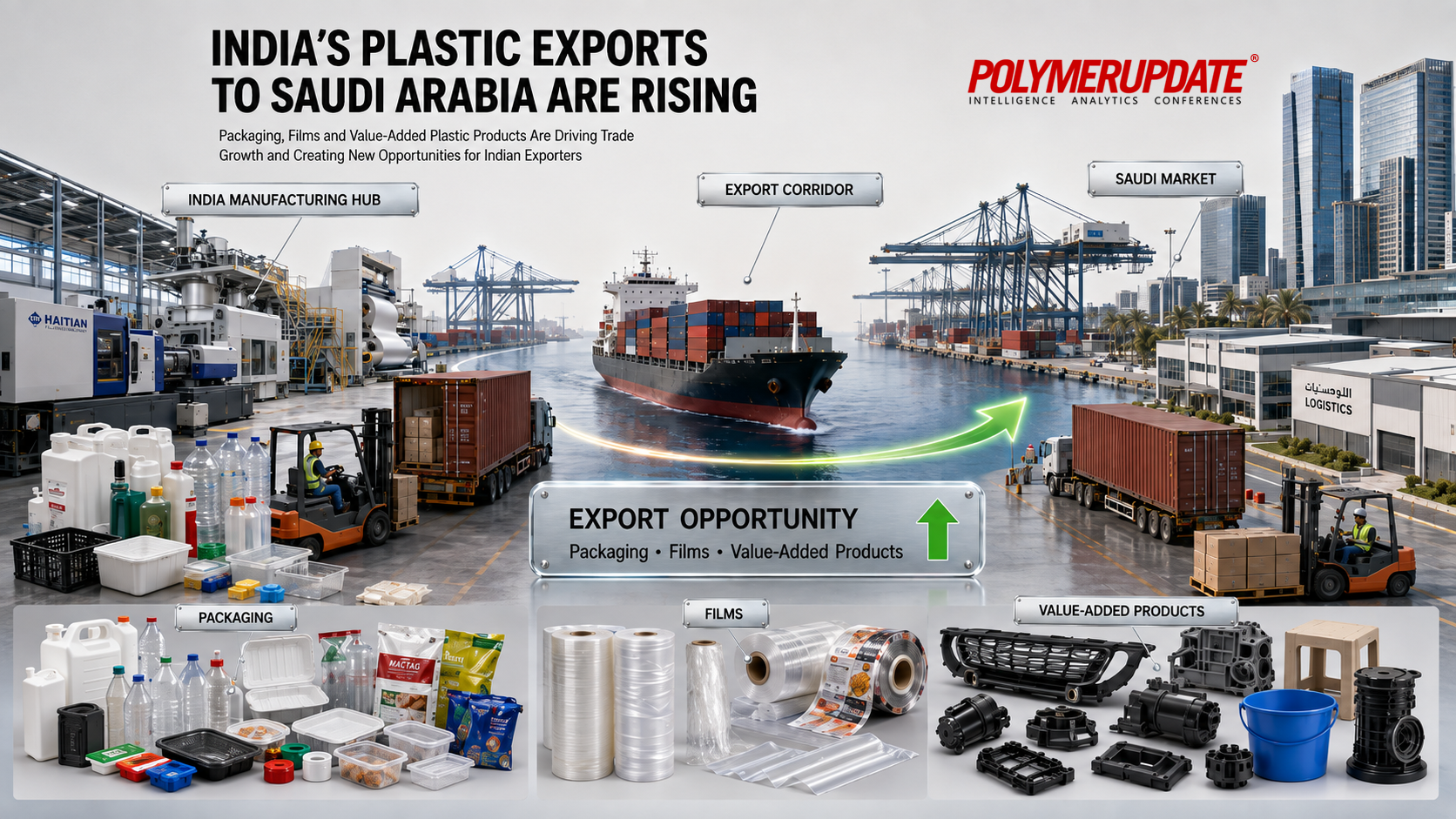
Saudi Arabia has emerged as one of the major destinations for Indian plastic products in recent years, with India’s exports to the Kingdom recording a sharp increase in the financial year 2024-25. Total inbound shipments of Indian plastics to Saudi Arabia were valued at around US$ 204.66 million (approximately Rs 1,700 crore) during FY2024-25, highlighting the growing acceptance of Indian-made packaging materials, plastic products and value-added goods in the Saudi market.
The development is significant because trade between the two countries has traditionally been skewed towards Saudi Arabia’s exports of petrochemical feedstocks and polymers to India. Indian manufacturers primarily import raw materials such as polyethylene and propylene from Saudi Arabia, while shipments in the opposite direction increasingly comprise processed plastic products, films, packaging materials and other value-added goods.
Trade sources expect India’s plastics exports to Saudi Arabia to continue expanding in FY2025-26 and beyond, supported by stronger bilateral economic ties, government initiatives to promote exports, regional trade agreements and improving business partnerships between Indian and Saudi companies. However, despite the recent growth, India’s share of the Saudi plastic market remains relatively small, leaving considerable room for Indian exporters to expand their presence.
Sribas Dasmohapatra, Executive Director, the Plastic Export Promotion Council (Plexconcil), commented. “Plastic exports (including masterbatch) to Saudi Arabia has grown by 86 percent to US$ 123.05 million in April-June 2026 quarter from US$ 66.3 million in the year ago period, largely led by raw materials, whose shipments grew more than threefold (from US$ 21 million to US$ 73 million in this period. Raw materials account for 60 percent of overall shipments this year, up from 32 percent last year.”
Plexconcil data showed, shipment of films and sheets more than doubled to US$ 14.7 million, while exports of masterbatch grew 40 percent to US$ 10 million. On the other hand, export of consumer houseware products, floor covering and packaging products declined during this period (April-Jun 2026). Among value added products, exports of cordage & fishnets, FRP and packaging items posted growth during last financial year (FY26).
Large and growing marketSaudi Arabia represents one of the largest markets for plastics and packaging products in the Middle East. Market estimates vary depending on the segment covered, with the overall plastics market valued at several billion dollars and the plastic packaging segment alone representing a substantial and rapidly expanding opportunity. The Saudi Arabian plastic packaging market is estimated to reach around US$ 11.93 billion by 2026, registering a compound annual growth rate of about 5.6 percent between 2021 and 2026. Other estimates place the value of the broader Saudi plastic packaging market at considerably higher levels, reflecting differences in market definitions and the product segments included.
Growth is being driven by the Kingdom’s expanding manufacturing base, rising consumption of packaged food and beverages, pharmaceutical production, textiles and apparel, and industrial diversification under its Vision 2030 programme. According to the Saudi Industrial Development Fund (SIDF), the country has hundreds of manufacturing facilities across sectors that are major consumers of plastic products and packaging. These include 964 food and beverage manufacturing facilities, 196 textile and apparel manufacturing facilities and 45 pharmaceutical manufacturing facilities.
The expansion of these industries is expected to sustain demand for flexible and rigid packaging, films, containers, closures and other plastic products. For Indian manufacturers, this provides an opportunity to move beyond commodity exports and establish a stronger position in Saudi Arabia’s value-added plastics supply chain.
Opportunity for Indian exportersIndia has developed a sizeable and diversified plastics manufacturing industry, supported by a large domestic market, expanding production capacity and a broad base of processors and converters. The country exports around US$ 12.5 billion worth of plastics and plastic products annually. The United States remains India's largest destination by a wide margin, accounting for roughly one-fifth of total plastic exports. The UAE is another important market, followed by China, the United Kingdom and Germany. Other significant destinations include Nepal, Hong Kong, Bangladesh, Vietnam and Italy.
Saudi Arabia, however, offers a different opportunity because of the country's large petrochemical industry and its growing downstream manufacturing base. While Saudi Arabia is a major producer and exporter of polymers, its expanding domestic manufacturing and consumer sectors require a wide range of converted and finished plastic products.
This creates potential for Indian companies that can supply specialised films, flexible packaging, industrial packaging, plastic household products, pipes and fittings, agricultural products, automotive components and other value-added applications. The shift from exporting commodities to supplying finished and semi-finished products could also improve margins for Indian companies while reducing their dependence on highly competitive commodity markets.
Bilateral ties to support growthIndia and Saudi Arabia have strengthened economic and commercial relations in recent years, creating a favourable environment for greater two-way investment and trade. Government efforts to facilitate exports, expand market access and deepen bilateral partnerships are expected to support Indian companies seeking opportunities in the Kingdom. For the plastics industry, closer commercial engagement could help manufacturers establish distribution networks, enter long-term supply agreements and develop partnerships with Saudi converters and end-users.
Indian companies also have an advantage in terms of manufacturing capabilities and cost competitiveness. The country's established plastics processing ecosystem enables manufacturers to offer a broad range of products at competitive prices while increasingly meeting international quality and compliance requirements. Timely delivery and product consistency will nevertheless remain critical for gaining market share in Saudi Arabia. Local distributors and end-users are likely to favour suppliers capable of maintaining uninterrupted supplies, meeting technical specifications and providing after-sales and technical support.
Competition remains intenseDespite the opportunities, Indian exporters face strong competition from established suppliers from China, the UAE, Turkey, Southeast Asia and other countries. Proximity, established distribution channels and competitive pricing give some of these suppliers an advantage. Indian exporters will therefore need to focus on product differentiation, quality, reliability and customer service rather than competing solely on price.
The Kingdom's Vision 2030 strategy is also encouraging localisation and development of domestic manufacturing capabilities. This could eventually create both opportunities and challenges for foreign suppliers. Companies that establish local partnerships or manufacturing and distribution arrangements could be better positioned to benefit from Saudi Arabia's industrial expansion.
Scope for further expansionThe sharp increase in Indian plastics exports to Saudi Arabia during FY2024-25 indicates that the market is already opening up for Indian manufacturers. Further growth could come from greater penetration of packaging, films and other converted products, particularly as Saudi Arabia's food, beverage, pharmaceutical and consumer industries continue to expand. The opportunity is also significant because Saudi Arabia's large petrochemical production base creates a natural ecosystem for downstream plastics manufacturing. Indian companies can potentially leverage Saudi polymer availability while supplying specialised conversion technologies and finished products to the domestic market.
For India, increasing plastics exports to Saudi Arabia would support the government's broader objective of moving the industry up the value chain and expanding the country's footprint in global markets. The immediate challenge, however, will be to convert the recent export momentum into a sustained market presence. With Saudi Arabia investing heavily in manufacturing diversification and India seeking new overseas markets, the two countries have the potential to build a more balanced plastics trade relationship—one that moves beyond the traditional flow of Saudi polymers to India and increasingly includes Indian value-added plastic products moving in the opposite direction.
Given the size of the Saudi market and the relatively small current share held by Indian exporters, the headroom for growth remains substantial. If Indian manufacturers can combine competitive pricing with international-quality products, reliable delivery and stronger local partnerships, Saudi Arabia could emerge as an increasingly important market for India's plastics and packaging industry.
DILIP KUMAR JHA
Editor
dilip.jha@polymerupdate.com