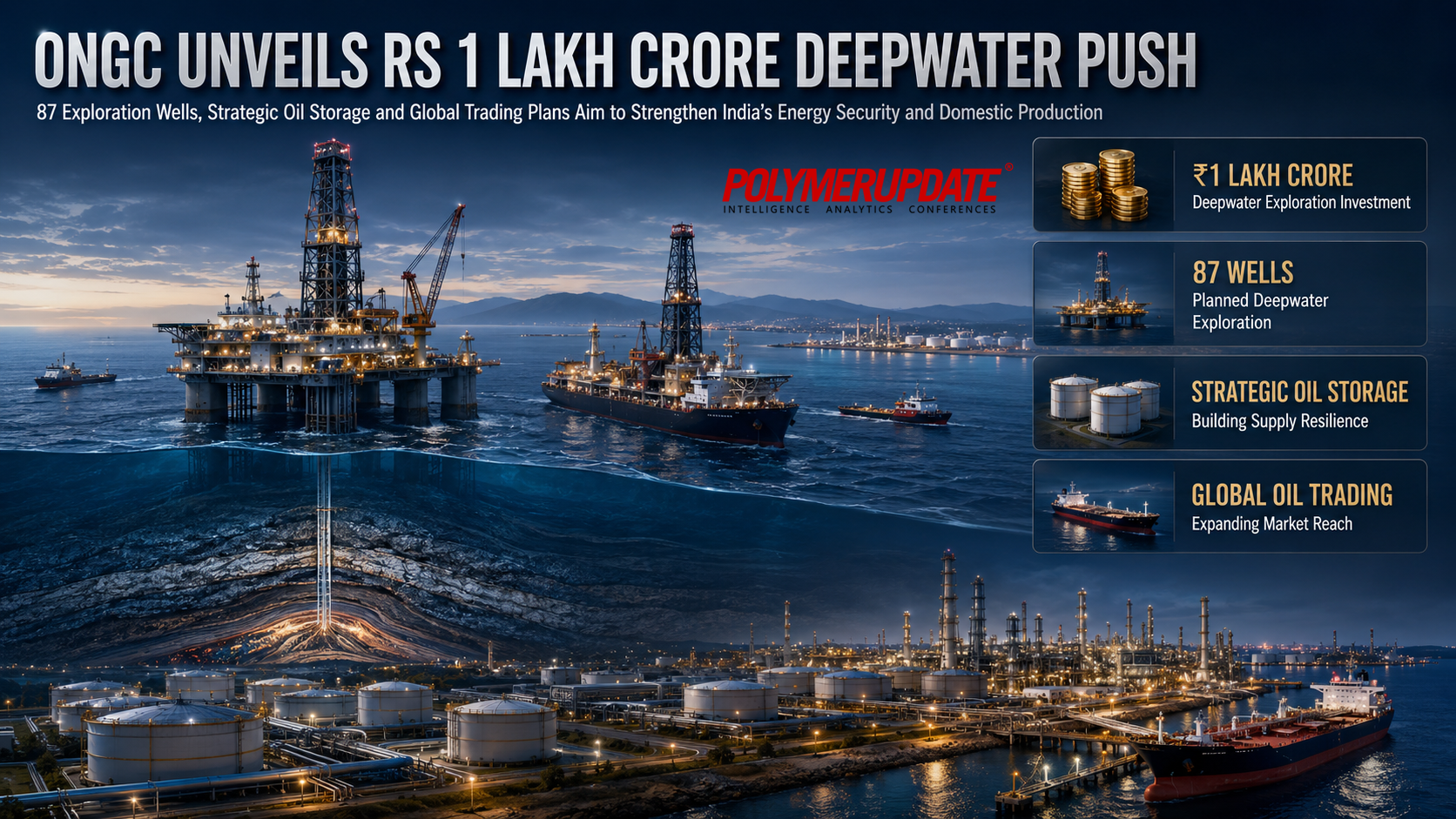
State-owned Oil and Natural Gas Corporation (ONGC) has unveiled an ambitious Rs 1 lakh crore (US$ 10.5 billion) investment programme aimed at unlocking India's vast deepwater and ultra-deepwater hydrocarbon reserves, marking one of the country's largest offshore exploration initiatives in recent years.
The five-year investment plan, announced by ONGC Chairman Arun Kumar Singh, comes at a crucial juncture as India seeks to reduce its growing dependence on imported crude oil while reversing a prolonged decline in domestic oil and natural gas production. The company plans to drill 87 deepwater and ultra-deepwater exploration wells by March 2031, targeting frontier offshore basins believed to hold significant untapped reserves.
The announcement signals a strategic shift in India's upstream energy sector, where conventional onshore and shallow-water fields have matured, making deeper offshore resources increasingly important for future production growth.
 A renewed push into frontier basins
India's sedimentary basins contain substantial hydrocarbon potential, but much of the deepwater acreage has remained underexplored due to technological complexities and high development costs. According to ONGC, advances in seismic imaging, drilling technologies and subsea production systems have significantly improved the commercial viability of these challenging reservoirs.
"India has huge untapped reserves of oil and gas in deepwater blocks, and technologies are now available to exploit these resources," Singh said while outlining the company's long-term exploration strategy.
The proposed investment will primarily focus on offshore regions along the eastern and western continental margins, including ultra-deepwater blocks where exploration activity has accelerated following improvements in drilling capabilities and reservoir imaging. Analysts believe successful discoveries in these frontier basins could reshape India's domestic energy landscape, particularly as production from legacy fields continues to weaken.
Reversing an 11-year production declineThe aggressive exploration programme is driven by an urgent need to arrest falling domestic output. India's crude oil production declined in fiscal year 2025–26 for the 11th consecutive year, underscoring the challenges facing the country's upstream sector despite rising energy demand.
For ONGC, which accounts for the bulk of India's domestic crude and natural gas production, discovering new commercially viable reserves has become essential to sustaining long-term production levels. Mature producing assets have witnessed declining recovery rates, while incremental gains from enhanced oil recovery projects have not been sufficient to offset natural field depletion.
Deepwater discoveries, although capital-intensive, offer the best opportunity to replenish reserves and strengthen India's energy security over the coming decades. The planned drilling of 87 wells represents a substantial expansion of exploration activity and reflects growing confidence in India's offshore geological potential.
Strategic petroleum reserve expansionAlongside upstream exploration, ONGC will invest approximately Rs 7,000 crore to develop a 1.75 million-tonne Strategic Petroleum Reserve (SPR) at Mangalore in Karnataka. The project forms part of the government's broader strategy to expand emergency crude storage capacity in response to heightened geopolitical uncertainties and increasing volatility in global oil markets.
India, the world's third-largest importer and consumer of crude oil, currently depends on overseas suppliers for nearly 90% of its oil requirements. Recent disruptions in global shipping routes, particularly around the Strait of Hormuz, have reinforced the importance of maintaining adequate emergency inventories.
According to ONGC, land for the Mangalore reserve has already been acquired, and the company has been entrusted by the government to construct the facility. Once operational, the additional storage will enhance India's ability to cushion supply disruptions and manage sudden spikes in international crude prices. The new reserve will complement existing strategic storage facilities at Visakhapatnam, Mangalore and Padur, strengthening the country's overall emergency stockholding capacity.
Global trading ambitionsIn another significant strategic initiative, ONGC plans to establish an international trading joint venture in either Dubai or Singapore by the end of March 2027. The proposed venture, to be formed with a global trading partner, is expected to handle 50 million tonnes of crude oil, refined petroleum products and natural gas annually. Unlike ONGC's existing business model, the trading platform will not be limited to marketing production from group companies. It will also trade third-party cargoes, allowing the company to participate more actively in international commodity markets and optimize procurement and sales across global supply chains.
Industry observers view the move as an effort to emulate integrated global energy companies that combine upstream production with sophisticated trading operations to improve profitability and manage price risks. Dubai and Singapore are considered the leading contenders because both serve as major energy trading hubs with established financial markets, shipping infrastructure and access to Asian crude buyers.
Energy security takes centre stageThe twin investments in deepwater exploration and strategic petroleum storage reflect India's evolving approach to energy security. As domestic consumption continues to rise, policymakers are pursuing a multi-pronged strategy that includes increasing indigenous production, diversifying crude import sources, expanding emergency reserves and strengthening international trading capabilities.
India's petroleum demand has remained resilient despite periodic economic slowdowns, driven by growth in transportation, manufacturing and petrochemicals. However, stagnant domestic production has widened the gap between consumption and indigenous supply, increasing exposure to geopolitical risks and international price fluctuations.
Deepwater exploration is increasingly viewed as one of the few remaining avenues capable of delivering sizeable new oil and gas discoveries within India's territorial waters. While exploration success is never guaranteed, technological advancements have improved drilling efficiency and reduced operational risks compared with previous decades.
High-risk, high-reward investmentDeepwater exploration remains among the most expensive segments of the oil and gas industry, requiring advanced drilling rigs, subsea infrastructure and sophisticated reservoir management. Individual exploration wells can cost hundreds of crores of rupees, making capital discipline and geological accuracy critical for commercial success.
Nevertheless, successful discoveries can yield substantial long-term returns through large recoverable reserves and extended production lifecycles. For ONGC, the Rs 1 lakh crore investment represents both a production revival strategy and a long-term commitment to strengthening India's domestic hydrocarbon base.
The company's simultaneous push into offshore exploration, strategic crude storage and global energy trading also signals its transformation from a traditional upstream producer into a more integrated energy enterprise capable of competing in increasingly complex international markets. As geopolitical tensions continue to influence global crude flows and energy prices, ONGC's investment roadmap underscores India's determination to enhance supply resilience while unlocking the untapped potential of its offshore energy resources.
DILIP KUMAR JHA
Editor
dilip.jha@polymerupdate.com