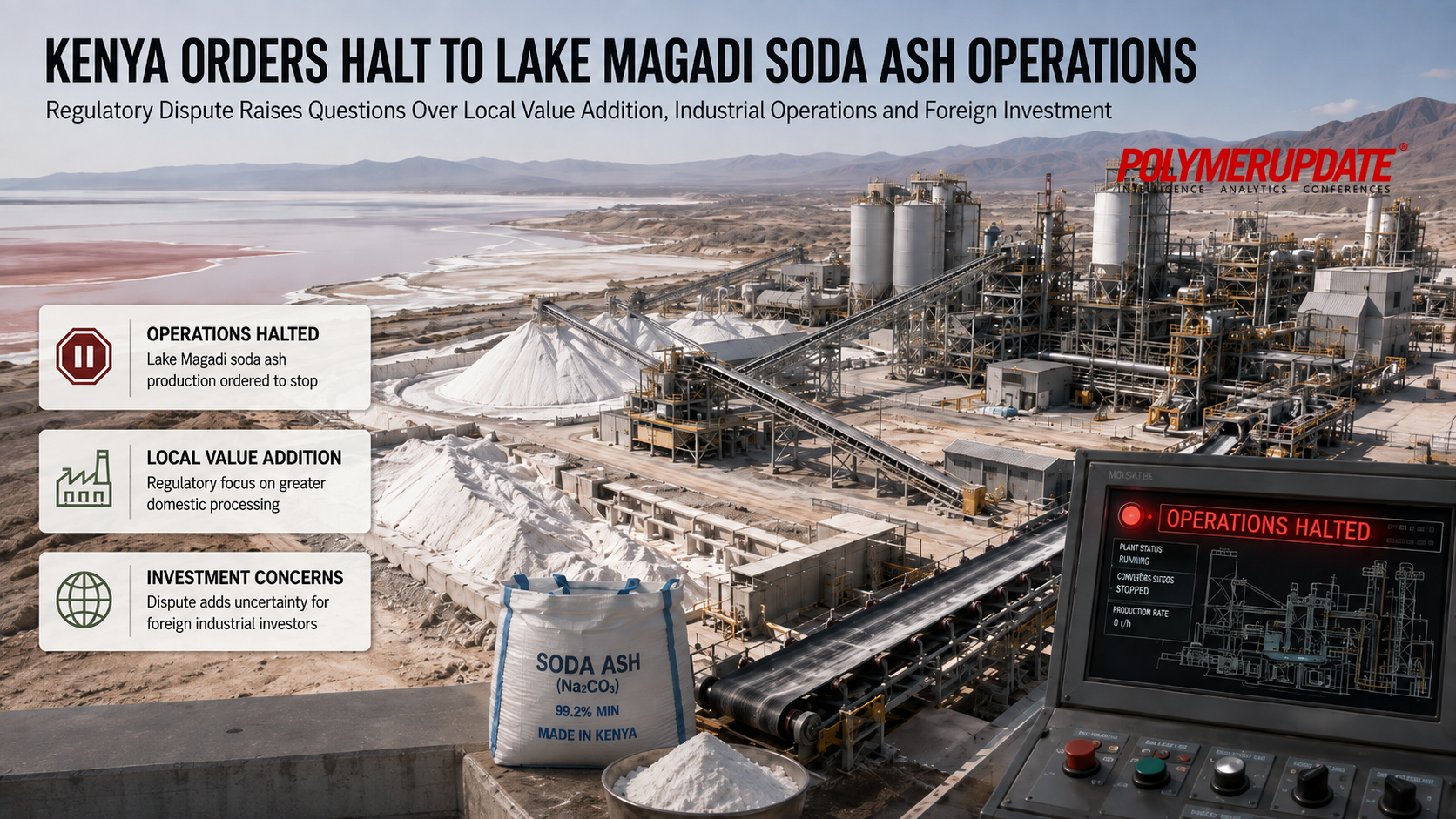
Kenya has ordered Tata Chemicals to cease operations at its long-running soda ash business at Lake Magadi, escalating a regulatory dispute into a major confrontation over foreign investment, mineral beneficiation and the economic benefits that host communities derive from natural resources. Kenyan President William Ruto announced the decision on September 3, saying Tata Chemicals had failed to deliver sufficient benefits to Kenya despite its presence in the Kajiado region for more than a century.
The President said the government would bring in two new companies to develop glass and chemical manufacturing facilities in the area, signalling a shift away from exporting raw or semi-processed mineral resources towards greater domestic value addition. The order follows a suspension imposed in late July by Kenya's Ministry of Mining, Blue Economy and Maritime Affairs on Tata Chemicals Magadi Limited (TCML), which operates the Magadi soda ash business.
At that time, the government cited a series of unresolved regulatory and statutory issues, including royalty reconciliation, export reporting, mineral beneficiation, community development, employment and skills transfer, local procurement and environmental compliance. The dispute therefore has two distinct dimensions. The immediate July action was framed as a regulatory-compliance matter, while President Ruto's latest intervention has broadened the issue into a question of whether Kenya is receiving adequate economic and industrial benefits from the exploitation of its natural resources.
 A century-old soda ash operation
The Magadi operation is one of Kenya's oldest large-scale mineral businesses. Soda ash production at Lake Magadi dates back to 1911, and the operation subsequently changed ownership before becoming part of Tata Chemicals in 2005. TCML extracts trona, a naturally occurring mineral containing sodium carbonate compounds, from Lake Magadi and processes it into soda ash. The product is an important industrial raw material used in glass manufacturing, detergents, chemicals and several other applications.
The operation has historically served both the East African market and overseas customers. Tata Chemicals' latest annual report says TCML's soda ash business primarily serves the container-glass and silicate sectors in East Africa as well as export markets in Southeast Asia and the Indian subcontinent.
In FY2025-26, TCML sold about 2.9 lakh tonnes of soda ash, compared with 2.8 lakh tonnes in the previous year. However, the business faced lower realisations amid weakness in the global soda ash market.
Tata Chemicals reported TCML revenue of Rs 586 crore in FY2025-26, compared with Rs 612 crore a year earlier, while EBITDA fell to Rs 101 crore from Rs 142 crore and net profit declined to Rs 48 crore from Rs 118 crore. The Kenyan operation is consequently strategically important to Tata Chemicals' global soda ash portfolio, although it represents only a part of the group's overall business.
Why Kenya actedThe government's July suspension provides the clearest explanation of the regulatory concerns behind the confrontation. Kenya said several issues remained unresolved despite years of engagement with Tata Chemicals Magadi. These included the absence of a clear mineral beneficiation and value-addition strategy, outstanding royalty reconciliation and payment obligations, inadequate export reporting and reconciliation, poor implementation of Community Development Agreements and insufficient plans for employment and skills transfer for Kenyan citizens. Authorities also cited weak procurement of local goods and services and environmental compliance shortcomings.
The government therefore directed the company to provide documentation demonstrating compliance and settle outstanding liabilities before operations could resume. Tata Chemicals, however, has maintained that it has responded comprehensively to the government's concerns. In August, the company said it had submitted all information, reports and documentation requested by the ministry and demonstrated compliance with applicable regulatory requirements. It also said it remained committed to constructive engagement with the Kenyan government. That regulatory dispute subsequently acquired a broader political dimension.
During his September 3 visit to Kajiado, President Ruto criticised Tata Chemicals for failing to establish significant downstream industrial activity in the region despite its long presence there. He said Kenya wanted new investors to establish a major glass manufacturing facility and another chemical plant in Kajiado. The message is significant: Nairobi increasingly wants minerals extracted in Kenya to generate jobs, manufacturing capacity, technology transfer and wider industrial activity inside the country rather than primarily being exported.
Impact on Tata ChemicalsFor Tata Chemicals, the immediate consequence is the loss of operating control over a business that has historically contributed profits and provided the company with a strategically located source of natural soda ash. The financial impact, however, needs to be viewed in perspective. TCML generated Rs 586 crore in revenue and Rs 48 crore in net profit during FY2025-26. Against the much larger consolidated operations of Tata Chemicals, the Kenyan business is not large enough on its own to fundamentally alter the group's financial profile.
Nevertheless, losing an established natural-resource operation could affect the company's African and international supply network and reduce its geographic diversification. The suspension also comes at an unfavourable point for the soda ash industry. Tata Chemicals said global supply remained elevated, particularly because of Chinese production, while soda ash prices declined by more than 10% during FY2025-26. The company has also invested in modernising the Magadi operation. Its FY2025-26 highlights include the commissioning of what Tata Chemicals describes as the world's first 50,000-tonne electric-calciner green soda ash facility at Magadi.
The latest government order could therefore put both existing operations and recent investments under greater uncertainty. Investor sentiment has already reflected the concern. Tata Chemicals shares fell about 3% on September 4 following the President's announcement, although the company's broader financial performance and the global soda ash cycle are also influencing its share price.
Implications for KenyaFor Kenya, the government's objective is to capture more value from Lake Magadi's mineral resources.
The country is seeking to move beyond the conventional extract-and-export model by encouraging domestic processing and manufacturing. If new investors establish glass and chemical plants in Kajiado, the government could potentially create additional employment, strengthen local supply chains and retain a larger share of the value generated by soda ash.
The policy could also provide a stronger industrial base for Kenya's glass, chemicals and construction-related sectors. However, replacing an established operator will not be straightforward. Mining, processing, logistics and export operations require specialised expertise, infrastructure and established customer relationships. Any transition to new operators could therefore create short-term disruption for workers, suppliers, local businesses and international customers.
Community concerns are another important factor. Some Magadi residents welcomed the July suspension, saying it offered an opportunity to address longstanding grievances and community concerns. At the same time, Tata Chemicals has stressed that the welfare of its employees, the Magadi community and other Kenyan stakeholders remains a priority.
Global soda ash market could feel the disruptionThe closure also has implications beyond Kenya because Magadi is an export-oriented soda ash operation. Government sources have said the company historically shipped more than 350,000 tonnes annually to international markets, while Tata's own reported sales volumes have been around 290,000 tonnes in recent years. Any prolonged shutdown could tighten supply for customers dependent on Magadi material, particularly in East Africa and selected export markets. The effect on the global soda ash market is likely to be limited because the international market is much larger, but regional availability and logistics could be affected if the interruption continues.
The episode also sends a wider message to international mining and chemicals companies operating in Africa. Governments are becoming increasingly focused not merely on tax and royalty collections but also on local manufacturing, employment, technology transfer, community development and environmental obligations. For Tata Chemicals, the immediate priority will be to determine whether the dispute can be resolved through regulatory and legal channels. The company has already submitted its compliance documentation and said it remains engaged with the authorities.
For Kenya, the bigger test will be whether the proposed transition can deliver what the government says the existing arrangement failed to provide: downstream manufacturing, better employment opportunities and greater local economic participation. The Lake Magadi dispute has thus evolved from a mining-compliance issue into a broader test of Kenya's industrial policy and its approach to foreign investment. Its outcome could influence not only the future of Tata Chemicals in Kenya but also how multinational resource companies assess the country's investment environment in the years ahead.
DILIP KUMAR JHA
Editor
dilip.jha@polymerupdate.com