In a significant step towards advancing India's circular economy, Petronas Lubricants India and Tata Motors have entered into a strategic partnership to develop a structured and scalable model for the collection and recycling of used automotive lubricants. The initiative aims to establish an organised, traceable system that transforms hazardous waste oil into high-quality re-refined base oil, supporting both environmental sustainability and regulatory compliance.
The two companies signed a Memorandum of Understanding (MoU) to launch the pilot simultaneously in Maharashtra and Tamil Nadu, two of India's largest automotive and industrial markets. The project is expected to serve as a blueprint for a nationwide used-oil recycling ecosystem aligned with the government's evolving Extended Producer Responsibility (EPR) framework.
The collaboration brings together Petronas Lubricants India's expertise in lubricant technology and recycling logistics with Tata Motors' extensive network of authorised commercial vehicle service centres. By integrating collection, aggregation, transportation and recycling into a single traceable value chain, the partners seek to address one of the country's most pressing waste management challenges.
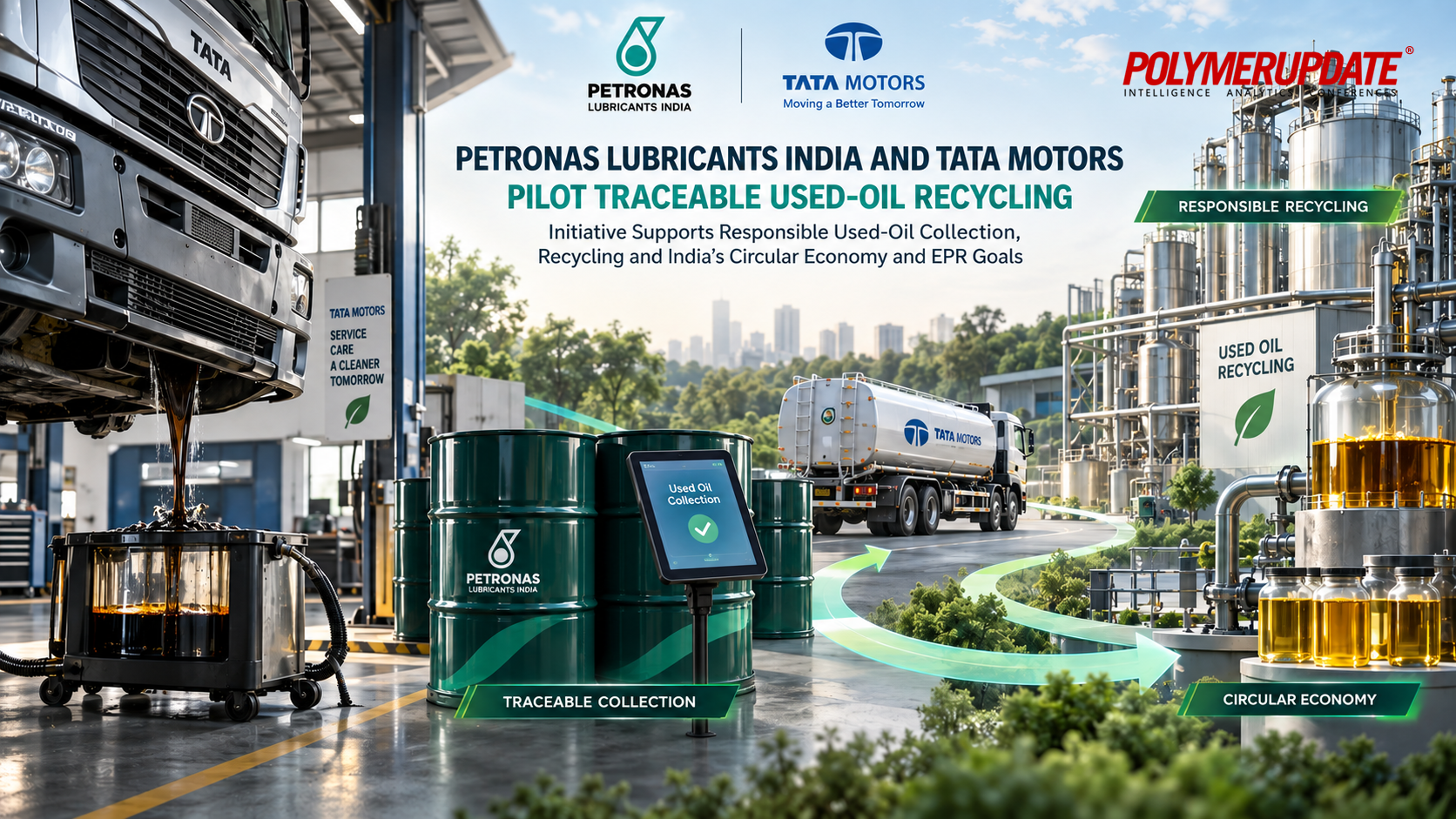 Building circularity into the lubricant value chain
Used automotive lubricants are classified as hazardous waste because of the contaminants they accumulate during engine operation. If improperly disposed of, they can pollute soil and water bodies while posing serious environmental and public health risks. However, when collected and processed through authorised recycling channels, the oil can be re-refined into base oil suitable for manufacturing new lubricants, significantly reducing dependence on virgin petroleum resources.
Petronas Lubricants India Managing Director Binu Chandy said true circularity can only be achieved when recycled base oil returns to the production cycle as a raw material for finished lubricants. "Achieving true circularity in used oil begins when re-refined base oil is reintegrated into finished lubricants. Our collaboration with Tata Motors marks an important step toward building a scalable model for used oil circularity and reflects the strength of our channel network as we work to significantly reduce our carbon footprint across operations," Chandy said while launching the pilot.
The initiative is expected to improve resource efficiency by ensuring that used lubricants are collected through authorised mechanisms rather than entering informal disposal channels. Petronas will oversee the aggregation and movement of collected oil through specialised collection systems before channelising it to registered recyclers capable of producing high-quality re-refined base oil.
Tata Motors to leverage nationwide service ecosystemTata Motors, India's largest commercial vehicle manufacturer, will play a pivotal role by mobilising its widespread authorised service network to facilitate systematic collection and responsible disposal of used lubricants generated during vehicle servicing. The company believes the partnership represents more than a recycling programme—it is an effort to embed circular economy principles across the automotive value chain.
Vikram Agrawal, Head of Spares and Non-Vehicle Business at Tata Motors, said sustainability-driven partnerships are essential for creating long-term environmental value. "At Tata Motors, practices and partnerships promoting sustainability are integral to advancing circular economy principles and creating meaningful environmental impact across the automotive value chain. Through our collaboration with Petronas Lubricants India, we are taking a significant step towards establishing a structured framework for the collection, recovery and recycling of used automotive lubricants. the pilot would evaluate the commercial and operational viability of a scalable recycling model capable of delivering long-term value while supporting India's broader sustainability ambitions," Agrawal said.
Supporting India's EPR regulationsThe partnership comes at a time when India is strengthening its regulatory framework for waste management through Extended Producer Responsibility. Under the EPR regime, producers and brand owners are increasingly required to ensure environmentally sound collection, recycling and disposal of products at the end of their useful life.
While EPR has already reshaped sectors such as plastics, batteries and electronic waste, used lubricants represent another critical area where organised collection systems remain underdeveloped. Industry observers believe structured partnerships between lubricant manufacturers, vehicle OEMs and authorised recyclers could accelerate compliance while improving recovery rates across the country.
By creating an end-to-end traceability mechanism—from service workshop to recycler—the Petronas -Tata Motors model seeks to enhance transparency, prevent leakages into informal markets and establish measurable sustainability benchmarks for the automotive lubricant industry.
From hazardous waste to valuable resourceA central objective of the pilot is to demonstrate that used oil should be viewed as a recoverable resource rather than waste. Re-refining consumes substantially less energy than producing virgin base oil from crude petroleum and contributes to lower greenhouse gas emissions across the lubricant lifecycle. The pilot will therefore assess not only collection efficiency but also logistics optimisation, storage standards, recycler integration and the quality consistency of re-refined base oil.
If successful, the framework could be replicated across additional states and potentially adopted by other automotive manufacturers and lubricant companies. The initiative also aligns with India's broader transition towards resource-efficient manufacturing, where recovering valuable materials from waste streams is becoming an increasingly important pillar of industrial sustainability.
Industry leaders with global reachPetronas Lubricants India is part of Petronas Lubricants International (PLI), the global lubricant manufacturing and marketing arm of Malaysia's Petronas. Established in 2008, PLI markets automotive and industrial lubricants in more than 100 countries and serves as the technology partner behind the Mercedes-AMG Petronas Formula One Team's high-performance fluid solutions.
Tata Motors, a member of the US$ 180 billion Tata Group, has over eight decades of leadership in commercial mobility and manufactures trucks, buses, pick-ups and utility vehicles for domestic and international markets. The company operates manufacturing facilities in India and South Korea while maintaining a strong presence across Africa, the Middle East, Latin America, Southeast Asia and SAARC countries.
Following its corporate restructuring sanctioned by the National Company Law Tribunal, the former TML Commercial Vehicles Limited was renamed Tata Motors Limited in October 2025, with its equity shares listed on both the BSE and the National Stock Exchange.
A blueprint for sustainable mobilityAs India's commercial vehicle fleet continues to expand, the volume of used lubricants generated annually is expected to rise significantly. Establishing formal collection and recycling infrastructure will therefore be critical for reducing environmental risks and improving material circularity within the automotive sector.
The Petronas Lubricants India-Tata Motors partnership signals an important shift towards collaborative sustainability, where manufacturers, service networks and recyclers work together to create closed-loop industrial systems. If the pilot proves successful, it could provide a scalable national model for responsible used-oil management and reinforce India's ambition of building a circular, low-carbon economy.
DILIP KUMAR JHA
Editor
dilip.jha@polymerupdate.com