MCPI Pvt Ltd and Indian Oil Corporation Ltd (IOCL) have signed a joint venture agreement to develop an integrated polyester manufacturing facility with an investment of around Rs 5,000 crore at Bhadrak in Odisha, marking a significant step towards strengthening India’s domestic polyester value chain and expanding downstream petrochemical manufacturing capacity. The proposed project will comprise a 900 tonnes-per-day (TPD) continuous polymerisation unit, along with downstream facilities for fully drawn yarn (FDY), draw textured yarn (DTY) and polyester chips.
According to IOCL’s annual report, the project is envisaged as a 300,000 TPA yarn manufacturing facility. The project will add substantial polyester manufacturing capacity in eastern India and is expected to strengthen the availability of domestic feedstock and downstream products for the textile and wider polymer-processing industries. The signing of the JV agreement follows approvals at both the corporate and government levels.
The IOCL Board approved the project in December 2024, while the Government of India granted clearance in June 2026. With the JV agreement now signed, the project is set to move towards formal incorporation of the joint venture and subsequent implementation. IOCL had initially approved an investment of approximately Rs 4,382 crore for the project in December 2024. The latest agreement puts the estimated project investment at around Rs 5,000 crore, reflecting an increase from the original approved cost.
Details of the revised equity structure have not yet been publicly disclosed. The JV was initially structured as a 50:50 partnership, with IOCL and MCPI each committing Rs 657.33 crore in equity against the original project cost. The companies are now expected to finalise the formal structure of the joint venture as the project progresses towards implementation.
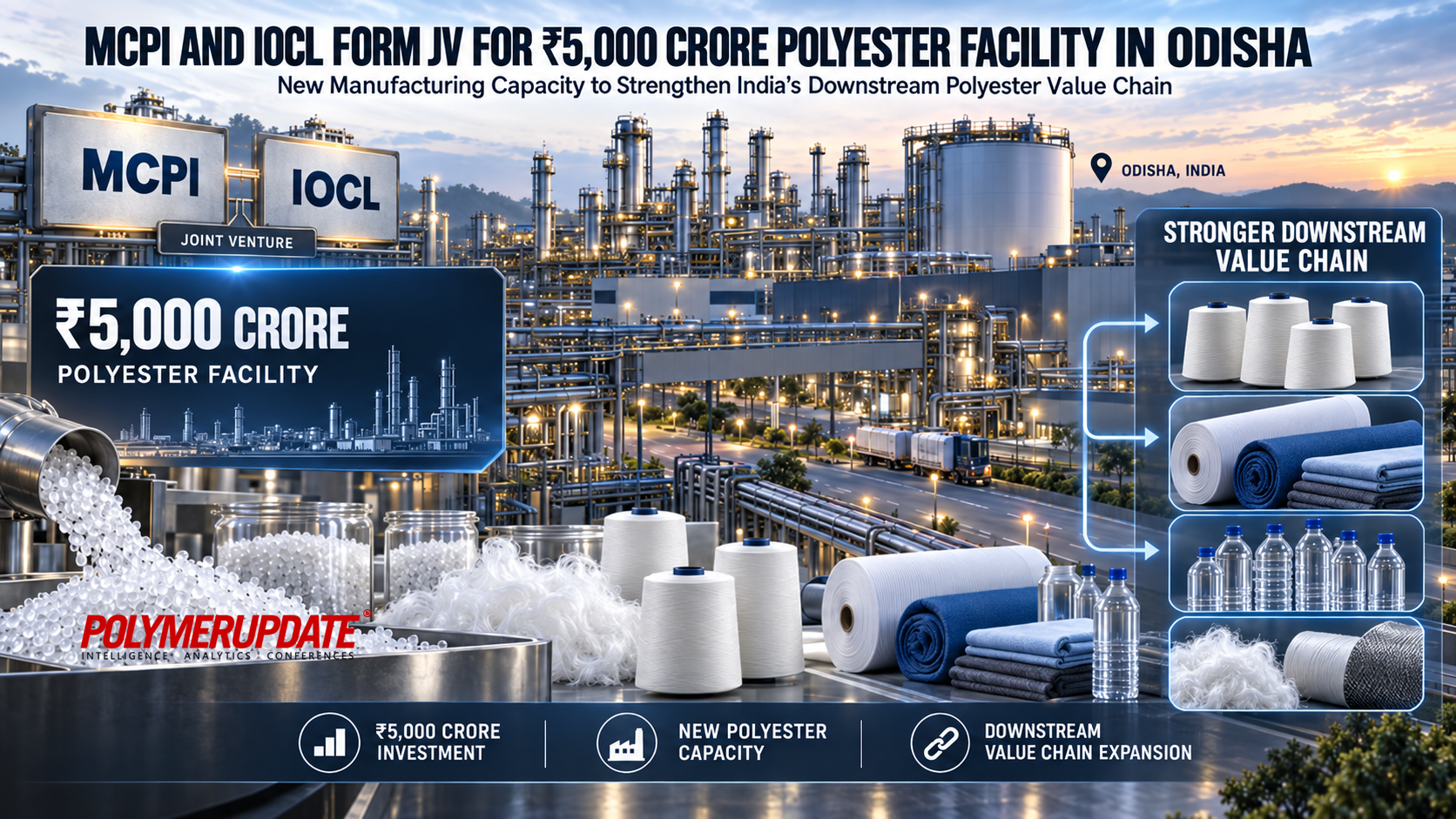 Strengthening downstream petrochemicals
The partnership brings together the petrochemical capabilities of IOCL and MCPI’s expertise in polyester and textile manufacturing. For IOCL, the project forms part of its broader strategy to diversify beyond conventional refining and fuel businesses and increase its exposure to downstream petrochemicals and value-added products. The polyester project will enable IOCL to participate more extensively in the rapidly evolving textile and synthetic-fibre value chain.
Polyester is widely used in apparel, home textiles, industrial applications and packaging, making it an important downstream segment for the petrochemical industry. MCPI, meanwhile, brings established experience in polyester manufacturing. Its expertise in polyester production and previous investments in FDY capacity, including its expansion at Surat, could support the development and operation of the proposed facility. The collaboration therefore combines IOCL’s access to petrochemical feedstocks and large-scale industrial infrastructure with MCPI’s experience in polyester manufacturing and downstream textile applications.
Boost to eastern IndiaThe location of the proposed facility at Bhadrak is strategically significant as Odisha seeks to strengthen its industrial and textile manufacturing base. The project is expected to create around 4,300 employment opportunities, according to estimates made at the time of the project’s original approval. The investment could also contribute to the development of a broader manufacturing ecosystem around Bhadrak by creating demand for logistics, packaging, engineering services, maintenance, warehousing and other ancillary activities.
For the polyester industry, the project represents a major addition to production capacity in a region that has considerable potential for downstream manufacturing. Increased domestic availability of polyester yarn and chips could help reduce dependence on supplies from other regions and provide textile manufacturers with greater sourcing flexibility. The project also has the potential to support the development of integrated supply chains linking petrochemical producers, fibre and yarn manufacturers, textile processors and end-use industries.
Changing dynamics of the polymer value chainThe Rs 5,000-crore investment comes at a time when India’s polymer and textile industries are undergoing significant structural changes. Demand for polyester continues to be influenced by growth in apparel, technical textiles, packaging and consumer products, while manufacturers are simultaneously facing changing global supply patterns, sustainability requirements and increasing competition.
The addition of large-scale virgin polyester capacity could influence sourcing patterns and competitive dynamics across the downstream value chain. As capacity expands, producers and converters will increasingly need to balance cost, quality, product differentiation and sustainability considerations. The growing emphasis on circularity is also likely to influence the market. Textile and plastics companies are under increasing pressure to incorporate recycled materials, improve traceability and reduce the environmental footprint of their products.
Consequently, the expansion of virgin polyester capacity is expected to occur alongside growing investments in polyester recycling and recycled-content applications. This could create opportunities for greater integration between virgin and recycled polyester markets. Manufacturers will increasingly need to determine the appropriate balance between virgin feedstock and recycled materials while meeting customer requirements and evolving environmental regulations.
Sustainability and circular economyThe development of new polyester capacity also comes as the plastics and polymer industries face growing regulatory and commercial pressure to improve resource efficiency and strengthen circular-economy practices. Issues such as extended producer responsibility (EPR), recycling infrastructure, sustainable packaging, recycled-content adoption and waste management are becoming increasingly important for companies across the plastics value chain.
These issues are expected to remain central to industry discussions at the Plastic Value Chain Conference 2026, which brings together polymer producers, processors, recyclers, machinery manufacturers, packaging companies, brand owners, policymakers and technology providers. The conference will examine market trends, technological developments, recycling innovations and emerging business opportunities, while focusing on areas such as EPR compliance, sustainable packaging, waste management, recycled-content adoption and environmental regulations.
The MCPI-IOCL project is therefore likely to be viewed not simply as a capacity addition but as part of the wider evolution of India’s downstream polymer and textile industries. The emergence of new polyester capacity will have implications for manufacturers across the value chain, from feedstock suppliers and fibre producers to textile processors, converters, recyclers and brand owners.
A new phase of investmentWith the JV agreement signed, the Bhadrak project has moved beyond the approval phase and entered the implementation process. The proposed 900 TPD polymerisation unit, supported by FDY, DTY and polyester-chip facilities, is expected to create a significant new manufacturing base for polyester in eastern India. For IOCL, the project represents another step in its transition towards a more diversified petrochemical portfolio. For MCPI, the partnership provides an opportunity to expand its manufacturing footprint and strengthen its position in India’s polyester industry.
As the project progresses, its impact will extend beyond additional capacity. The investment could reshape regional supply chains, create new manufacturing and employment opportunities and enhance the integration of India’s petrochemical, polyester and textile industries. At the same time, the success of the project will depend on how efficiently the partners execute the investment, manage changing market conditions and respond to the industry’s increasing focus on sustainability and circularity.
The Rs 5,000-crore MCPI-IOCL venture thus marks a significant new investment in India’s downstream polymer and textile value chain. As the country seeks to build greater domestic manufacturing capability and reduce supply-chain vulnerabilities, projects of this scale could play an important role in shaping the competitiveness and resilience of India’s polyester industry in the years ahead.
DILIP KUMAR JHA
Editor
dilip.jha@polymerupdate.com