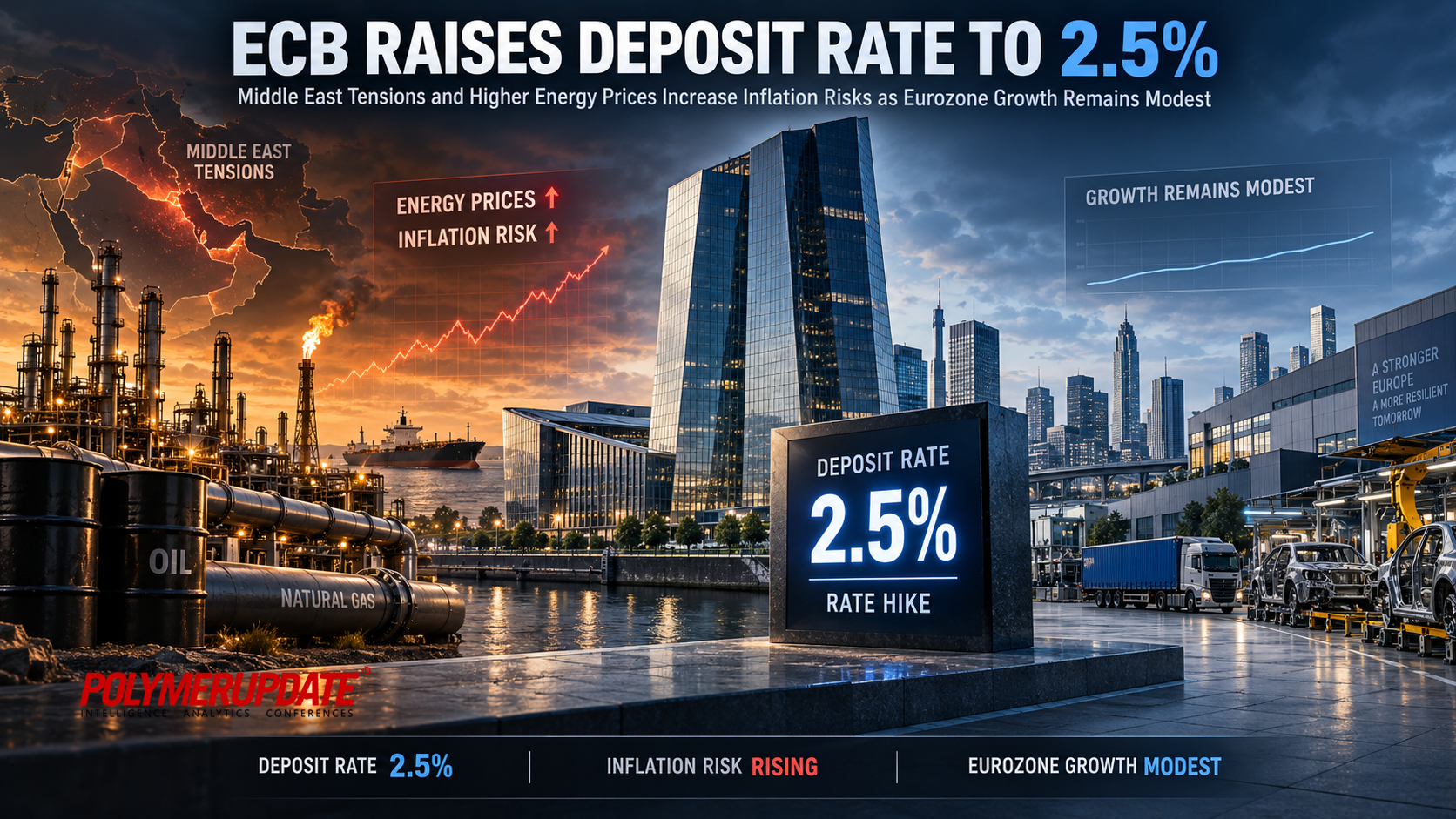
The European Central Bank (ECB) raised its key deposit interest rate by 25 basis points to 2.5 percent, tightening monetary policy as escalating tensions in the Middle East and higher energy prices threaten to keep inflation elevated across the Eurozone. The widely anticipated move takes the ECB's main policy rate to what it describes as the upper bound of its neutral interest-rate range—a level that neither stimulates nor significantly restrains economic activity.
While policymakers avoided describing the decision as an "insurance" rate hike, economists say the increase is designed to keep inflation expectations anchored and prevent rising oil prices from spreading into the broader economy. The decision comes at a time when geopolitical tensions have intensified following renewed conflict in West Asia, pushing crude oil prices sharply higher and raising concerns over global energy supplies. Although underlying inflation indicators remain relatively contained, the ECB judged that acting early was necessary to preserve its credibility and demonstrate its commitment to price stability.
 Energy prices strengthen the case for tightening
The rate increase had been largely priced into financial markets even before the latest geopolitical developments. However, the recent surge in crude oil prices significantly reinforced the argument for tighter monetary policy. Unlike demand-driven inflation, the current price shock stems primarily from higher energy costs—a classic supply-side disruption. Despite this, the ECB appears determined to ensure that temporary increases in fuel and transport costs do not translate into persistently higher wages and consumer prices.
So far, evidence of so-called second-round inflation effects remains limited. Measures of core inflation, services inflation and survey-based inflation expectations continue to suggest that businesses and households have not yet broadly adjusted their long-term pricing behaviour in response to higher energy costs. Nevertheless, policymakers concluded that waiting for broader inflationary pressures to emerge would carry greater risks than acting pre-emptively.
Inflation outlook remains above targetThe ECB's latest staff projections illustrate why inflation continues to concern policymakers despite moderating domestic price pressures. Headline inflation is expected to remain at 3.0 percent in 2026, unchanged from previous projections. However, forecasts for the following two years have been revised upward, with inflation now projected at 2.5 percent in 2027 and 2.1 percent in 2028. Core inflation—which excludes volatile food and energy prices—is forecast to remain stubbornly above the ECB's 2 percent target for much of the projection period.
The central bank expects core inflation to average 2.5 percent in 2026, rise slightly to 2.6 percent in 2027, before easing to 2.3 percent in 2028. Although these projections indicate gradual disinflation, they also suggest that price pressures will remain more persistent than previously anticipated. Importantly, economists note that the forecasts do not fully incorporate the latest spike in oil prices or the sharp rise in government bond yields witnessed in recent weeks. As a result, inflation risks could still tilt to the upside if energy markets remain disrupted.
Growth outlook shows modest resilienceDespite tighter financial conditions, the ECB remains cautiously optimistic about the Eurozone economy. Economic growth has been revised slightly higher, with gross domestic product now expected to expand 0.9 percent in 2026, followed by 1.4 percent in 2027 and 1.5 percent in 2028. The modest upgrade reflects continued resilience in household consumption and labour markets, even as elevated borrowing costs weigh on investment. However, growth remains well below historical averages, highlighting the fragile nature of Europe's recovery.
The combination of subdued growth and above-target inflation presents a difficult policy balancing act. Unlike periods of overheating demand, the current inflationary episode has been driven largely by external supply shocks, limiting the effectiveness of aggressive monetary tightening.
Neutral today, restrictive tomorrowWhile Thursday's decision appeared relatively straightforward, the path ahead is considerably less certain. By raising rates to 2.5 percent, the ECB has effectively reached the ceiling of what it considers neutral monetary policy. Any additional increase would move policy into restrictive territory, implying that the central bank believes deliberately slowing economic activity is necessary to curb inflation. That is a much more contentious proposition. Economists argue there is an important distinction between an economy demonstrating resilience and one that is overheating.
The Eurozone continues to grapple with weak productivity, sluggish industrial activity, strained public finances and rising sovereign borrowing costs. Government bond yields have climbed sharply in several member states, increasing debt-servicing costs and tightening financial conditions even before any further policy action. Against that backdrop, additional rate hikes could amplify recession risks without directly addressing the underlying cause of inflation—higher energy prices. The ECB therefore faces a delicate trade-off. Failing to respond to persistent inflation could undermine its inflation-fighting credibility, while tightening too aggressively risks pushing an already fragile economy into contraction.
Markets focus on future guidanceFinancial markets are now likely to shift their attention from the rate decision itself to the ECB's forward guidance. Analysts broadly view the latest move as a demonstration of vigilance rather than the beginning of a prolonged tightening cycle. Unless energy-driven inflation begins feeding more visibly into wages and broader consumer prices, many believe the ECB will prefer to pause and assess the cumulative impact of higher borrowing costs.
However, policymakers have left the door open to further action should inflation prove more persistent than expected. The trajectory of crude oil prices, geopolitical developments in the Middle East and incoming inflation data will therefore play a decisive role in shaping future monetary policy.
For now, the ECB has chosen to stay ahead of the curve—raising rates to defend its inflation mandate while stopping short of signalling an outright shift toward restrictive monetary policy. Whether that proves sufficient will depend largely on how long Europe's latest energy shock endures.
DILIP KUMAR JHA
Editor
dilip.jha@polymerupdate.com