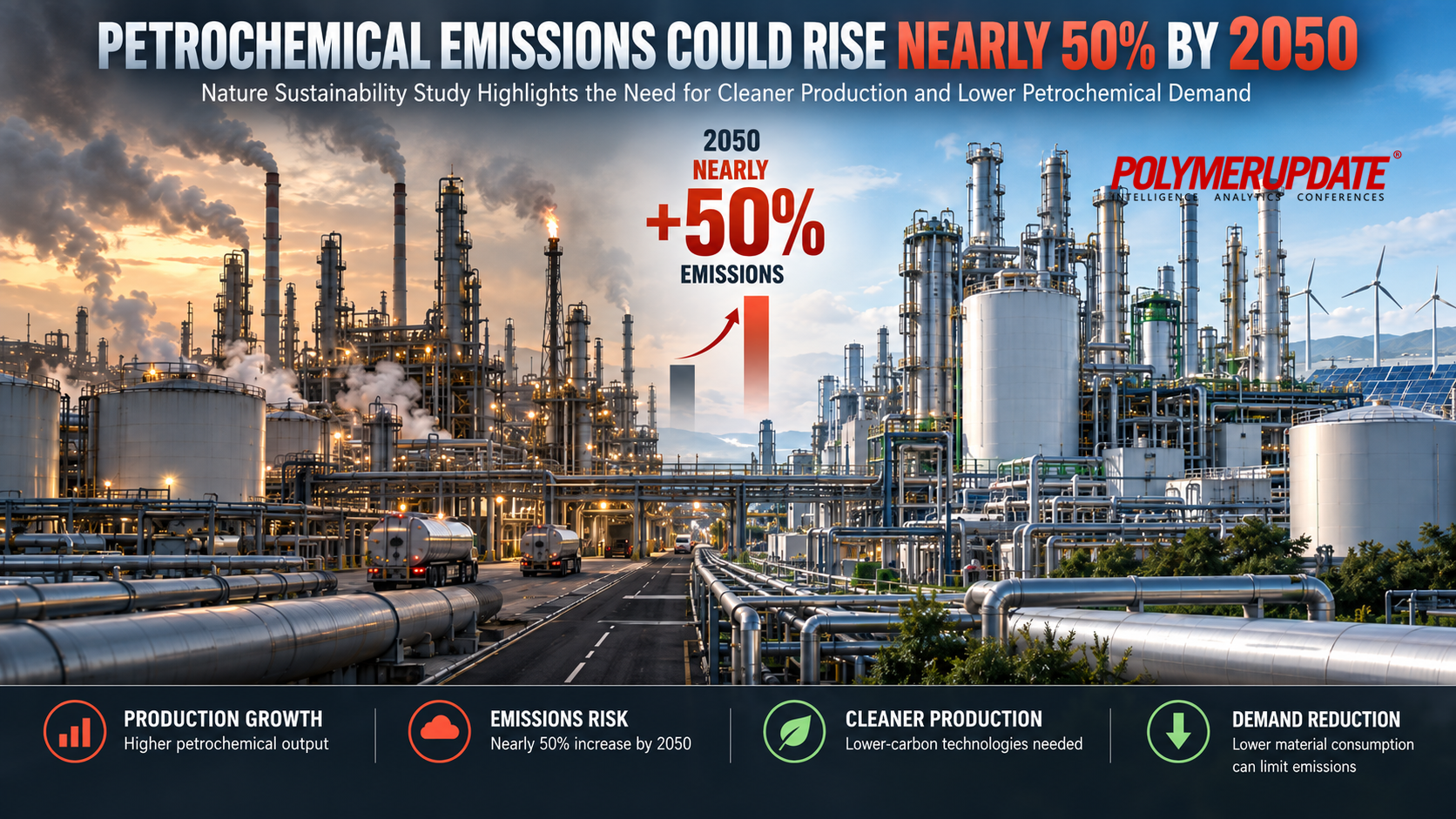
The global petrochemical industry is on course to increase its greenhouse gas emissions by nearly 50 percent by 2050 unless decisive decarbonisation measures are adopted, according to a major new study published in Nature Sustainability. The findings underscore the growing climate challenge posed by one of the world's fastest-expanding industrial sectors, even as governments and companies pursue net-zero ambitions.
The study estimates that greenhouse gas emissions from petrochemical production could rise from 2.0 ± 0.8 gigatonnes of carbon dioxide equivalent (GtCO2e) in 2023 to 3.0 ± 1.2 GtCO2e by 2050 under a business-as-usual scenario. Researchers conclude that no single technological solution—including carbon capture, electrification or bio-based feedstocks—will be sufficient to eliminate the sector's emissions.
Led by Dr Fanran Meng of the University of Sheffield, the research provides one of the most comprehensive facility-level assessments of global petrochemical emissions to date. The team mapped emissions from 37,379 production facilities across 81 chemicals and 2,043 manufacturing processes, offering policymakers and industry an unprecedented picture of where emissions originate and where intervention could deliver the greatest impact.
 A rapidly growing industrial giant
Petrochemicals have become indispensable to modern economies, supplying the raw materials used in plastics, synthetic fibres, fertilisers, rubber, solvents, detergents and countless consumer products. However, their expanding production has also made the industry one of the world's largest industrial emitters. According to the study, the petrochemical sector accounts for 13 percent of global industrial greenhouse gas emissions and around 3.5 percent of total global emissions. Since 1980, production has increased by roughly 500 percent, reaching nearly one billion tonnes annually.
The industry's appetite for fossil fuels is equally significant. It consumes approximately 30 percent of industrial energy, while accounting for 14 percent of global oil demand and 9 percent of natural gas demand. Long-term growth remains firmly embedded in global industrial projections. The International Energy Agency (IEA) expects production of primary chemicals to increase from 680 million tonnes in 2020 to 971 million tonnes by 2050, equivalent to an annual growth rate of 1.3 percent. Plastics alone account for around 420 million tonnes of current production.
Emissions concentrated in a handful of facilitiesOne of the study's most striking findings is the highly uneven distribution of emissions across the global petrochemical industry. Just 10 percent of production facilities generate 53 percent of cradle-to-gate emissions, suggesting that prioritising the highest-emitting plants could deliver disproportionately large climate benefits. Rather than applying identical policies across thousands of facilities, researchers argue that governments and companies should focus investment and regulatory efforts on these major emission hotspots.
The geographical concentration is similarly pronounced. The top nine emitting countries accounted for 63 percent of global petrochemical emissions in 1990, rising to 76 percent in 2020, and are projected to contribute 79 percent by 2050. China remains the dominant producer and emitter, accounting for 37 percent of global petrochemical emissions in 2020, equivalent to 660 ± 260 million tonnes of CO2e. By mid-century, China, the United States and India together are expected to account for 63 percent of global production emissions, highlighting the pivotal role these three economies will play in determining the industry's climate trajectory.
The research also reveals that much of the carbon footprint associated with finished petrochemical products originates much earlier in the manufacturing chain. Around 83 percent of emissions embodied in downstream products stem from upstream production of primary and intermediate chemicals, reinforcing the importance of decarbonising foundational chemical processes.
Ethylene and ammonia dominate the carbon footprintAmong individual chemicals, ethylene and ammonia emerge as the sector's largest emitters. In 2023, ethylene production generated approximately 290 ± 50 million tonnes of CO2e, while ammonia contributed 250 ± 50 million tonnes. Both chemicals are essential building blocks for everyday products ranging from food packaging and household cleaners to fertilisers and synthetic materials.
The study's broader assessment of 2020 emissions estimates the industry's total footprint at 1.8 ± 0.7 GtCO2e annually. Nearly 45 percent came from indirect electricity and energy use, while 34 percent originated from feedstock extraction and processing. Carbon dioxide accounted for 74 percent of the industry's climate impact over a 100-year timeframe, with methane contributing 15 percent and nitrous oxide 11 percent.
No single technology can deliver net zeroResearchers evaluated multiple decarbonisation pathways, including electricity grid decarbonisation, carbon capture and storage (CCS), feedstock substitution and electrification of industrial processes.
Even under the most optimistic scenario—assuming fully decarbonised electricity grids, 100 percent deployment of CCS at technically eligible facilities and sufficient bio-based feedstocks to replace fossil alternatives—the petrochemical sector still fails to achieve net-zero emissions by 2050.
Electrification offers substantial long-term potential, but its effectiveness depends heavily on the carbon intensity of regional power grids. In countries where electricity generation still relies predominantly on coal or other fossil fuels, switching industrial processes from fuel combustion to electricity could actually increase emissions in the near term. The researchers therefore conclude that decarbonisation strategies must be tailored to regional energy systems rather than universally applied.
Smarter targeting could accelerate emissions cutsThe study suggests that the sequencing of climate investments may be as important as the technologies themselves. A prioritised rollout of decarbonisation measures targeting the highest-emitting facilities could avoid 23 ± 3 GtCO2e of cumulative emissions by 2050 compared with an untargeted approach. In the model's upper-bound scenario, emissions could fall below 2020 levels as early as 2025, instead of waiting until 2045.
However, implementing such strategies is complicated by the interconnected nature of petrochemical manufacturing. Integrated industrial complexes often share feedstocks, energy systems and intermediate products, meaning changes in one production process can affect multiple downstream operations.
The study highlights butadiene as an example. Around 95 percent of global butadiene production is obtained as a by-product of naphtha steam cracking used to manufacture ethylene. As producers adopt alternative feedstocks and lower-carbon production routes, butadiene yields decline even while demand continues to rise, illustrating the complex trade-offs within integrated chemical networks.
Demand reduction becomes unavoidablePerhaps the study's strongest conclusion is that cleaner production alone will not solve the industry's climate problem. Because indirect emissions dominate much of the petrochemical value chain, reducing demand for petrochemical products must become a central pillar of any credible net-zero pathway. This includes improving material efficiency, increasing recycling, extending product lifespans and developing circular economy models that reduce reliance on virgin petrochemical production.
The researchers also caution against overreliance on biomass as a renewable carbon source. Replacing fossil feedstocks entirely with bio-based alternatives could trigger unintended ecological and social consequences, including biodiversity loss, land-use change, competition with food production, soil degradation and water pollution. Similarly, large-scale CCS deployment faces significant practical barriers. Suitable geological storage sites, extensive pipeline networks and long-term transport infrastructure would all be required, while many proposed CCS projects worldwide remain uncertain.
“Emissions from the petrochemical industry are already enormous, and yet our research has found that they are on course to rise by 50 percent by 2050 under a business-as-usual scenario,” said Dr Fanran Meng. “There is no silver bullet. Reducing demand for petrochemical products alongside cleaner production will need to form part of the solution.”
The researchers believe their facility-level emissions database can help governments and industry identify priority plants, products and processes for intervention. While the analysis covers emissions from production through the factory gate, future research will seek to connect manufacturing with global trade, consumption and end-of-life treatment to provide a complete lifecycle assessment of petrochemical products.
DILIP KUMAR JHA
Editor
dilip.jha@polymerupdate.com