Click the icon to add a specified price to your Dashboard list. This makes it easy to keep track on the prices that matter most to you.

By Professor Dr. Sajjid Mitha
CEO & Founder, Polymerupdate | Founder, Polymerupdate Academy | Founder, RACE Expos & Conferences
For much of the last four decades, China’s economic story has been remarkably consistent. It built factories, achieved enormous economies of scale and became the workshop of the world.
That model is now entering another phase.
China is no longer simply manufacturing more of the things the world already consumes. It is increasingly manufacturing the hardware and industrial infrastructure that the world will need for its next technological cycle.
The latest trade numbers offer a revealing glimpse of this shift.
In August, Chinese exports rose 25% year-on-year to $401.4 billion, well ahead of expectations. Imports rose even faster, by 28.2%, to $282.4 billion. That left China with a monthly trade surplus of $119.1 billion and pushed the surplus for the first eight months of the year to a record $806 billion.China had already closed 2025 with a merchandise surplus of roughly $1.2 trillion.
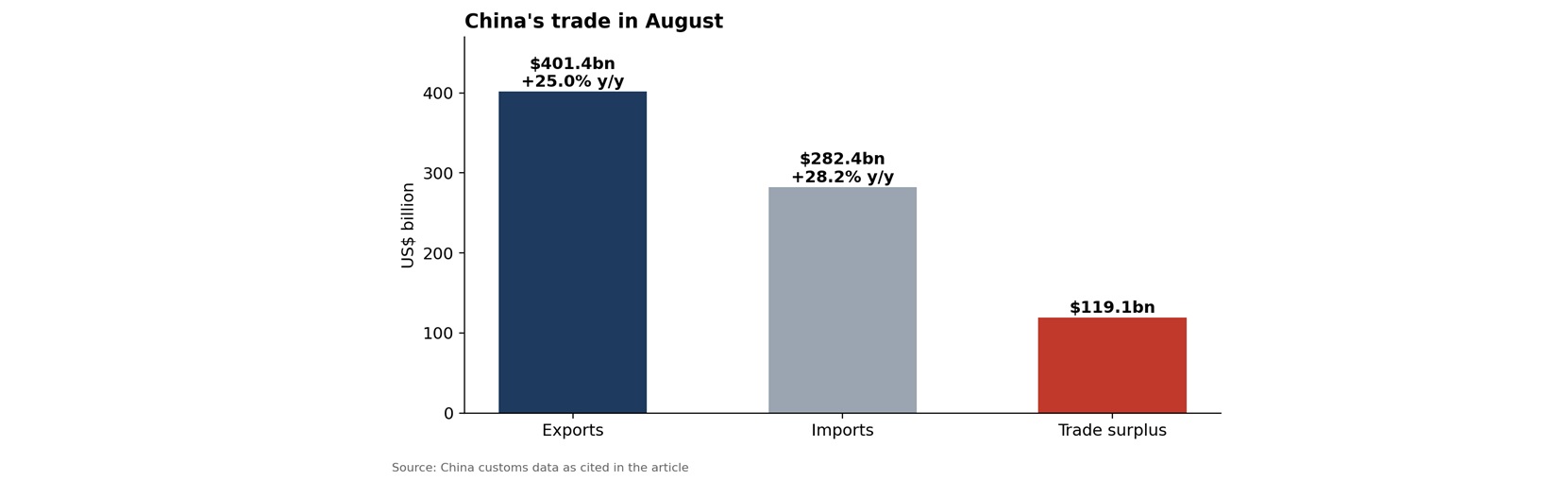
Figure 1: China’s August trade at a glance
The size of these numbers is striking. But the number that interests me more is what sits underneath them.
It is the changing composition of China’s exports.
From cheap goods to expensive hardware
For years, the shorthand for Chinese exports was straightforward: furniture, garments, toys, appliances and, later, automobiles.
That description is becoming increasingly inadequate.
The export basket now contains a growing amount of integrated circuits, servers and data-processing equipment, batteries, electric vehicles, power electronics and the machinery required to build the physical infrastructure of artificial intelligence.
The August numbers illustrate the point.
Integrated-circuit exports increased 129.8% year-on-year to around $40.7 billion. Exports of automatic data-processing equipment increased 76.5%. According to Nomura’s calculations, those two categories alone contributed more than 11 percentage points to the overall 25% increase in exports.
In other words, almost half of the increase in China’s exports in August came from these two technology-related categories.

Figure 2: Contribution to August’s 25% export growth
High-tech exports as a whole increased by roughly 46% during the first eight months of the year.
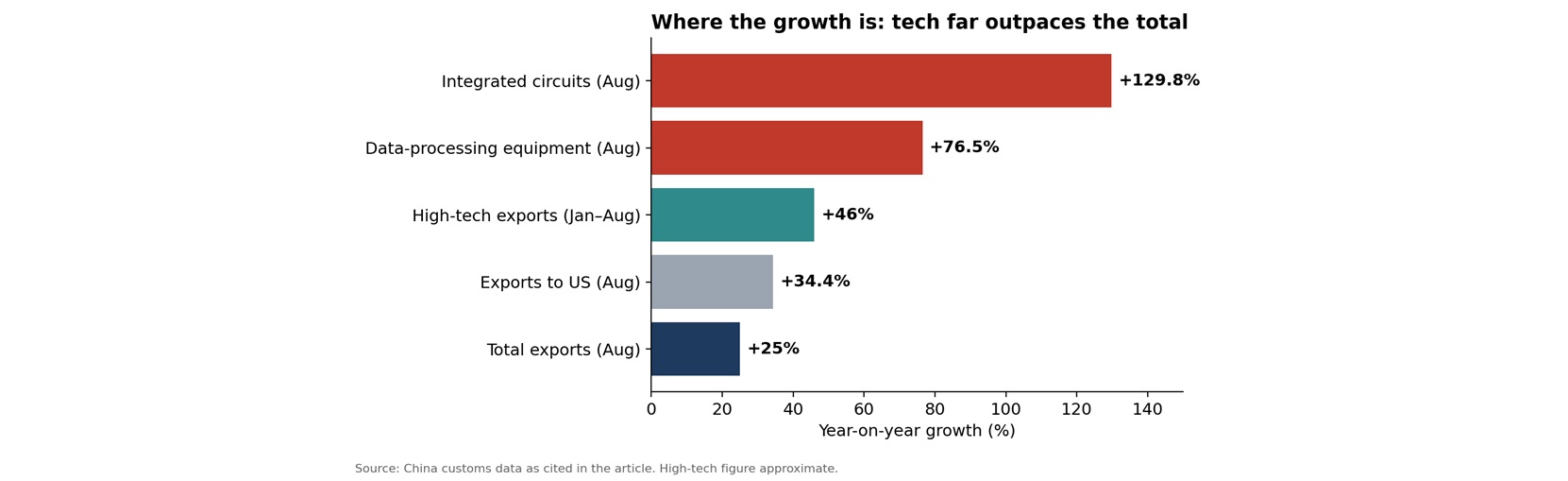
Figure 3: Export growth by category
That is not simply an increase in China’s exports.
It is a change in what China is exporting.
And that distinction matters.
The semiconductor number needs to be read carefully
There is, however, an important qualification to the headline semiconductor number.
A 130% increase in the value of chip exports does not mean that China suddenly shipped twice as many chips. Shipment volumes actually fell by around 8%.
The difference was price.
The global AI build-out has created enormous demand for memory and other semiconductor components, and shortages in parts of the market have pushed prices sharply higher. China’s export value has therefore benefited from what is, at least in part, a terms-of-trade effect.
This doesn’t make the export story less interesting. It makes it more nuanced.
China is, in some categories, shipping fewer units but receiving considerably more value for each unit.
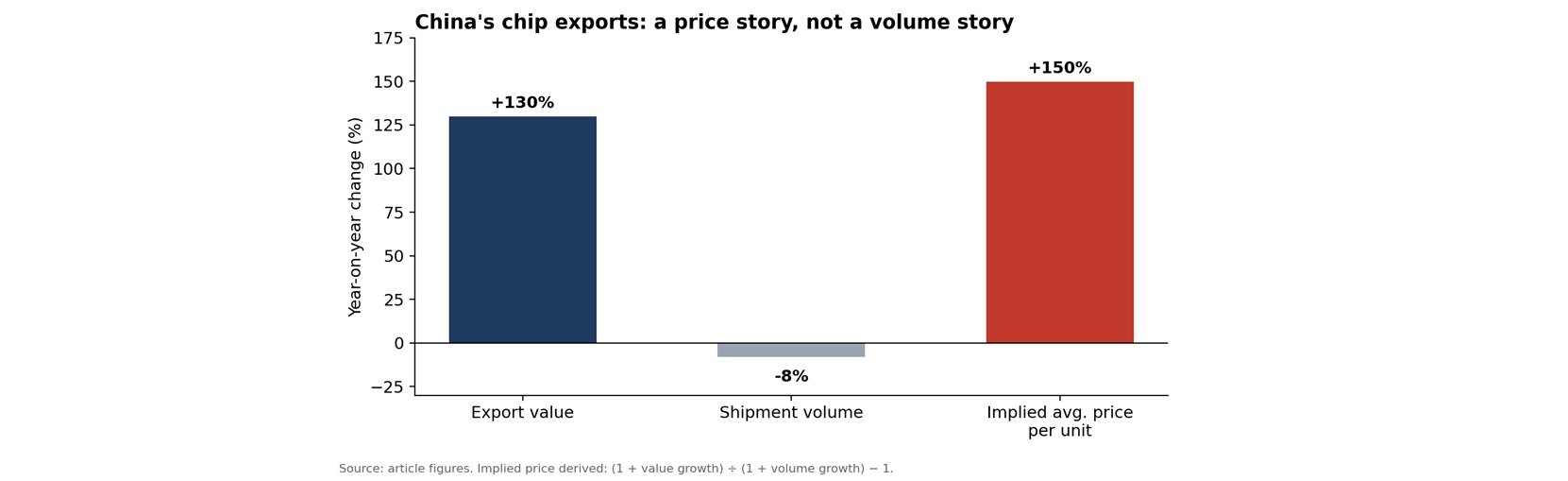
Figure 4: Chip export value vs. volume — the implied price effect
There is another point that is often missed in discussions about China’s semiconductor exports. China remains a substantial net importer of chips. A meaningful portion of its IC exports also reflects assembly, packaging and testing of components that originate elsewhere.
So the extraordinary increase in exports should not be interpreted as evidence that China has suddenly moved to the technological frontier in semiconductors.
It hasn’t.
China still accounts for only a relatively small share of global production of the most advanced AI accelerators and high-bandwidth memory. Its progress is much more visible in the middle and lower layers of the hardware stack.
But that may be enough.
AI is an industrial demand shock
Much of the public discussion about artificial intelligence is focused on models, hyperscalers and chip designers.
Trade data tell us something else.
AI is an intensely physical revolution.
A data centre requires semiconductors and servers, but that is only the beginning. It needs transformers, switchgear, power-management systems, cooling equipment, fibre-optic and copper cabling, racks, storage and backup power.
Behind those products sits another enormous supply chain involving steel, copper, aluminium, polymers and specialty chemicals.
This is where China’s industrial depth becomes particularly important.
China does not have to dominate every layer of artificial intelligence to benefit from the AI investment cycle. It needs to manufacture a sufficiently large share of the physical ecosystem around it.
And it already does.
The company that develops the most capable AI model will receive considerable value from that achievement. But the economies producing the machines, components, materials, electrical equipment and infrastructure required to run that technology may capture value on a different—and potentially more durable—part of the curve.
This is something the petrochemical industry has taught us repeatedly.
The materials story behind AI
Those of us who have spent years watching energy and petrochemical markets have seen this movie before.
Over the past decade, China built one of the world’s largest integrated refining and petrochemical systems. It invested heavily in paraxylene, purified terephthalic acid, polyethylene, polypropylene and a wide range of downstream products.
Capacity was added on a huge scale. Integration brought costs down. Domestic production became increasingly competitive, and China’s changing import requirements reshaped trade flows across the Middle East and Southeast Asia.
When domestic demand could not absorb all the production, the surplus naturally looked for a home in export markets.
The same industrial logic is now becoming visible in technology.
The AI economy has a much larger materials footprint than is generally appreciated.
It requires engineering plastics for connectors and housings. It requires fluoropolymers and specialty films for electronics. There are polymers and dielectric materials involved in cooling and insulation, cable compounds, adhesives, coatings, composites and high-purity process chemicals.
China’s advantage is not simply that it can make one of these products cheaply.
Its advantage is that many of the supply chains required to make them exist within a remarkably concentrated industrial geography—from feedstock to finished component.
That proximity matters.
It means a manufacturer can move from an engineering idea to commercial production with extraordinary speed.
China’s real industrial advantage may ultimately be its ability to move from innovation to mass production faster than almost anyone else.
And then there is energy
AI infrastructure is enormously power-intensive.
That brings another part of China’s industrial system into the picture: grid equipment, solar generation, batteries and power electronics.
China has built manufacturing capacity in all of these areas at a scale that is difficult for other economies to replicate quickly.
As countries around the world begin investing heavily in data centres and the electrical infrastructure required to support them, China’s manufacturing base in these areas becomes an export opportunity in its own right.
The AI boom, therefore, is not simply creating demand for chips.
It is creating demand for an entire industrial ecosystem.
China happens to sit unusually deep inside that ecosystem.
The paradox inside China
There is an interesting contradiction beneath these extraordinary export numbers.
The external economy is performing extremely strongly.
The domestic economy is not.
The property correction continues to weigh on household wealth. Consumer confidence remains subdued. Local-government finances remain under pressure, while producer prices have been experiencing persistent deflationary pressure.
This creates a difficult economic equation.
China may be producing more than its domestic market can absorb while, at exactly the same time, producing many of the things the rest of the world increasingly wants to buy.
AI has arrived at a particularly convenient moment for China.
It gives an industrial system with substantial existing capacity a new external market just as domestic demand remains relatively weak.
That is one reason these export numbers deserve to be watched so closely.
The world is buying—but asking questions
China’s export story is also no longer simply a story about America.
Chinese manufacturers have spent years expanding their presence in ASEAN, the Middle East, Africa and Latin America. That diversification has reduced their dependence on any single Western market.
The United States nevertheless remains important.
Shipments to America rose 34.4% in August, albeit from a depressed base, pushing the bilateral surplus to its widest level since January 2025. Washington continues to press Beijing to rely more heavily on domestic consumption.
The broader question is unavoidable.
When the world’s largest manufacturing economy records an $800 billion trade surplus in just eight months, its trading partners are going to ask what is driving it.
Is it Chinese competitiveness?
Is it weak domestic demand?
Is it industrial policy?
Is it excess capacity?
The uncomfortable answer is that it is some combination of all four.
China’s industrial upgrading is real. So is the efficiency created by decades of investment and scale.
At the same time, domestic demand remains weaker than the country’s manufacturing capacity.
It is the interaction between these forces that makes China’s current trade position so difficult for its trading partners to manage.
A surplus is not the same as prosperity
There is a temptation to look at an $800 billion trade surplus and conclude that the Chinese economy must be performing exceptionally well.
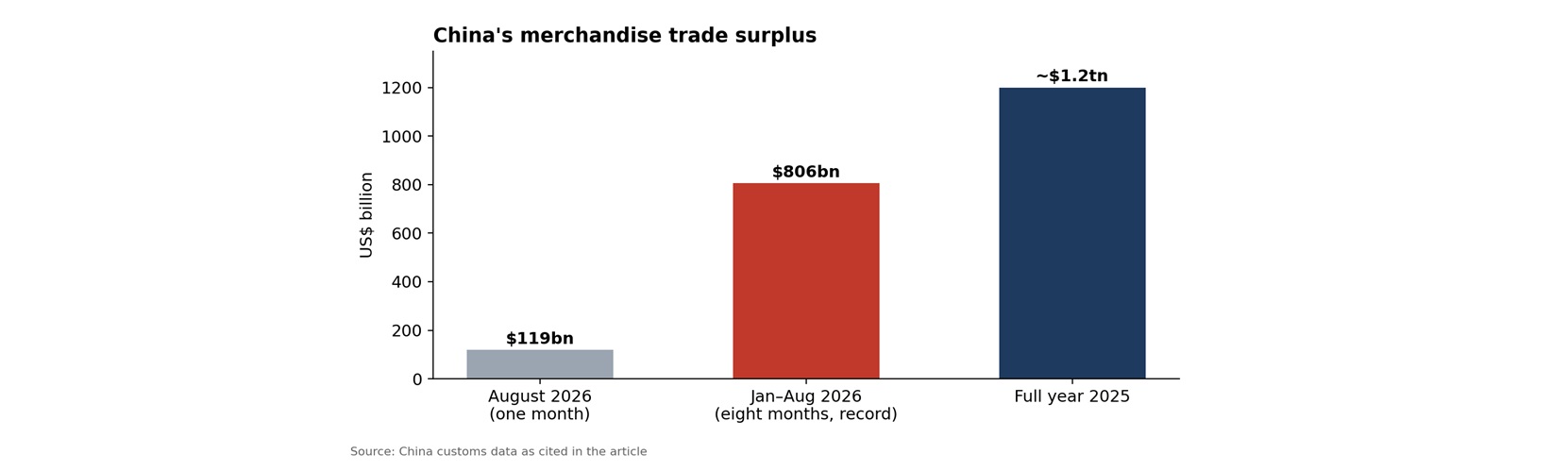
Figure 5: The scale of China’s merchandise trade surplus
That would be too simplistic.
A trade surplus tells us the difference between what an economy sells and what it buys. It does not, by itself, tell us about household prosperity, productivity, consumer confidence or the underlying balance of the domestic economy.
In fact, a surplus of this magnitude is partly a reflection of the imbalance China has been trying to address for years.
There is also a cyclical element to the semiconductor numbers.
A significant part of the increase in chip export values has come from higher prices, particularly in memory. Semiconductor markets are notoriously cyclical. When today’s shortages eventually ease, some of that price effect will disappear.
That distinction is important.
China’s structural improvement in manufacturing capability may prove durable.
The price windfall sitting on top of it may not.
The two should not be confused.
The real Chinese AI story
For Western economies, the strategic question has therefore changed.
For much of the past few decades, the question was whether China could manufacture a particular product more cheaply.
Increasingly, the question is whether China can manufacture the infrastructure of the next technological revolution faster, cheaper and at greater scale than its competitors.
The first Chinese export revolution put televisions, washing machines, toys, furniture and countless other consumer products into homes around the world.
The next one may be rather different.
It could put the physical infrastructure of artificial intelligence into almost every major economy.
That has consequences far beyond China’s customs statistics.
It matters to Germany’s machinery manufacturers, Korea’s semiconductor industry, Japan’s industrial base, America’s technology ecosystem and Southeast Asia’s manufacturing ambitions.
It will matter to India as well.
And perhaps that is the most important point to take away from the August numbers.
China’s next export machine may not be built around what the world wants to consume.
It may increasingly be built around what the world needs to build.
That is a much bigger opportunity—and potentially a much more consequential challenge—for the rest of the industrial world.
| Professor Dr. Sajjid Mitha is the CEO and Founder of PolymerUpdate, PolymerUpdate Academy, and RACE Expos and Conferences. |