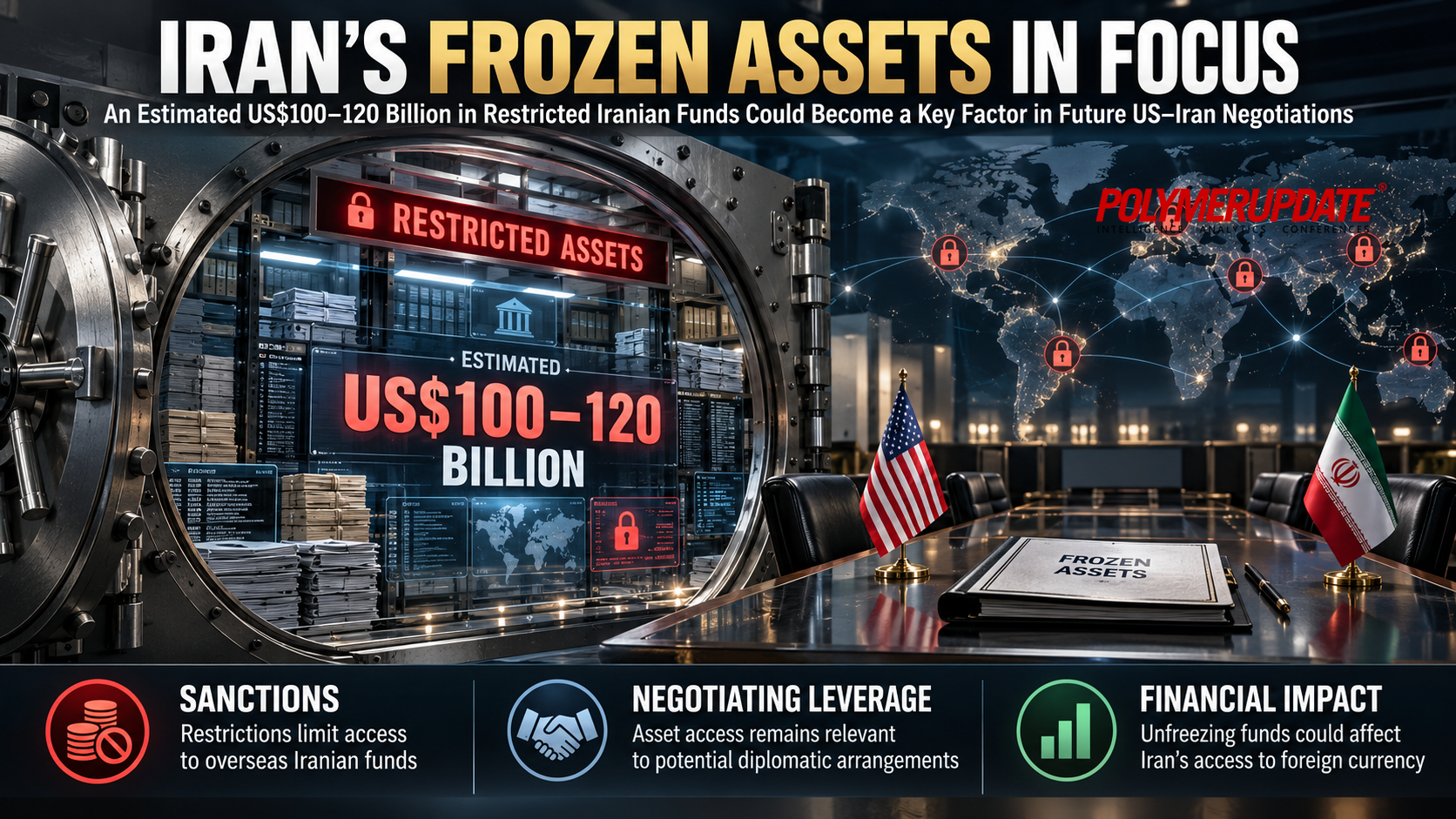
A series of sanctions imposed by the United States has left Iranian funds valued at US$ 100-120 billion frozen, restricted or otherwise inaccessible across financial institutions and counterparties worldwide. This underscores the enormous economic stakes surrounding any potential agreement between Tehran and Washington on sanctions, Iran’s nuclear programme and the Strait of Hormuz.
The figure represents a broad estimate rather than a single pool of cash held by the United States. Iranian funds are spread across several countries and can include unpaid oil revenues, foreign-exchange reserves, bank deposits, commercial receivables and other assets whose access has been restricted by US sanctions or by financial institutions seeking to avoid exposure to Washington’s sanctions regime.
The issue has gained renewed importance as indirect US-Iran negotiations continue, with mediators seeking to bridge major differences over sanctions relief, Iran’s nuclear activities and the reopening of the Strait of Hormuz. Recent diplomatic discussions have reportedly included the possibility of restoring some access to Iranian funds as part of a broader arrangement.
 China leads
Among the largest pools of potentially restricted Iranian funds are believed to be in China. Estimates put Iranian oil revenues and other receivables held or restricted in China at roughly US$ 20-50 billion. Much of this money is associated with oil trade and has been subject to complex payment arrangements because of the risk that banks and companies handling Iranian transactions could face US secondary sanctions.
China has remained one of Iran’s most important economic partners and a major destination for Iranian crude. However, the ability of Tehran to freely repatriate or use the proceeds of its oil sales has been constrained by the international financial system and US sanctions. Consequently, funds may remain available for approved trade or specific transactions without being freely transferable to Iran.
Iraq followsIraq is another significant holder of Iranian-related funds. Estimates suggest that around US$ 6-15 billion is owed to Iran for electricity and natural-gas imports. These funds have been subject to restrictions because Iraq must balance its energy dependence on Iran with the requirements of the US sanctions regime.
The Iraqi payments issue illustrates the distinction between money being owed to Iran and money that Tehran can freely access. Although the funds represent legitimate commercial receivables, restrictions on how they can be transferred or spent can prevent Iran from using them as unrestricted foreign-exchange reserves.
Oil funds with other nationsIndia is estimated to have around US$ 7 billion in restricted Iranian funds originating from earlier crude oil purchases. India was historically a major buyer of Iranian oil before US sanctions sharply curtailed the trade. Payment mechanisms were subsequently developed to manage outstanding balances and facilitate permitted trade, but access to the accumulated funds has remained constrained by sanctions and banking restrictions.
Qatar also holds restricted Iranian funds. One of the better-known arrangements involved billions of dollars originating from Iranian oil sales to South Korea that were transferred under a mechanism designed to limit their use to humanitarian purposes. Such arrangements demonstrate that sanctions relief does not necessarily mean unrestricted access to cash. Funds may be released only for specified categories of goods and through tightly controlled financial channels.
The United States itself holds a comparatively smaller portion of Iran’s overseas assets directly. More than US$ 2 billion in Iranian deposits and properties has been frozen or otherwise subject to legal restrictions in the United States over the decades. Additional smaller amounts are believed to be held in financial institutions in Japan, Luxembourg and other European jurisdictions.
Historical referencesThe historical roots of Iran’s frozen assets date back to the 1979 hostage crisis. On November 14, 1979, President Jimmy Carter issued Executive Order blocking Iranian government assets under US jurisdiction. US historical records show that the initial freeze affected assets worth substantially more than US$ 8 billion, while other contemporary estimates put the amount of Iranian government assets blocked at around US$ 12 billion.
The restrictions subsequently evolved into a much broader sanctions architecture covering trade, banking, oil exports, investment and a range of Iranian entities and activities. The US sanctions programme was expanded over subsequent decades in response to concerns including Iran’s nuclear and missile programmes and other US foreign-policy objectives. The US Treasury’s Office of Foreign Assets Control continues to maintain a comprehensive Iran sanctions programme.
Funds in foreign banksA critical point in understanding Iran’s frozen funds is the distinction between control and possession. The United States does not physically hold most of the estimated US$ 100-120 billion in Iranian funds in American vaults or bank accounts. Much of the money is located in foreign banks or represents receivables owed by overseas companies and governments.
The US influence comes largely from the reach of its financial system and sanctions. Foreign banks and companies that conduct transactions involving sanctioned Iranian entities can face restrictions on access to the US financial system. This creates a powerful incentive for international institutions to block, restrict or carefully control Iranian funds even when the assets are physically located outside the United States.
US sanctions have therefore transformed the treatment of Iranian funds into a complex international financial issue. In practical terms, an Iranian asset may remain legally owned by an Iranian entity while being inaccessible for ordinary commercial purposes. The funds may instead be placed in escrow, restricted accounts or special-purpose mechanisms under which withdrawals are permitted only for authorised transactions.
A major determinant for US-Iran dealThis distinction could become particularly important in any future US-Iran agreement. The release of frozen funds would not necessarily involve transferring the entire estimated US$ 100-120 billion directly to Tehran. Instead, sanctions relief could involve a phased release, humanitarian exemptions, access to specific oil revenues, permission to use restricted balances for imports, or the removal of restrictions on selected banking channels.
The economic implications are significant for both sides. For Iran, greater access to overseas funds would provide additional foreign-exchange liquidity at a time when sanctions have constrained oil revenues and international financial access. It could also support imports of food, medicines, industrial equipment and other essential goods.
For global oil markets, however, the potential release of Iranian funds is closely linked to the possibility of increased Iranian crude exports. Any sanctions arrangement that permits Tehran to sell more oil internationally could gradually add supply to an already volatile market. The timing and scale would depend on the terms of any agreement, the pace at which sanctions were removed and the ability of Iranian producers and exporters to restore unrestricted market access.
Diplomatic issuesThe issue has consequently become an important component of the broader diplomatic debate. Iran has sought sanctions relief and greater economic access, while Washington has continued to link any significant easing of restrictions to its demands concerning Tehran’s nuclear activities. Recent diplomatic efforts have also been complicated by the conflict and disruptions to shipping through the Strait of Hormuz.
With so much Iranian money potentially tied up across the international financial system, frozen assets could become one of the most consequential economic components of any eventual settlement. The precise amount available for immediate release, however, would depend on the legal status of individual assets, the jurisdiction in which they are held and the conditions attached to their use.
For now, the estimated US$ 100-120 billion represents not a single readily accessible Iranian war chest, but a complex collection of funds and assets accumulated over decades and constrained by successive rounds of sanctions. How much of that money can ultimately be unlocked—and under what conditions—could become a central measure of the economic impact of any future US-Iran diplomatic agreement.
DILIP KUMAR JHA
Editor
dilip.jha@polymerupdate.com