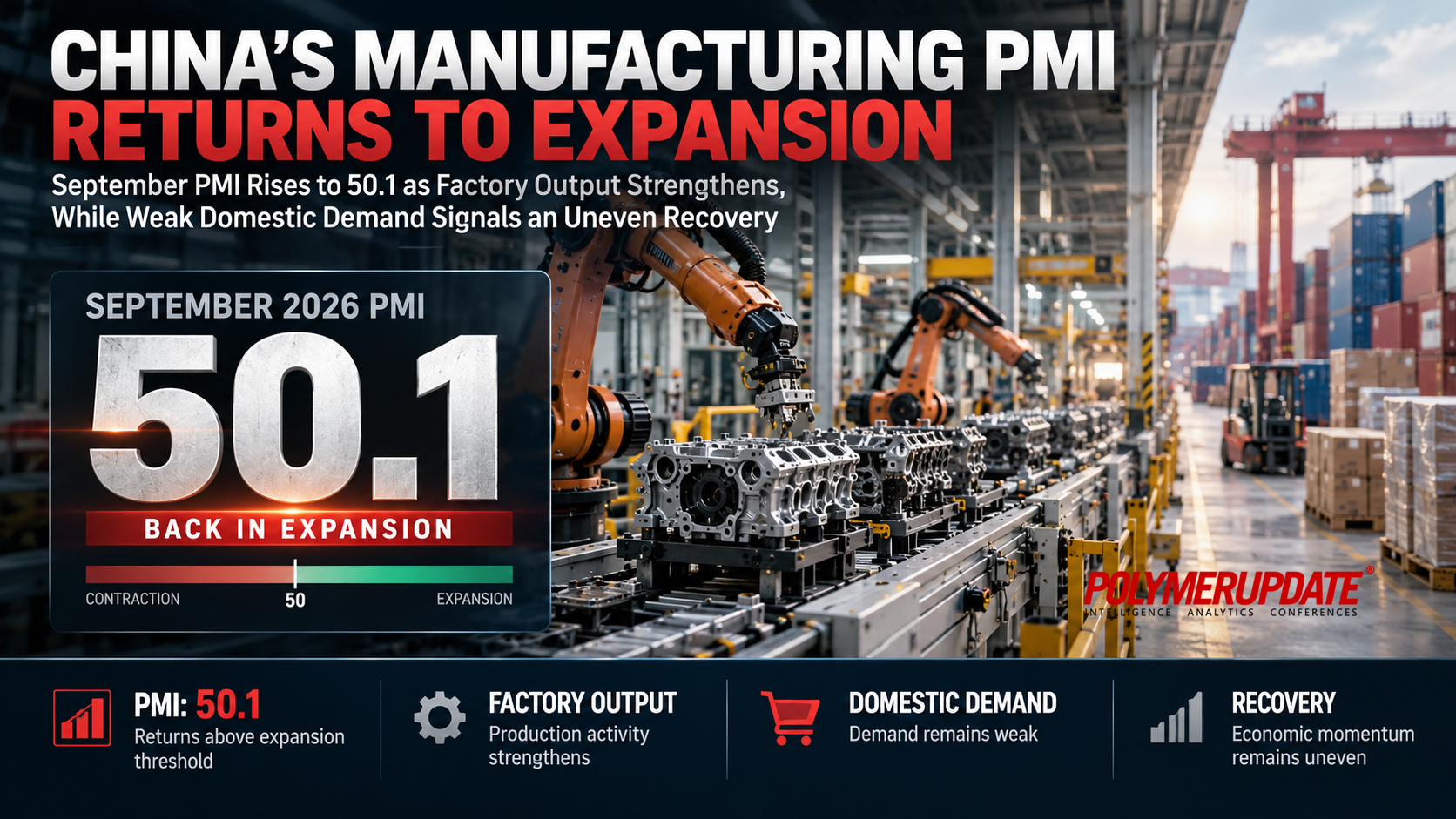
China’s Purchasing Managers’ Index (PMI) rose to 50.1 in September 2026, up 0.3 percentage point from the previous month, official data from the National Bureau of Statistics (NBS) showed on Wednesday. The reading marked the PMI’s return to expansion territory after two consecutive months of contraction. It moved above the 50-point threshold separating expansion from contraction, suggesting a modest improvement in manufacturing activity.
The uptrend offers a cautiously positive signal for China’s industrial activity and could provide some support to global commodity markets, particularly crude oil, petrochemicals and industrial raw materials. However, the data also highlights the uneven nature of China’s economic recovery, with external demand and strategically important industries continuing to perform relatively better than domestic consumption and investment. The divergence suggests that while manufacturing activity is gaining some momentum, a broader and more sustainable recovery will depend on a stronger revival in domestic demand.
 Manufacturing PMI
China’s official manufacturing PMI rose to 50.1 in September from 49.4 in August, moving above the 50-point threshold separating expansion from contraction for the first time in three months. The reading was in line with market expectations and the forecast from ING Economics. More importantly for commodity markets, the production sub-index climbed to 51.7, its highest level of 2026. The increase indicates that industrial production has gained momentum, although the improvement in demand was less convincing.
The new orders index slipped 0.1 percentage point to 50.5, while new export orders declined by 0.1 percentage point to 50. The figures suggest that Chinese factories are increasing output, but the recovery in underlying demand remains relatively fragile. A separate RatingDog manufacturing PMI, which has a more export-oriented sample, rose more sharply to 52.1 from 51.5. The stronger performance of export-oriented manufacturers reinforces the view that external demand remains an important driver of China’s industrial economy.
This distinction is important for global commodity markets. China is the world's largest consumer of many industrial commodities, including crude oil, petrochemical feedstocks, polymers, steel and several non-ferrous metals. A sustained acceleration in industrial production would normally translate into higher demand for energy and raw materials. However, unless domestic consumption and investment also strengthen, the impact on commodity demand could remain uneven.
Industrial activity provides supportThe September manufacturing data nevertheless provides some evidence that China’s industrial sector is regaining momentum. The production index at 51.7 represents the strongest reading of the year and suggests that manufacturers are operating at relatively healthy levels. If the improvement is sustained, it could provide support to demand for crude oil, naphtha, natural gas and petrochemical products. For the petrochemical industry, the development is particularly relevant because China has significant downstream processing capacity across polymers, aromatics, olefins and other chemical products.
Higher industrial utilisation can improve demand for packaging, automotive components, consumer products, electrical goods and construction-related materials. However, the demand indicators remain less encouraging. New orders at 50.5 are only marginally above the expansion threshold, while new export orders at 50.0 are essentially stagnant. This suggests that manufacturers have not yet seen a broad-based acceleration in new business. The stronger RatingDog reading indicates that exporters are benefiting more from external demand than companies dependent on China’s domestic market. This divergence remains one of the defining features of China’s economy in 2026.
Price pressures begin to buildAnother important development for commodity markets is the sharp increase in the manufacturing price sub-indices. The raw-material price index rose to 60.8, a five-month high, while the ex-factory price index increased to 54.0, also the highest level in five months. The rise indicates that manufacturers are facing higher input costs and, increasingly, may be passing some of those costs through to customers. Energy prices are an important factor. The continuing conflict in the Middle East has increased volatility in global crude oil and energy markets, raising costs for energy-intensive industries.
Higher crude oil prices can feed through into transportation, chemicals, plastics and manufacturing costs. For petrochemical producers, higher feedstock prices can have mixed implications. Higher crude and naphtha costs can raise production costs and support product prices, but weak downstream demand can make it difficult for producers to fully pass on the increase. Consequently, the direction of Chinese demand will remain critical for the global petrochemical market.
Services sector delivers a surpriseChina’s non-manufacturing economy also produced a more positive signal than expected. The official non-manufacturing PMI rose to 50.2, beating market and ING expectations of 49.2. The improvement indicates that services and construction-related activity returned to modest expansion. The new orders index increased to 46.5, while new export orders rose to 48.5. Both remained below 50, indicating that demand conditions have not fully recovered. However, business expectations improved considerably. The expectations index climbed to 55.5, the highest level since January.
A separate RatingDog services PMI also strengthened to 51.6. The improvement in expectations could become significant if it translates into higher hiring, investment and household spending. Stronger consumer demand would broaden China’s recovery beyond manufacturing and exports, providing a more sustainable foundation for commodity consumption.
Property sector remains crucialFor commodity and petrochemical markets, one of the most important questions is whether China’s property sector can stabilise. The government has introduced additional targeted measures to support economic activity. The People’s Bank of China has expanded its targeted easing measures, including a 25-basis-point cut to the pledged supplementary lending rate and expanded relending programmes. The Ministry of Finance, PBOC and National Financial Regulatory Administration have also announced a one-percentage-point mortgage-interest subsidy for eligible first-time homebuyers.
The measures are aimed at supporting housing demand and improving conditions in a sector that has weighed heavily on domestic investment and consumer confidence. A sustained stabilisation of property activity would have significant implications for commodities. Construction is a major consumer of steel, aluminium, copper, cement and other industrial materials, while housing-related consumption also supports demand for plastics, pipes, insulation, electrical components, coatings and other petrochemical products. However, the September PMI data does not yet demonstrate a broad-based property-led recovery. The improvement in expectations is encouraging, but new-order indicators remain relatively weak.
Implications for crude oil demandChina’s industrial recovery is also important for global crude oil markets. Higher factory utilisation, stronger transportation activity and an improvement in manufacturing output can support refinery throughput and petroleum-product demand. China remains one of the world's largest crude oil importers, meaning even a modest change in its consumption pattern can influence global balances.
However, the impact of the September PMI data should not be overstated. Manufacturing growth remains modest, while domestic demand continues to lag.
Furthermore, crude oil demand depends not only on industrial production but also on transportation, petrochemical feedstock consumption, refinery economics and inventory behaviour. The price sub-indices provide another complication. Higher energy prices could raise the value of China’s crude import bill without necessarily generating an equivalent increase in physical consumption. Consequently, the PMI data is a positive signal for demand expectations, but confirmation will require evidence from crude imports, refinery runs, industrial output and domestic consumption in the coming months.
OutlookThe September PMI data provides evidence that China’s economy regained some momentum during the month. Manufacturing returned to expansion, factory production reached its highest level of the year and the non-manufacturing PMI unexpectedly moved back above 50. The improvement could help third-quarter GDP recover from the 4.3% growth recorded in the second quarter, particularly with more favourable base effects. Lynn Song, Chief Economist, Greater China, ING Economics, projected, further policy support is likely as Beijing seeks to achieve its 2026 GDP growth target of 4.5-5.0 percent.
DILIP KUMAR JHA
Editor
dilip.jha@polymerupdate.com