India’s crude oil imports from Saudi Arabia fell sharply from US$2.8 billion in April 2026 to US$0.9 billion in June, before partially recovering to US$1.4 billion in July, as the ongoing conflict in West Asia disrupted shipping routes and complicated regional energy trade, consultancy firm Rubix Data Sciences said in its periodic report released on Thursday. The decline comes at a time when India and Saudi Arabia are seeking to broaden their economic relations beyond hydrocarbons.
The report, titled ‘Rubix Country Insights: Saudi Arabia Update – September 2026,’ found that Saudi Arabia remained India’s third-largest crude oil supplier by value during April-July 2026, despite sharp fluctuations in actual deliveries. This highlights the continued importance of the Kingdom in India’s energy supply chain. However, the composition of bilateral trade is gradually changing. Crude oil and natural gas accounted for 68 percent of India’s imports from Saudi Arabia during the first four months of FY2027, compared with 74 percent during the corresponding period a year earlier.
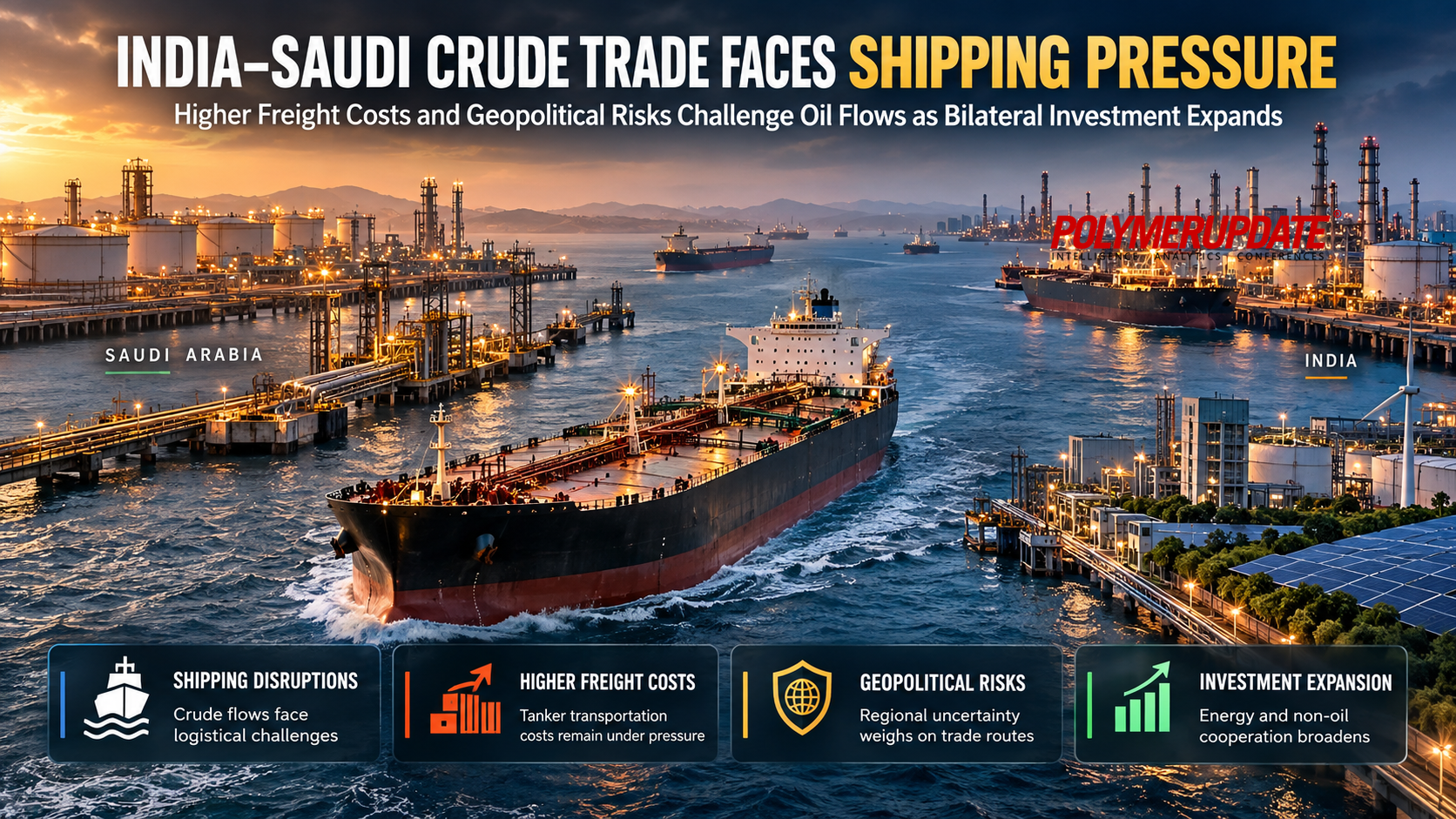
However, disruptions to maritime routes have emerged as an important risk to the energy component of the bilateral relationship, particularly as attacks on shipping in the Red Sea and Bab-el-Mandeb have complicated alternative supply routes. For Indian buyers, the disruption has become particularly significant because cargoes loaded at Yanbu and destined for India may now have to take a longer route around the Cape of Good Hope.
 Pipeline offers partial protection
Saudi Arabia has some infrastructure that provides a degree of protection against disruptions in the Strait of Hormuz. The Kingdom’s East-West pipeline carries crude from its eastern oil-producing regions to Yanbu on the Red Sea, allowing a portion of Saudi exports to bypass the strategic waterway.
However, the pipeline does not eliminate the shipping risk. Recent Houthi attacks on shipping in and around the Bab-el-Mandeb Strait have raised concerns over the security of vessels travelling through the Red Sea. The longer voyage has implications not only for delivery schedules but also for freight economics.
According to the analysis cited by Rubix, freight rates for Saudi crude could increase by as much as 50 percent as vessels avoid high-risk maritime routes. Higher freight costs could raise the delivered cost of Saudi crude for Indian refiners and potentially alter the relative economics of sourcing barrels from different regions. The disruption also underscores the broader vulnerability of Asia’s energy supply chains to geopolitical developments. India imports the bulk of its crude oil requirements and has increasingly diversified its supplier base in recent years. Nevertheless, the Gulf remains strategically important because of its geographical proximity, established refining and shipping infrastructure and the availability of large volumes of crude.
Bilateral trade remains resilientWhile energy trade has faced disruption, the broader India-Saudi economic relationship continues to expand across several sectors. India-Saudi goods trade stood at US$ 41.1 billion during FY2026, covering April 2025 to March 2026, according to the Rubix report. During the first four months of FY2027, from April to July 2026, bilateral goods trade was broadly stable year-on-year at around US$ 13.3 billion.
Saudi Arabia has also emerged as an important destination for Indian exports. During April-June 2026, India became Saudi Arabia’s second-largest export destination, overtaking Japan, with a share of approximately 15 percent. The expansion of bilateral economic relations is being supported by Saudi investment ambitions in India. The Kingdom has committed US$ 100 billion in investments across sectors including energy, petrochemicals, infrastructure, technology, manufacturing, healthcare and pharmaceuticals.
For India, such investments could provide opportunities to deepen participation in Saudi Arabia’s economic diversification programme while reducing the bilateral relationship’s traditional dependence on crude oil. For Saudi Arabia, partnerships with Indian companies offer access to one of the world’s largest and fastest-growing major economies, as well as opportunities to strengthen supply chains, manufacturing links and technology cooperation.
Saudi growth outlook weakensThe Rubix report also highlighted the impact of the regional conflict on Saudi Arabia’s domestic economic outlook. Saudi Arabia’s real GDP growth is projected to slow to 1.7 percent in 2026 from 4.6 percent in 2025, as the conflict affects oil production, trade and broader economic activity. The slowdown represents a significant moderation in growth at a time when Riyadh is pursuing an ambitious economic transformation agenda aimed at reducing its dependence on oil revenues. The Kingdom’s Vision 2030 programme seeks to develop non-oil sectors, attract foreign capital and expand private-sector participation in the economy.
The outlook could improve if regional conditions stabilise. The International Monetary Fund expects Saudi Arabia’s economic growth to rebound to 5.5 percent in 2027, provided regional conditions improve and maritime trade normalises. Such a recovery would be important for the Kingdom’s investment and diversification plans. A normalisation of shipping routes would reduce logistics costs, improve trade flows and provide greater certainty for companies operating across the region.
Foreign investment continues to riseDespite the geopolitical challenges, Saudi Arabia has continued to attract foreign capital. Net foreign direct investment inflows increased by around 53 percent to US$ 32.6 billion in 2025, according to data from the United Nations Conference on Trade and Development (UNCTAD). The increase moved Saudi Arabia to 13th globally among FDI recipients in 2025, compared with 17th in 2024. The rise indicates continued investor interest in the Kingdom’s diversification strategy despite the risks associated with regional instability.
Saudi Arabia is simultaneously pursuing reforms aimed at making its capital markets more accessible to international investors. Since February 2026, the Saudi Stock Exchange, or Tadawul, has been open to all categories of foreign investors. The move is part of a broader effort to deepen the Kingdom’s capital markets, improve access to international capital and encourage greater foreign participation in domestic companies.
Privatisation and mining offer new opportunitiesSaudi Arabia’s National Privatization Strategy is another potential avenue for foreign and Indian investors. The programme targets SAR240 billion, equivalent to approximately US$ 64 billion, in private investment by 2030 through more than 220 public-private partnership contracts. The programme covers sectors where Saudi Arabia is seeking to increase private-sector participation and improve infrastructure and service delivery. Indian companies with expertise in infrastructure, engineering, construction, technology and services could potentially find opportunities as the programme expands.
Mining is another area receiving increasing attention. Saudi Arabia aims to attract nearly SAR92 billion in mining investment between 2025 and 2030, compared with approximately SAR45 billion in 2024. The mining push is significant because the Kingdom is seeking to develop its mineral resources as part of its broader economic diversification strategy. It also creates potential opportunities for international companies across exploration, mining technology, processing, logistics and related infrastructure.
Risk management becomes increasingly importantThe evolution of India-Saudi economic relations therefore presents a mixed picture. Energy trade remains the foundation of bilateral commerce, but recent disruptions demonstrate the exposure of even established supply chains to geopolitical and maritime risks. The sharp decline in India’s Saudi crude purchases between April and June, followed by a partial recovery in July, illustrates how quickly trade flows can respond to changes in shipping conditions.
The continued uncertainty around the Red Sea and Bab-el-Mandeb routes could keep freight costs and delivery timelines under pressure. At the same time, the expansion of bilateral trade into infrastructure, manufacturing, technology, healthcare, pharmaceuticals, mining and other sectors provides a broader base for the economic relationship.
Commenting on the findings, Tushar Bhaskar, President, Rubix Data Sciences, said, “India and Saudi Arabia are deepening their economic ties at the same time as the routes that connect them are under strain. The opportunities in infrastructure, manufacturing, logistics, and mining are real, and so is the exposure to freight costs and delivery timelines. Indian businesses trading with or investing in the Kingdom must undertake counterparty and supply-chain risk assessment as a part of the basic planning.”
For Indian businesses, the changing environment makes diversification of suppliers, shipping routes and logistics arrangements increasingly relevant. The same applies to companies looking to invest in Saudi Arabia, where opportunities from economic diversification are expanding alongside exposure to geopolitical, trade and transportation risks.
OutlookThe trajectory of India-Saudi economic ties will therefore depend not only on investment and trade policies but also on the stability of the maritime corridors connecting the two economies. While the Kingdom’s East-West pipeline provides an important alternative to the Strait of Hormuz, recent disruptions demonstrate that no single route can completely insulate regional energy trade from wider geopolitical risks.
DILIP KUMAR JHA
Editor
dilip.jha@polymerupdate.com